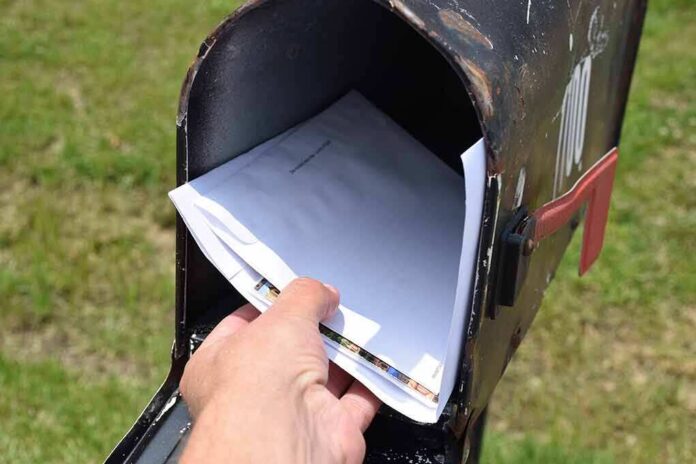
The fight over when Kansas mail ballots must arrive has become a case study in how election rules, courts, and politics collide—because the Kansas Supreme Court has now refused, in a 5–2 decision, to let a new Election Day receipt deadline take effect, keeping a three‑day grace period in place for voters whose ballots arrive after the polls close.
Key Points
- The Kansas Supreme Court rejected Secretary of State Scott Schwab’s emergency bid to enforce Senate Bill 4’s strict Election Day receipt deadline for advance mail ballots right before the state’s primary.
- A temporary injunction from a Douglas County judge, upheld by the Kansas Court of Appeals, restored Kansas’s long‑standing three‑day grace period for ballots postmarked by Election Day and received within three days.
- The Legislature’s 2025 law, SB 4, had eliminated that grace period and required ballots to be received by 7 p.m. on Election Day; the courts have blocked it from taking effect for the current election.
- The dispute sits inside a broader Kansas battle over voting rules and judicial power, including a 2026 constitutional amendment proposal to elect Supreme Court justices and rework how courts shape election law.
The Core Ruling: Grace Period Preserved, Deadline Blocked
At the heart of this episode is a straightforward but consequential question: must a Kansas mail ballot physically arrive by the close of polls, or is a voter protected so long as they mail it by Election Day and the postal system delivers it within three days? For years, Kansas used the latter approach; advance ballots postmarked by Election Day were counted if they reached county election offices within three days. In 2025, the Legislature passed Senate Bill 4, which amended Kansas Statutes Annotated 25‑1132 to eliminate that grace period and require all advance voting ballots to be “received in the county election office or polling place no later than the close of the polls” beginning January 1, 2026.
Voting‑rights groups challenged SB 4 in Douglas County District Court, arguing that stripping away the three‑day window violated Kansas constitutional protections of equal protection, due process, and voting rights. On July 16, the district court issued a statewide temporary injunction blocking SB 4, explicitly restoring the prior three‑day rule for ballots postmarked by Election Day and received within three days. That order immediately reset the legal landscape just weeks before the August primary.
Secretary of State Scott Schwab responded with an emergency motion to stay the injunction, urging the Kansas Court of Appeals to keep SB 4 in force while litigation proceeded. The Court of Appeals declined. In its July 28 decision, the court upheld the injunction and summarized Schwab’s argument—that the order would confuse voters because ballot instructions mailed earlier that month told them their ballots must be received by Election Day—before rejecting his request to “enter the fray.” The appellate panel emphasized that the injunction likely rested on strong constitutional grounds and preserved continuity with the rules Kansas had used since 2017.
Schwab then turned to the Kansas Supreme Court, seeking a last‑minute intervention so that SB 4’s strict receipt deadline would govern the upcoming primary. In a 5–2 vote, the justices refused. According to reporting on the order, the majority found no basis to conclude the district court’s ruling was “plainly erroneous” and stressed that the injunction maintained the status quo while broader legal questions are resolved. The immediate consequence is clear: for the election at issue, Kansas must count mail ballots postmarked by Election Day and received within three days, and SB 4’s Election Day receipt rule remains dormant.
What SB 4 Tried to Do, and Why It Matters
Understanding the stakes requires a close look at SB 4. The bill was a targeted change to the mechanics of mail voting: it did not abolish advance ballots, but it tightened when they must arrive. Under prior law, codified in K.S.A. 25‑1132, counties accepted properly postmarked ballots for three days after Election Day; SB 4 amended that section to require all such ballots to be received by 7 p.m. on Election Day. In practice, the change shifts the risk of postal delay fully onto the voter. A ballot mailed on Monday of Election Week that arrives on Thursday counted under the old rule; under SB 4, it would be discarded even if the envelope bears a timely postmark.
Schwab and legislative supporters framed SB 4 as an effort to enhance clarity and security. In a June 29 press release responding to the U.S. Supreme Court’s Watson v. Republican National Committee decision, which upheld grace‑period rules in more than half the states, Schwab emphasized that “the U.S. Constitution grants state legislatures the authority and discretion to determine whether or not a state will accept and count mail ballots postmarked by Election day but received after polls close” and noted that in 2025 “the Kansas Legislature decided not to authorize a grace period for mail‑in ballots.” His office’s public guidance for 2026 told voters that “all mail ballots must be received in the county election office, authorized drop box, or polling place by close of polls on Election day” and that “voters will no longer have a 3‑day grace period for their ballot to arrive.”
For election administrators, a receipt‑by‑Election‑Day rule simplifies tabulation: when the polls close, every ballot has either arrived or not, and the canvas proceeds without waiting on mailbags. For voters who rely on the postal service—particularly rural Kansans, overseas voters, and those with limited transportation—SB 4 raises the stakes of any delay, misrouting, or inconsistent postmarking. That trade‑off between administrative certainty and voter risk is precisely why grace‑period rules have become a recurring flashpoint in election law across the country.
The Courts’ Reasoning: Status Quo and Constitutional Concerns
The Douglas County injunction did more than freeze SB 4; it signaled the court’s view that eliminating the grace period “likely violates the Kansas Constitution protections relating to equal protection of the law, due process and voting.” While the full merits have yet to be litigated, that finding of likely unconstitutionality is what persuaded the Court of Appeals to leave the injunction in place and, ultimately, the Kansas Supreme Court to decline Schwab’s emergency request.
Democracy Docket’s summary of the Supreme Court’s order notes that the justices focused on two ideas: that the lower court’s ruling was not “plainly erroneous” and that it maintained the status quo rather than disrupting settled expectations. The status quo dimension matters. A temporary injunction that restores a familiar rule—in this case, the three‑day grace period in use since 2017—reduces uncertainty for voters who have participated in multiple election cycles under that framework. Imposing SB 4’s stricter deadline on the eve of a statewide primary, especially when tens of thousands of ballots had already been mailed with conflicting instructions, would have risked confusion and uneven treatment.
This approach aligns with a broader judicial pattern in election disputes: courts are generally reluctant to make late‑breaking changes to core voting rules. The U.S. Supreme Court, in cases like Watson, has recognized that states have considerable leeway to set receipt deadlines but has also warned against altering election procedures close to an election in ways that might disenfranchise voters who reasonably relied on prior rules. Kansas’s high court, faced with a law that had never governed a major election and a constitutional challenge pointing to voter protections, chose stability over a rushed implementation.
The Larger Kansas Context: Voting Rules and Judicial Power
SB 4 is not an isolated skirmish; it sits within a longer Kansas story in which lawmakers and courts have repeatedly clashed over voting rules. In recent years, state and federal courts have struck down or narrowed several provisions in broader election laws, including restrictions on pre‑filled mail ballot applications and vague criminal penalties tied to assisting voters with their ballots. The Kansas Supreme Court has upheld limits on ballot collection—making it a felony to turn in more than ten advance ballots for other people—while sending other contested provisions back to lower courts for further review.
Those decisions have fed a political campaign to reshape the judiciary itself. On the August 2026 ballot, Kansans are being asked whether to abandon the current merit‑based selection system for Supreme Court justices, in which a nominating commission led by attorneys screens candidates and the governor appoints from a short list, followed by retention elections. The proposed constitutional amendment would require justices to run in statewide elections, potentially with partisan affiliation, for six‑year terms.
Supporters of the amendment, including Attorney General Kris Kobach and groups like Americans for Prosperity Kansas, argue that the existing “Missouri Plan” has produced a court out of step with voters, citing decisions on topics from school finance to criminal sentencing and pointing to U.S. Supreme Court reversals as evidence of poor jurisprudence.[KC Week in Review] They frame direct elections as restoring popular control and transparency, noting that no justice has ever lost a retention vote and criticizing the lawyer‑dominated nominating commission as an insider body.
Opponents, including the ACLU of Kansas, Planned Parenthood Great Plains, and civic organizations like Kansas Appleseed, see the amendment as an effort to politicize the court and make justices more responsive to campaign donors than to law and precedent. They point out that the current system has produced rulings that protect individual rights, including reproductive autonomy and voting access, and warn that allowing partisan campaigns for judicial seats would expose election law, including decisions like the SB 4 injunction, to direct political retaliation.[Inside Kansas Politics]
Against that backdrop, the Kansas Supreme Court’s refusal to fast‑track SB 4’s strict deadline takes on added significance. It is not simply a procedural decision about injunctive standards; it is a demonstration of how the existing court, selected under the merit system, interprets its role when confronted with a law that arguably narrows voting access. The very fact that this ruling can be cited in campaigns—either as an example of a court “thwarting” legislative choices or as proof that the judiciary still protects voters—illustrates how deeply judicial structure and election rules are intertwined in Kansas political life.
Mechanism and Practical Effects: How the Grace Period Works
From an operational perspective, the three‑day grace period is a modest but meaningful buffer built around the realities of mail delivery. County election officers begin transmitting advance ballots 20 days before the election; voters may return them by mail, drop box, or in person. Under the restored rule, a ballot is timely if it is postmarked on or before Election Day and arrives at the county office within three days. The postmark functions as a proxy for voter action: the voter must have delivered the envelope to the postal service by the deadline, even if the mail system takes longer to carry it.
Nationally, this structure is commonplace. The National Conference of State Legislatures notes that more than half the states and the District of Columbia permit mailed ballots to arrive after Election Day, provided they were sent by the deadline. States vary in the length of the window—from one day to a week or more—but the underlying philosophy is shared: a voter who meets the legal mailing requirement should not lose their vote because of routine postal delay. In Kansas, preserving the three‑day period keeps the state within that mainstream cohort rather than in the stricter group that demands receipt by close of polls.
For voters, the practical guidance is straightforward but important. As the Court of Appeals explained, “as the requirements for mail‑in voting stand a week out from the primary, if you request a mail‑in ballot, your ballot must be postmarked on Election Day and received no later than three days after Election Day.” Civic groups, county election offices, and the Secretary of State’s own website have had to adjust public information to reflect the injunction, underscoring how legal decisions can ripple through the logistics of voter education.
Where the Dispute Goes From Here
The Kansas Supreme Court’s 5–2 vote does not resolve the constitutionality of SB 4; it addresses only whether the law should be enforced while that question is litigated. The underlying case will continue in the Court of Appeals and, ultimately, may return to the state’s high court for a full merits decision on whether the Kansas Constitution permits lawmakers to eliminate the grace period in the way SB 4 attempted.
In the meantime, the current election will be conducted under the restored three‑day rule, and any ballots meeting the postmark and receipt requirements must be counted. The political debate over mail voting deadlines will likely persist, especially as legislators, advocates, and candidates for judicial office seek to position themselves as defenders of either “election integrity” or “voter access.” But the immediate legal landscape is settled enough for Kansans to know what rules govern their ballots in this cycle—which, in an era of contested election law, is itself a significant achievement.
Kansas Supreme Court Rejects Effort to Enforce Election Day Mail Ballot Deadline in 5-2 Vote – Late Ballots Will Be Counted Days After the Election https://t.co/0HROdCkhD1 #gatewaypundit via @gatewaypundit
— Anita (@1methinks) July 31, 2026
Implications for Voters and Institutions
For individual Kansans, the practical takeaway is simple: the ballot you mail by Election Day still counts if the postal service delivers it within three days. For institutions—the Legislature, courts, and advocacy groups—the episode underscores how tightly coupled election statutes, constitutional guarantees, and judicial selection have become. SB 4’s fate will signal how far Kansas’s Constitution can be stretched in the name of deadline clarity; the Supreme Court amendment vote will determine who interprets that Constitution in the decades to come.
Sources:
thegatewaypundit.com, sos.ks.gov, yahoo.com, thebeaconnews.org, kwch.com, kctv5.com, kansasreflector.com, lawrencekstimes.com, ground.news, statecourtreport.org, kansasappleseed.org, democracydocket.com, kcur.org, facebook.com