
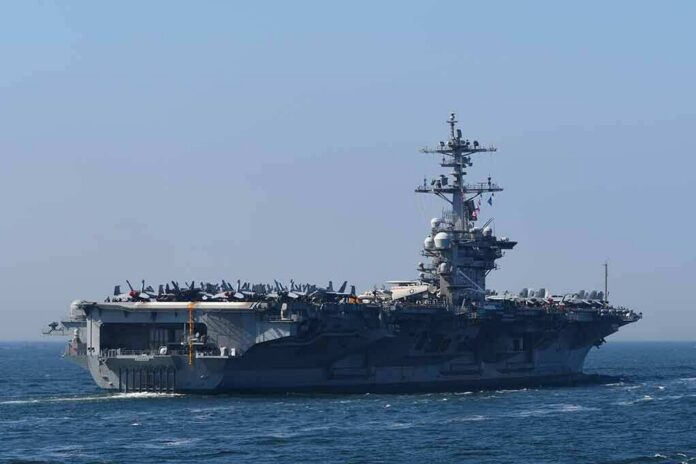
Eight sailors linked to the USS Abraham Lincoln carrier strike group attempted suicide during its extended deployment, according to an official Navy letter to Congress.
Story Highlights
- An acting Navy secretary told a senator there were eight suicide attempts in the Lincoln strike group.
- The count spans the carrier, air wing, destroyers, and attached squadrons, not just the ship.
- No deaths occurred during the deployment, the letter said.
- Earlier public statements said the Navy had not identified an increase in attempts, creating tension in messaging.
What the Navy Told Congress
Acting Secretary of the Navy Hung Cao wrote to Senator Kirsten Gillibrand that eight sailors assigned to the USS Abraham Lincoln carrier strike group attempted suicide since the deployment began. The letter said the number includes the carrier crew and personnel from the air wing, destroyer squadron staff, escorting destroyers, and embarked aviation squadrons. News outlets reviewed or reported on the letter and confirmed the central figure. The letter also said there were no deaths during the deployment.
Major outlets, including CNN, The Hill, USA Today, the British Broadcasting Corporation, and NBC News, reported the same total and source for the figure. Reporters linked the disclosure to a deployment that included high operational tempo and combat operations against Iran, and a modern record for time at sea. That context helps explain stress on crews, though it does not prove a cause for any individual case. The Navy did not release case-level details tied to the eight attempts.
Scope of the Count and Why It Matters
The eight attempts cover the entire strike group, not only the USS Abraham Lincoln. That means the number spans multiple commands that share the same deployment cycle and stressors. Headlines that suggest “aboard the Lincoln” can mislead if readers assume all cases were on the carrier itself. Clear scope matters because policies, staffing, and medical access differ by ship and squadron. Accurate scope also guides where leaders target resources and oversight during long deployments.
Earlier, Navy officials told reporters they had not identified an increase in suicidal ideation or attempts aboard the ship. That public stance now sits next to the letter’s disclosure of eight attempts across the wider strike group. The two statements are not the same metric, but the contrast fuels questions about how the Navy tracks, classifies, and communicates self-harm events during operations. The difference highlights the need for precise definitions and unit-level scope when leaders brief the public.
Operational Strain and Mental Health Access
Research and past Navy reporting show that underway life raises stress, strains family ties, and makes care harder to reach, especially during long deployments. The Lincoln strike group’s extended time at sea and combat operations fit that known risk environment, even if the exact cause of each attempt is not public. Carrier crews include embedded behavioral health staff, but long stretches at sea can still limit routine appointments and continuity of care, which can delay help when sailors need it most.
Acting US Navy Secretary Hung Cao has confirmed that there were “eight suicide attempts” by personnel assigned to the USS Abraham Lincoln aircraft carrier strike group during their Middle East deployment.
— NOOR ALI (@NoorAliNews) September 24, 2026
The policy stakes are concrete. Families and sailors on both left and right want honest data, steady care, and leaders who fix gaps before lives are lost. Congress can press for anonymized, unit-level reporting that protects privacy while showing trends by ship and squadron. The Navy can expand afloat mental health staff, improve telehealth bandwidth, and ensure fast transfers ashore when risk spikes. These are practical steps that match the facts and the duty of care owed to the force.
Sources:
mediaite.com, cnn.com, thehill.com, newsweek.com, bbc.com, ynetnews.com, marineinsight.com, x.com, wsws.org