
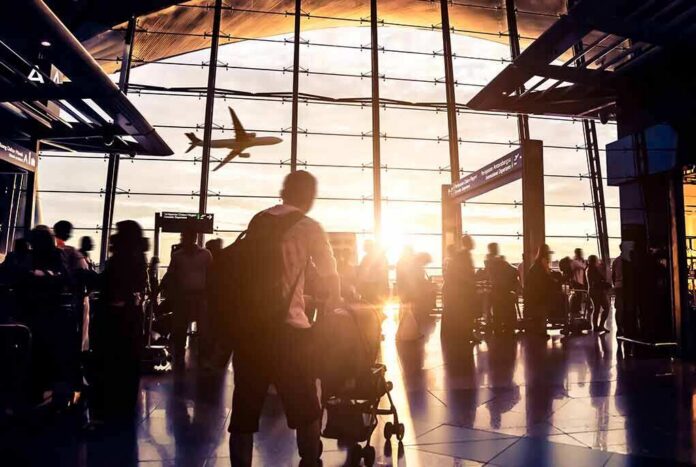
A single telecommunications failure froze every departing flight in the country for more than four hours Friday, stranding thousands of travelers and forcing pro sports teams to scramble for backup transportation home.
Quick Take
- The Federal Aviation Administration (FAA) ordered a nationwide ground stop Friday after a telecommunications outage hit air traffic control centers across the country.
- Transportation Secretary Sean Duffy said overloaded routers sent bad data to controllers, forcing the shutdown as a safety precaution.
- Homeland Security Secretary Markwayne Mullin said there was no sign of a cyberattack, though the investigation was still active.
- The stop lasted roughly four hours and led to thousands of canceled or delayed flights before the FAA lifted it Friday evening.
- The outage echoes a 2023 shutdown that exposed deep problems with the FAA’s aging computer systems.
Every U.S. Airport Grinds to a Halt
The FAA stopped all departing flights nationwide Friday, telling the public: “There has been a temporary telecommunications outage — out of an abundance of caution all flights have been halted.” The agency said every flight already in the air was accounted for and safe. The order applied to every U.S. airport at once, not just a handful of regional hubs, making it one of the most sweeping ground stops in decades.
Thousands of passengers posted photos of packed terminals and empty departure boards, with one traveler’s “I have status” complaint about being stuck in a long rebooking line capturing the frustration shared by stranded flyers from coast to coast. Professional sports teams, including squads with weekend games on the line, had to find charter buses and alternate routes after their flights were grounded without warning.
Officials Blame Overloaded Routers, Not an Attack
Transportation Secretary Sean Duffy said the trouble started inside the FAA’s own network hardware. “Our switches, our routers, actually got overloaded with data… and started to give us inconsistency in the data from those routers. And because of that, we shut the system down,” Duffy said. He described instability spreading through radar and communications systems at air traffic control centers nationwide, not a single isolated glitch at one facility.
Homeland Security Secretary Markwayne Mullin moved quickly to calm fears of foreign interference. He said there was “no indication” of anything “nefarious” behind the outage and no reason to believe it threatened the United States. His comments were limited to what investigators knew at that moment, a standard caveat officials use while a technical review continues.
A Four-Hour Shutdown, Then Slow Recovery
The ground stop lasted more than four hours before the FAA lifted it Friday evening. Airlines warned that recovery would stretch well beyond the stop itself, since planes and crews were scattered out of position across the country. Duffy acknowledged it would “take time” to work through the backlog of delayed and canceled flights. Thousands of flights were affected nationwide, with some reports citing nearly 5,000 cancellations tied to the disruption.
The nationwide ground stop that halted US flights on Friday came down to overloaded legacy telecom routers sending inconsistent data – not a cyberattack, and not the Microsoft outage. The FAA says a 30 billion dollar modernization request is pending.https://t.co/1tIngGc8z1
— Go Brief (@gobrief) November 14, 2026
This was only the second time since the September 11, 2001 attacks that the FAA has grounded flights across the entire country, and the first since a separate outage in January 2023. That earlier shutdown stemmed from a failure in the FAA’s Notice to Air Missions system, which pilots rely on for safety alerts before takeoff.
Aging Systems Under Scrutiny for Years
Government auditors have warned for years that the FAA runs on outdated technology. After the 2023 shutdown, the agency reviewed all 138 of its air traffic control systems and found 51 of them — 37 percent — were “unsustainable,” with another 54 systems rated as potentially unsustainable. That assessment means Friday’s outage fits a pattern government watchdogs have flagged repeatedly, rather than a one-time fluke.
The Government Accountability Office has tracked FAA modernization troubles since the 1990s, citing cost overruns, missed deadlines, and performance shortfalls that have piled up over decades. For travelers stuck in terminals Friday, and for taxpayers who have funded repeated upgrade efforts, the episode raises a basic question that has nothing to do with politics: whether the backbone of American air travel can keep pace with the demands placed on it.
Sources:
youtube.com, abc7news.com, cnn.com, stlpr.org, washingtonpost.com, gao.gov, files.gao.gov