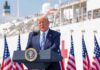
President Trump warned Tuesday that the United States will “take care of things” if Yemen’s Houthi rebels follow through on threats to block Red Sea shipping lanes carrying Saudi oil and goods.
Quick Take
- Trump made the warning in the Oval Office while hosting Lebanese President Joseph Aoun on July 21, 2026.
- The Houthis had already announced a maritime blockade against Saudi Arabia and separate threats against Israeli-linked ships.
- This follows a 2025 U.S. bombing campaign that ended in a ceasefire, but attacks on shipping never fully stopped.
- Experts say past strikes weakened the Houthis but never removed their ability to threaten global trade routes.
Trump Draws A Line In The Red Sea
President Trump told reporters the United States is watching closely for any Houthi move to shut down shipping through the Red Sea. “So far, it hasn’t happened, might happen, but we take care of things,” Trump said. “If something like that happens, we take care of it”. His comments came as the Yemeni rebel group escalated threats against two U.S. partners at once.
The Houthis, backed by Iran, had already declared a “maritime embargo” on Saudi Arabia, saying it was payback for a Saudi blockade of Houthi-held ports and airports in northwest Yemen. Weeks earlier, the group also said it would block Israeli-linked ships in the Red Sea, tying that threat to the wider conflict involving Iran. Together, the moves put pressure on one of the world’s busiest trade routes.
A Ceasefire That Never Fully Held
Trump’s warning echoes a fight the U.S. already fought once. In March 2025, he ordered Operation Rough Rider, a 52-day bombing campaign against Houthi targets meant to restore “freedom of navigation” in the Red Sea. U.S. forces launched more than 1,000 airstrikes before Trump declared the Houthis had “capitulated” and ended the operation in May 2025.
That ceasefire, though, came with limits. Analysts who studied the operation found the only promise that truly held was that Houthi fighters would not strike American ships directly. Attacks on other vessels, including ones tied to Israel, continued in smaller, more selective bursts. One 2026 forecast called the calm “not a de-escalation” but “a structured pause under tension”.
A Pattern Of Strikes, Pauses, And New Threats
This tug-of-war goes back further than 2025. The United Nations Security Council first condemned Houthi shipping attacks in January 2024 and demanded they stop. The U.S. and United Kingdom launched joint strikes that same month, followed by the multinational Operation Prosperity Guardian meant to protect commercial vessels passing through the region.
Despite years of strikes under two different presidents, the Houthis have kept enough strength to threaten shipping again and again. Researchers tracking U.S. and Houthi statements found a repeated gap between claims of “degrading” the group’s abilities and the reality of continued attacks. That history explains why Trump’s new warning lands as a familiar threat rather than a surprising one.
Why This Matters Beyond Yemen
A blockade would hit Saudi Arabia’s oil exports and squeeze global shipping costs, since the Red Sea corridor links Europe, Asia, and the Middle East. Trump’s warning signals he is willing to use military force again to keep that route open, much as he did last year. For a country weary of open-ended conflicts, the question is whether another round of strikes would work any better than the last one did.
Trump warned the US would respond if Yemen's Iran-backed Houthis carry out their threat to blockade commercial shipping in the Red Sea.
Speaking alongside Lebanese President Joseph Aoun, Trump said, "If something like that happens, we take care of it," signalling Washington's… pic.twitter.com/VWWdhX6ucr
— India Today Global (@ITGGlobal) July 21, 2026
Congressional researchers note the U.S.-Houthi truce from May 2025 has technically held, even as smaller flare-ups continued elsewhere in the region. Whether Trump’s latest warning leads to another bombing campaign, a diplomatic push, or another uneasy pause likely depends on whether the Houthis actually follow through on the blockade threat against Saudi Arabia.
Sources:
en.wikipedia.org, thehill.com, abcnews.com, youtube.com, bbc.com, press.un.org, unav.edu, stimson.org, acleddata.com, strategiecs.com, cfr.org