What mattered in Mike Johnson’s riff wasn’t the comedy; it was the choice to frame presidential vigor through a personal, repeatable anecdote—late-night and dawn phone calls—that he then dramatized with a Trump impression, turning a claim about access and energy into a memorable political performance.
At a Glance
- Johnson publicly said President Trump calls him in the very early hours, casting Trump as relentlessly active.
- He delivered a Trump impression while recounting those calls, using humor to humanize and amplify the point.
- A contemporaneous policy-retreat transcript records Johnson’s specific phrasing about 2 a.m. and 7 a.m. calls.
- Similar riffs surfaced at a campaign rally, indicating the anecdote traveled and evolved across venues.
What Happened: Johnson’s Anecdote And Impression, On The Record
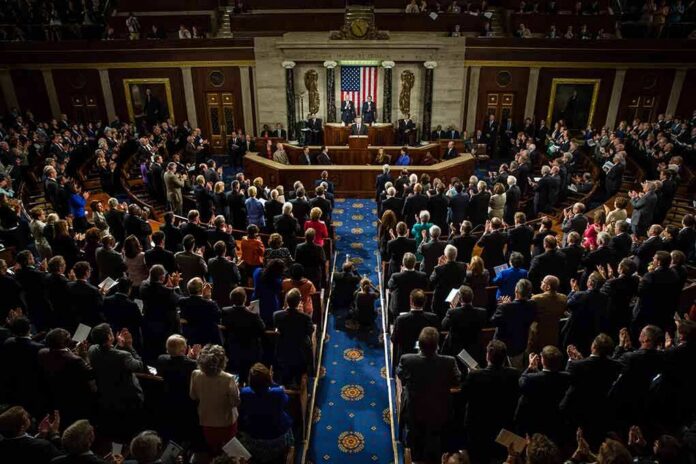
House Speaker Mike Johnson has repeatedly described President Trump as tireless and hyper-engaged, anchoring that portrait in a simple story: the president calls him in the dead of night and again at daybreak. At the House Republicans’ annual policy retreat—an event captured in a transcript—Johnson lauded Trump as “the most active” and “the most energized,” then added, “I get calls from him at 2:00 AM and 7:00 AM, sometimes in the same day.” That is not paraphrase; the phrasing appears in the contemporaneous record.
He later turned the premise into stagecraft. At a rally, with Trump on stage, Johnson performed a brief impression that hinged on the same motif—ungodly-hour calls punctuated by a familiar Trumpism: “Mikey, are you sleeping?” Parallel accounts captured the bit, including the call-and-response cadence Johnson used to keep the mood light while signaling proximity to the president.
How The Riff Works: Performance Politics Built On A Relatable Hook
Politicians reach for vivid, low-friction anecdotes when they want to convey traits otherwise hard to measure—stamina, access, decisiveness. Schedules, call logs, and informal conversations leave an incomplete public paper trail; what sticks with an audience is a concrete picture of behavior. Johnson’s device is elemental and effective: specify times (2 a.m. and 7 a.m.), add a direct quote (“Mikey, are you sleeping?”), and embody the speaker’s voice. The impression is more than comic relief; it’s mnemonic compression. Listeners come away with an image of constant motion and an insider’s intimacy, not a spreadsheet of meeting durations. The retreat transcript cements that the core language—times and framing—originated in Johnson’s own words, not later retellings.
The bit’s portability is part of its utility. Variants appeared across venues with slight shifts in the clock—reports cite 1 a.m./5 a.m. at a rally and 2 a.m./7 a.m. at the retreat—while preserving the same narrative spine. That is what durable political anecdotes do: they survive contextual edits because the underlying message doesn’t rely on an exact timestamp so much as a pattern of behavior and relationship.
Documented Pattern: Johnson Has Imitated Trump Before
Johnson’s turn at mimicry was not a one-off flourish. Profiles preceding these events described his habit of imitating political figures—including Trump—as part of his repertoire. That prior record matters because it shows the impression was an established communicative tool, not an improvisation born of a single campaign stop. When a politician already known for mimicry pairs that skill with a self-referential access story—calls at odd hours—the performance reads as consistent character, not opportunistic shtick.
This continuity also explains why the anecdote scales: audiences that have watched Johnson use impersonation to animate praise or critique are primed to accept the form as authentic to him, even when the substance serves the moment’s aims (rallying a crowd, flattering a candidate, or underscoring a governing relationship).
Where The Evidence Line Runs: Three Distinct Claims, Weighed Cleanly
Separate the episode into its verifiable parts. First, did Johnson say Trump calls at extreme hours? Yes—the policy-retreat transcript documents his claim with specific language. Second, did Johnson perform a Trump impression on stage that folded in the “Mikey, are you sleeping?” refrain? Yes—multiple reports describe the same impression and dialogue in public settings where video exists. Third, did the calls occur at the precise times stated? That rests on Johnson’s account; the public record in hand substantiates the telling, not the telecommunications. For the purposes of understanding the political communication, however, the key fact is that Johnson framed and performed the claim as part of his case for the president’s energy and engagement.
Because the story’s function is reputational rather than administrative—an illustration of vigor, not a logbook entry—the analytic center of gravity sits with what Johnson put into the public sphere and how he delivered it. That is what voters saw, shared, and remembered.
House Speaker Mike Johnson breaks into an unexpected impression of President Donald Trump while joking about the president's late-night phone calls. pic.twitter.com/KZ5LXtKHAT
— AXEL VASA (@Real_Axelvasas) November 2, 2026
Why It Resonates: Energy, Access, And The Logic Of Repetition
Energy is the coin of the realm in modern executive politics. Leaders who project “always on” focus—particularly by calling lieutenants across the circadian divide—signal urgency and control. Johnson’s line compresses two assets into one anecdote: presidential stamina and the Speaker’s own proximity to the source of power. Performance makes it sticky; repetition makes it durable. Communication research has long observed how repetition cements perceptions, even when audiences know a claim is a claim rather than an audited fact. In political contexts, memorable frames endure; corrections and caveats often do not.
There is a corollary. Because the anecdote is portable, it inherits the elasticity of live speech: call times can shift to suit the moment, a joke can lengthen or tighten, and the impression can be dialed up or down depending on whether the president is standing five feet away or watching on a screen. That plasticity is a feature, not a bug, of campaign rhetoric; it keeps the message intact while refreshing the delivery for new rooms.
What To Watch Next: From Stagecraft To Strategy
Expect the motif to persist. As long as Johnson wants to underscore Trump’s pace and his own working relationship with the White House, the overnight-call story does the job with minimal setup and maximum recall. If the Speaker deploys it in governance contexts—committee briefings, donor gatherings, swing-district rallies—it will signal audience targeting: reassurance for allies who value presidential availability and urgency.
For observers parsing the difference between anecdote and administration, the relevant threshold isn’t whether a specific call happened at 1:03 a.m. or 2:17 a.m.; it’s whether the governing coalition consistently uses first-person access stories to translate presidential style into perceived capacity. Johnson’s impression—and the transcripted language that underwrites it—shows how that translation works in practice.
Sources:
facebook.com, rawstory.com, hindustantimes.com, newsnationnow.com, newyorker.com