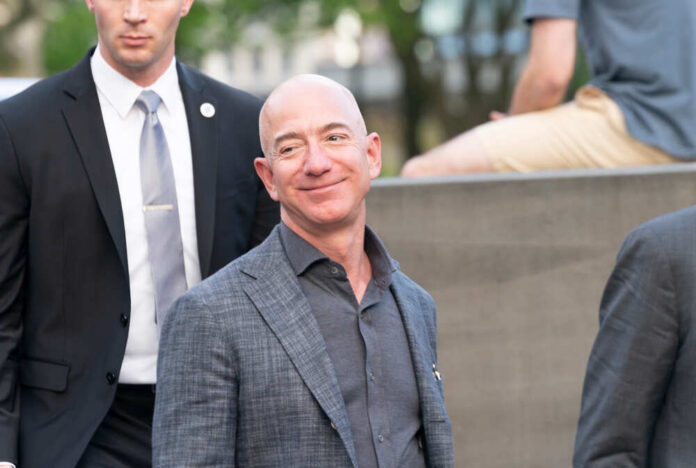
Jeff Bezos is reportedly floating a staggering $100 billion AI-manufacturing fund that could supercharge factory automation—and leave working Americans wondering who benefits when Wall Street “efficiency” replaces paychecks.
Story Snapshot
- Reports say Bezos is in early-stage talks to raise a $100 billion investment fund focused on buying manufacturing companies and automating them with AI.
- No formal launch, commitments, partners, or timeline have been publicly confirmed; the reporting emphasizes the discussions are preliminary.
- The plan would target legacy, real-world industrial firms—not just software—aiming to modernize operations through AI-driven automation.
- Supporters see a potential productivity and reshoring boost; critics worry blue-collar job losses could accelerate if automation is deployed aggressively.
What the reporting says Bezos is building
Multiple outlets citing The Wall Street Journal report that Jeff Bezos is in talks to raise roughly $100 billion for a new fund designed to acquire manufacturing companies and then deploy artificial intelligence to automate and transform their operations. The key detail is timing: the coverage describes the conversations as “early talks,” meaning the concept is real enough to circulate among potential backers but not yet a finalized vehicle with signed investors or named targets.
The reported strategy stands out because it focuses on physical industry rather than another app economy play. Manufacturing acquisitions are capital-intensive, regulated, and dependent on supply chains, skilled labor, and equipment cycles. That makes the scale—$100 billion—more than a headline-grabber; it signals a desire to buy influence over a major slice of industrial capacity. At this stage, however, the public record lacks specifics about fund structure, governance, or which factories would be first in line.
Why manufacturing—and why this scale—matters in 2026
The backdrop is a manufacturing sector still dealing with supply-chain fragility, cost pressures, and a global race for advanced production. The reporting frames the fund as a bid to accelerate “Industry 4.0” modernization: using AI and automation to squeeze more output from existing plants. The political context matters too. With the U.S. focused on strategic production and competition with China, any mega-fund aimed at industrial capabilities intersects with national interest, even when it’s privately led.
Bezos’ history makes the premise plausible. Amazon’s rise leaned heavily on logistics optimization, automation, and data-driven decision-making—tools that can be transplanted into factories. But the research available here is thin on operational details, and there are no direct public quotes from Bezos in the provided reporting. For readers trying to sort signal from noise, the strongest confirmed fact is simply the existence of preliminary fundraising talks, not a guaranteed $100 billion war chest ready to deploy.
The investor angle: who’s likely to be courted and what they want
The reporting describes potential investors as unnamed limited partners, which typically means large pools of capital—major institutions, sovereign wealth funds, and other deep-pocketed players. Those investors generally expect measurable returns, and AI automation pitches usually focus on cutting costs, boosting throughput, and reducing downtime. That may be good business, but it also explains why working families watch these stories differently: “efficiency” in boardroom language often translates into fewer jobs or weakened bargaining power on the shop floor.
So far, nothing in the provided sources identifies which manufacturing subsectors would be targeted, how labor impacts would be handled, or whether any commitments would be made to keep production—and jobs—rooted in the United States. The sources also leave open a basic question: can $100 billion actually be raised for this specific mission, or does the concept shrink once investors demand clearer proof of returns? The “early talks” language is the caution flag.
The real-world stakes: productivity gains versus community disruption
If this fund materializes at anything close to the reported scale, it could pressure competitors to adopt automation faster simply to keep up. That might strengthen output and improve resilience in some supply chains, especially if modernized plants stay onshore. But the research also flags the downside: rapid automation can displace blue-collar workers and deepen inequality when ownership captures most gains. Those tensions are not hypothetical—manufacturing towns live or die by payrolls, not press releases.
From a conservative perspective grounded in limited government and family stability, the central question is accountability. Private investors can pursue profits, but communities absorb the consequences when factories restructure. The provided reporting does not indicate any policy component, and it does not claim government control. Still, Americans have learned to be skeptical when elite-led “transformations” promise prosperity while shifting risk downward. With details scarce, the prudent stance is watchful: productivity is good, but not when it hollows out Main Street.
For now, the most concrete takeaway is uncertainty. The reports agree on the core idea—Bezos exploring a $100 billion AI-manufacturing fund—but provide few verifiable specifics beyond that. Until there’s a formal fund announcement, named partners, or identifiable acquisition targets, Americans should treat the story as an early-stage power move that could reshape industrial employment if it becomes real. The next hard facts to watch are filings, investor commitments, and where any first acquisitions would land.
Sources:
Jeff Bezos in Talks to Raise $100 Billion for AI Manufacturing Fund
Jeff Bezos AI project “Prometheus”