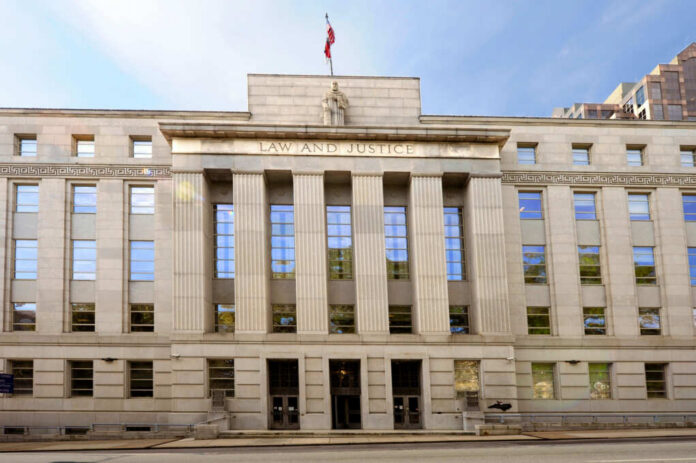
A federal appeals court just slammed the door on Sam Bankman-Fried’s bid for freedom, keeping the disgraced FTX kingpin locked up for 25 years while he now turns to Washington begging for a pardon.
Story Snapshot
- A three-judge federal appeals panel upheld Sam Bankman-Fried’s fraud conviction and 25-year prison sentence.
- The court rejected his claims that the trial was “fundamentally unfair” or that the judge was biased against him.
- Bankman-Fried must forfeit about $11 billion, reflecting massive harm to investors and customers.
- After losing in court, he is now asking President Trump for a pardon, insisting he did nothing wrong.
Appeals Court Locks In the 25-Year Sentence
A federal appeals court in New York has upheld Sam Bankman-Fried’s fraud conviction and his 25-year prison sentence for crimes tied to the collapse of FTX, once one of the largest cryptocurrency exchanges in the world.[1] A three-judge panel unanimously rejected his attempt to overturn the 2023 jury verdict, which found him guilty on all counts of fraud and conspiracy after billions of dollars in customer assets went missing.[1] This ruling leaves the original judgment fully in place and confirms that the trial judge’s core decisions will stand.
News outlets report that the appeals court found no legal errors serious enough to justify a new trial or a lighter sentence, despite Bankman-Fried’s complaints about evidence and procedure.[1] Prosecutors had urged the court to deny his appeal, arguing that he failed to show his conviction was unfair.[3] With this ruling, Bankman-Fried remains on track to serve decades in federal prison and faces an $11 billion forfeiture order aimed at repaying victims of his scheme.[4]
Court Rebuffs Claims of “Unfair Trial” and Bias
Bankman-Fried’s lawyers argued that his trial was “fundamentally unfair,” pointing to what they called bad evidentiary rulings and a judge who allegedly favored the government. The appeals panel was not persuaded and rejected those claims, signaling that the trial court handled the case within the rules. Reports say the judges saw no reason to second-guess the jury that heard weeks of testimony about how customer funds were moved, spent, and lost inside FTX and its sister trading firm.[1]
This outcome fits a broader pattern in federal criminal cases, where appeals are long shots and most convictions are upheld once a jury has spoken and a sentence is imposed. Like many white-collar defendants, Bankman-Fried tried to focus on procedure, not guilt, because appeals courts do not redo the fact-finding done at trial. In this case, that standard worked against him. The panel’s decision shows that complaints about fairness must rest on strong proof, not just disagreement with the result.
From Crypto Star to Convicted Fraudster Seeking a Pardon
Before FTX collapsed, Bankman-Fried was a media darling, a huge political donor, and a favorite of many on the left who praised his “effective altruism” and open support for progressive causes. After his 2023 conviction, a federal judge sentenced him to 25 years in prison and ordered him to forfeit about $11 billion for victim compensation, a signal that the court saw massive financial harm and a deep breach of trust.[4] Many conservatives saw this as a rare moment when an elite insider finally faced tough consequences.
Even after losing his appeal, Bankman-Fried still says he did not commit fraud and claims FTX customers were repaid. In a recent Fox Business interview, he defended himself and confirmed he has asked President Trump for a pardon. He also continues to deny that his large donations to media outlets and politicians were attempts to buy influence, even though his money flowed heavily toward left-leaning institutions that once boosted his image. His stance places him at odds with the jury, the trial judge, and now the appeals court.
What This Means for Accountability and Equal Justice
This case raises a question many conservatives ask often: will powerful insiders be held to the same standard as everyone else? For years, Bankman-Fried enjoyed glowing coverage and access to Washington power while everyday investors and retirees poured savings into FTX based on that trust. The guilty verdict, the 25-year sentence, and now the failed appeal show that, at least in this case, the justice system did not look the other way because he was rich, well-connected, or politically useful.[4]
SBF's last legal lifeline just died.
Three federal appeals judges reviewed every argument Sam Bankman-Fried's team had. All of them. And rejected every single one — unanimously.
The Second Circuit Court of Appeals upheld his 25-year sentence on Friday, dismissing his central… pic.twitter.com/y47KI1g4eB
— Bullish Times (@BullishTimes_) June 13, 2026
At the same time, media framing still risks turning the whole story into a simple “fraudster loses appeal” headline, leaving out the deeper lessons.[1] The record we have is mostly from news summaries, not the full court opinion, so the public depends on secondhand reporting to understand what the judges actually decided.[1] That makes it easier for partisan voices and crypto promoters to spin the outcome as either a witch hunt or a minor setback, instead of a clear signal that massive financial abuse has real consequences.
Sources:
[1] Web – A federal court shut down Sam Bankman-Fried’s bid to overturn his …
[3] Web – SBF ‘ s appeal to overturn 25-year sentence rejected – Odaily
[4] Web – Prosecutors Say SBF’s Appeal Should Be Rejected – KuCoin