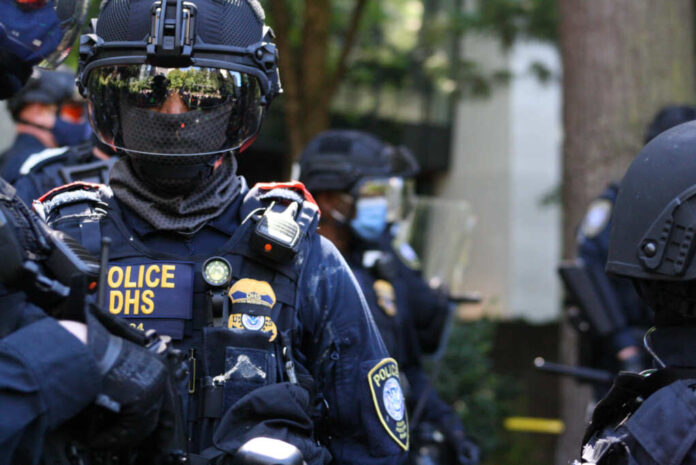
The Department of Homeland Security (DHS) has documented a substantial increase in violent attacks targeting its Immigration and Customs Enforcement (ICE) officers. This report analyzes the rise in assaults over an 11-month period and addresses the attributed factors, reigniting discussions about federal-local law enforcement cooperation and the impact of political discourse.
Story Highlights
- The DHS report indicates a 1,150% increase in assaults against ICE officers over an 11-month reporting period.
- The Department documented 238 violent attacks on officers during this time.
- DHS attributes the surge in violence to the political rhetoric originating from officials in jurisdictions with “sanctuary” policies.
- The findings underscore concerns regarding officer safety and the growing tension in federal-local law enforcement relationships.
DHS Report Documents Rise in ICE Officer Assaults
According to a recent report from the Department of Homeland Security (DHS), violent attacks against Immigration and Customs Enforcement (ICE) officers increased by 1,150% over an 11-month period, with 238 total incidents documented. The DHS attributes this surge to what it describes as aggressive rhetoric from politicians in “sanctuary cities” who have been vocal in their opposition to federal immigration enforcement policies. The report frames this situation as reflecting a growing tension between federal agencies and local jurisdictions that have adopted sanctuary measures. The data suggests that the environment surrounding the debate on immigration enforcement has intensified, prompting the DHS to highlight the potential threat to officer safety.
Assaults on immigration agents skyrocket 1,150% since Trump took office as sanctuary city rhetoric fuels disturbing rise https://t.co/4AWLZfKilt pic.twitter.com/QzklUKkx8g
— New York Post (@nypost) November 24, 2025
Context of Sanctuary City Policies
Sanctuary cities are municipalities that have adopted policies limiting their cooperation with federal immigration authorities, often restricting local law enforcement from assisting ICE with immigration enforcement activities. These policies remain a major point of debate. Proponents of sanctuary policies argue that they are essential for protecting immigrant communities, fostering trust, and encouraging cooperation with local police on other matters. Conversely, critics assert that these policies may compromise federal law enforcement efforts and introduce public safety risks.
The documented rise in violence against ICE officers has intensified the debate over sanctuary policies and their broader consequences. The DHS report suggests that anti-ICE rhetoric from some sanctuary city officials has contributed to a potentially hostile environment, raising questions about the balance between protecting immigrant communities and maintaining the safety of federal law enforcement personnel.
Implications for Federal-Local Cooperation
The significant increase in assaults on ICE officers is anticipated to carry both short- and long-term implications for law enforcement cooperation and policy. In the near term, this may result in heightened tensions between federal agencies and sanctuary jurisdictions, along with an increased focus on reviewing and adjusting officer safety protocols. The report also provides data that enforcement advocates may use in the political arena to challenge sanctuary policies, potentially leading to legislative or policy responses at the federal and local levels.
Over the long term, the consequences for the relationship between federal and local law enforcement could be considerable. Adjustments to existing sanctuary city policies or changes in federal-local agreements may be considered to address safety concerns raised in the report. Additionally, the political discourse surrounding immigration enforcement is likely to continue to evolve, with potential impacts on public perception of both ICE operations and sanctuary policies.
Over the past 10 months, Democrat politicians have compared ICE to Nazis, the Gestapo, and slave patrols, fueling a 1,153% increase in assaults.
From January 21, 2025, through November 21, 2025, there have been 238 reported assaults against ICE law enforcement. There were only…
— Secretary Kristi Noem (@Sec_Noem) November 24, 2025
Sources
Sanctuary Politicians’ Rhetoric Fuels More Than 1,150% Increase in Violence Against ICE Law Enforcement | Homeland Security
ICE officer assaults surge 1150% under Trump admin
Exclusive | Assaults on ICE agents skyrocket 1150%