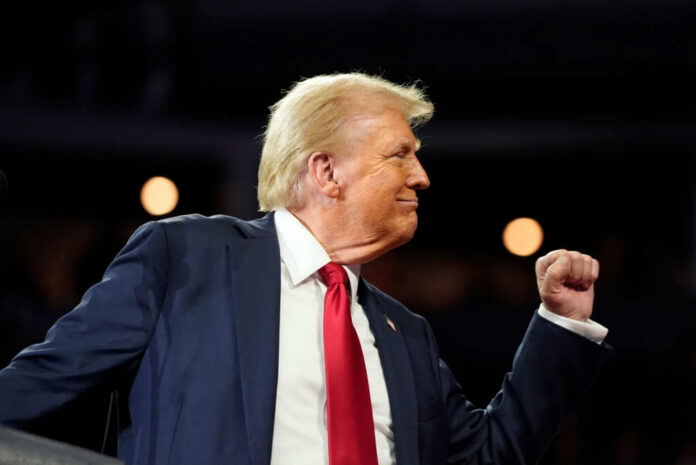
President Trump’s revived “New Monroe Doctrine” is forcing a blunt question Americans haven’t faced in decades: should Washington treat the Western Hemisphere as “ours” again—and what does that mean for freedom, trade, and accountability at home?
Quick Take
- Trump has publicly linked his Venezuela policy to a rebooted Monroe Doctrine framework, framing the hemisphere as a U.S.-led sphere.
- Supporters argue it blocks hostile powers and secures trade routes; critics warn it revives interventionism and strains Latin American sovereignty.
- China’s growing economic footprint in Latin America is a central driver of the new, more explicit exclusionary posture.
- Analysts say the modern version expands “security” beyond military threats into infrastructure, supply chains, energy, and migration enforcement.
From a 19th-Century Warning to a 21st-Century Power Play
President James Monroe’s 1823 doctrine originally warned European empires against further colonization in the Americas, reflecting a young nation’s desire for strategic breathing room. Historians generally describe it as aspirational at first, because the United States lacked the power to enforce it consistently. Over time, later interpretations pushed it toward interventionism, setting precedents that still shape how Americans debate national interest versus entanglement.
President Trump’s second-term rhetoric revives the doctrine’s hemisphere-first logic, but with a more transactional tone: U.S. influence is treated as an operational policy tool, not merely a diplomatic warning. Reporting tied the “Donroe Doctrine” label to Trump’s post-Venezuela posture, describing it as a modernized claim to regional primacy. The key factual dispute is not whether the doctrine exists historically, but how aggressively Washington now intends to apply it.
Venezuela as the Trigger Point for the “Donroe Doctrine”
Recent coverage describes Trump pointing to Venezuela as a turning point—an event used to justify a tougher, U.S.-directed hemispheric stance after the Maduro government’s removal. Research summaries also note discussion of designating Venezuela’s government as a terrorist entity, a step that can broaden legal and operational options for enforcement. Those moves land differently across the spectrum: conservatives often see border, crime, and energy stakes; liberals see mission creep and risk.
Measured strictly by the available sources, the strongest verified point is the administration’s public framing: Venezuela is presented as proof that U.S. action can reshape outcomes in the region. What remains less clear from the provided material is how far the policy extends beyond messaging—whether it becomes a consistent doctrine applied across multiple countries, or stays largely focused on a small set of high-profile targets and strategic corridors.
China, Supply Chains, and the Economic Version of “Security”
Analysts emphasize that today’s “New Monroe Doctrine” isn’t just about tanks and treaties; it’s also about ports, telecommunications, mineral access, and supply chain control. China’s Belt and Road partnerships in Latin America are frequently cited as the key rationale for a sharper exclusionary approach. From an America First perspective, the argument is simple: if rivals control regional infrastructure, the U.S. inherits security vulnerabilities and economic dependence.
Chatham House and other observers describe a broader “hemispheric tilt,” where economic strategy merges with national security thinking. That approach aligns with voter frustrations about globalism and fragile supply chains revealed by shocks in the 2020s. Still, a doctrine that treats trade and infrastructure as security tools can expand federal power quickly—raising a familiar concern on the right: policies sold as “security” can become permanent, expensive, and difficult to audit.
Latin American Sovereignty and the Risk of Endless “Conditional” Partnerships
Commentary in the research argues the new posture implicitly conditions sovereignty on cooperation with U.S. priorities—especially migration, counternarcotics, and alignment against China. That framework may deliver short-term leverage, but it can also breed resentment among allies and neutrals alike, particularly if Washington is seen as dictating internal policy. For Americans skeptical of the “deep state,” this is where distrust spikes: foreign policy missions can turn into open-ended bureaucracies.
The New Monroe Doctrine: In This World, It’s Just Ushttps://t.co/jxkeRcKIPD
— PJ Media (@PJMedia_com) April 25, 2026
The political reality in 2026 is that Republicans can implement much of this agenda, while Democrats can slow it through messaging, litigation pressure, and procedural fights. The bigger question is whether Congress and the public will demand clear limits: defined objectives, transparent costs, and measurable outcomes. A hemisphere-focused strategy can be defensible if it protects borders and counters rivals—but it will test whether Washington can act decisively without sliding back into the same unaccountable habits voters say they’re fed up with.
Sources:
Trump, Venezuela and the History of the Monroe Doctrine
The Monroe Doctrine, the United States, and Latin American Independence
The United States’ “New Monroe Doctrine”
The economics of a new Monroe Doctrine