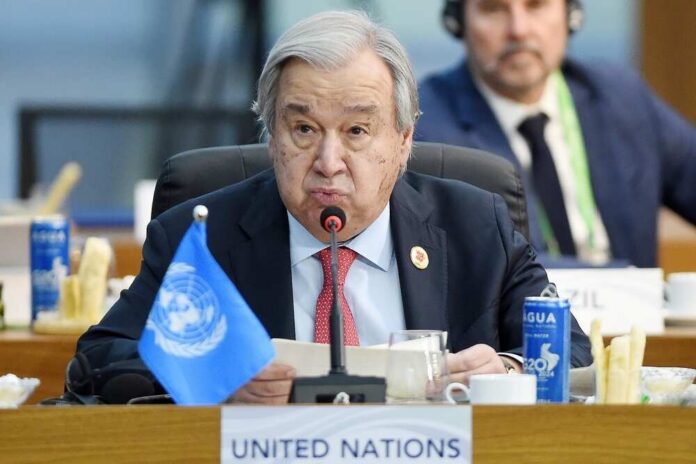
UN Secretary-General António Guterres issued a stark warning that the foundational nuclear arms control treaty is collapsing while global military spending hits record highs and nuclear arsenals expand for the first time in decades.
Story Snapshot
- Guterres declared “arms control is dying” at the eleventh Nuclear Non-Proliferation Treaty Review Conference on April 27, 2026
- Nuclear warheads are proliferating for the first time since the Cold War amid eroding trust between nations
- Global military spending surged to $2.7 trillion in 2025, equaling Africa’s entire GDP and outpacing humanitarian aid thirteenfold
- Emerging AI and quantum computing technologies create unprecedented nuclear threats that existing treaties cannot address
Alarm Bells Ring at Nuclear Summit
UN Secretary-General António Guterres delivered an urgent address to diplomats gathered at UN Headquarters in New York, declaring that the Nuclear Non-Proliferation Treaty stands on the brink of collapse. Speaking at the opening of the eleventh NPT Review Conference, Guterres stated bluntly: “For too long, the Treaty has been eroding. Commitments remain unfulfilled. Trust and credibility are wearing thin. The drivers of proliferation are accelerating.” His remarks represent the first explicit acknowledgment by a UN chief that nuclear warheads are increasing after decades of post-Cold War reductions, marking a dangerous reversal in global security.
Treaty Crumbles Under Weight of Broken Promises
The NPT, which entered into force in 1970 with 191 member states, was designed as humanity’s bulwark against nuclear catastrophe by binding nuclear powers—the United States, Russia, United Kingdom, France, and China—to pursue disarmament while preventing other nations from acquiring weapons. Yet those commitments now ring hollow. Arms control agreements between major powers have lapsed, modernization programs continue unchecked, and geopolitical tensions fuel mistrust that fractures any remaining consensus. UN disarmament officials warn the path forward has become “less certain” as nuclear-armed states prioritize deterrence over their treaty obligations, creating a credibility crisis that non-nuclear nations increasingly view as hypocrisy.
Record Military Spending Fuels New Arms Race
The 2025 global military expenditure of $2.7 trillion underscores where national priorities lie—a figure thirteen times larger than all international humanitarian aid combined and equivalent to the gross domestic product of the entire African continent. This unprecedented spending surge funds not just conventional forces but also nuclear arsenal upgrades across all weapon states, reversing decades of gradual disarmament. Meanwhile, emerging technologies including artificial intelligence and quantum computing introduce entirely new dimensions of nuclear risk that the fifty-six-year-old treaty framework was never designed to address. Guterres warned against what he termed “collective amnesia” about Cold War-era norms, noting that even nuclear testing taboos face erosion.
Stakes Reach Breaking Point
The conference unfolds against a backdrop where “nuclear sabres rattle” and concrete war dangers loom larger than at any point in recent memory. A failed Review Conference risks accelerating proliferation cascades, potentially unraveling the international safeguards system overseen by the International Atomic Energy Agency and abandoning non-nuclear states to fend for themselves in an increasingly dangerous world. The short-term implications include heightened escalation risks in flashpoint regions, while long-term consequences could include the complete breakdown of the nuclear war taboo that has held since 1945. Guterres called for breathing new life into the treaty through strengthened enforcement, updated frameworks for AI-era threats, and renewed commitment to disarmament obligations.
For Americans across the political spectrum frustrated with government dysfunction and elite failures, this development highlights a broader pattern: international institutions created to protect ordinary citizens prove ineffective when powerful nations prioritize their own interests over collective security. While conservatives rightly question whether globalist frameworks serve American interests, and liberals worry about unchecked military power, both can agree that a world where nuclear arsenals grow unchecked while diplomatic mechanisms crumble serves no one except defense contractors and the political class that profits from perpetual tension. The question facing conference delegates is whether they will take meaningful action or allow this critical safeguard to join the growing list of failed institutions that leave everyday people more vulnerable.
Sources:
‘Looming’ risk of nuclear arms race, UN proliferation meeting hears – UN News
UN chief warns drivers of nuclear proliferation accelerating – Dawn