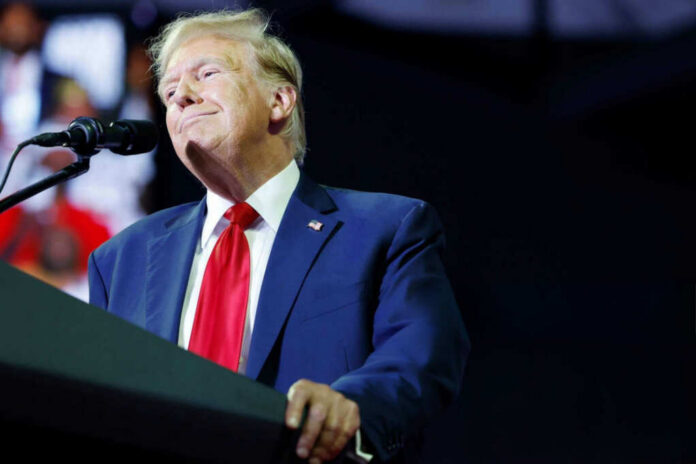
A single unfiltered C-SPAN call shows how quickly politics can devolve into defamatory claims and quasi-religious rhetoric—and how easily the system that’s supposed to inform voters can become a megaphone for the country’s worst divisions.
Story Snapshot
- A self-identified Republican caller on C-SPAN’s Washington Journal accused President Donald Trump of being a pedophile and compared MAGA supporters to Nazis.
- The caller also claimed his own family “prays to” Trump and views him as a Jesus-like figure, citing a reportedly deleted image shared by Trump.
- C-SPAN host Mimi Gerges repeatedly tried to steer the call back toward workable discussion, highlighting the limits of live call-in moderation.
- The episode drew attention mainly after a media write-up, underscoring how niche moments can be amplified into broader political narratives.
What Happened on C-SPAN—and Why It Landed So Hard
C-SPAN’s Washington Journal aired a call from “Todd” of Port St. Lucie, Florida, who said he was a Republican but launched into extreme allegations against President Donald Trump. Todd accused Trump of being a pedophile, invoked Jeffrey Epstein, and described MAGA as a racist cult. He also claimed his family treats Trump as a sinless, Jesus-like figure, saying they “pray to” him. C-SPAN host Mimi Gerges pressed for clarity and attempted to redirect the discussion.
‘He’s a Pedophile!’ C-SPAN Caller Takes Host on Wild Ride, Says Family Thinks Trump ‘Is Jesus Christ’ #Mediaite https://t.co/dR1HPXcjom
— #TuckFrump (@realTuckFrumper) April 25, 2026
The most newsworthy element wasn’t policy—there was none—but the snapshot of polarization: a caller attacking a sitting president from the right while framing his relatives as consumed by political worship. For conservative viewers, the moment is a warning about how quickly bad-faith framing can define public discourse. For liberal viewers, it reinforces a familiar narrative about “cult” politics. Either way, the format rewarded heat over light, and the segment’s value became controversy, not understanding.
Open Lines, Minimal Gatekeeping, and the Incentive to Go Viral
C-SPAN has built its brand on letting Americans speak in their own voices, and Washington Journal has run caller segments for decades. That openness can surface genuine concerns—about inflation, border security, crime, or costs that hit working families first. But it also allows fringe claims to reach a national audience with limited friction. In this case, the call carried accusations that were not substantiated in the available reporting, yet the emotional delivery made it shareable.
How Epstein Allegations Keep Reappearing—and What the Record Can Actually Support
The caller’s pedophilia accusation leaned on the broader public association between Trump and Epstein, a theme that has circulated for years. The research provided notes that Trump had a social relationship with Epstein earlier in life and has denied wrongdoing. That distinction matters: acknowledging a documented social connection is not the same as proving criminal conduct. When media ecosystems blur that line, they train citizens to treat rumor as evidence—an especially dangerous habit in a country already struggling to trust institutions.
Older Americans on both sides recognize another pattern here: political talk is increasingly moralized, with opponents cast as evil rather than wrong. Conservatives often feel that this dynamic is used to justify censorship, lawfare, and bureaucratic pressure campaigns. Liberals often feel it’s necessary to confront perceived threats. The C-SPAN exchange illustrates the downside for everyone: once politics becomes a contest of dehumanizing labels, there’s little room left for due process, limited government, or the basic principle of fair judgment.
The Family Angle Reveals a Deeper Problem Than Partisanship
Todd didn’t only attack Trump; he described cutting ties with relatives and portrayed political disagreement as a form of enemy contact. That’s not unique to one party, and it’s one of the most destabilizing trends in American life. When politics replaces faith, community, and shared civic identity, people stop negotiating and start excommunicating. The call’s religious language—Trump as Jesus-like, sinless, prayed to—was presented as the caller’s personal account and cannot be independently verified from the provided sources.
Even so, the broader reality is verifiable: modern politics increasingly borrows the language of salvation and heresy, and that makes compromise almost impossible. Republicans may control Congress and the White House in 2026, but that doesn’t automatically restore social trust. If citizens come to believe every institution is either propaganda or a weapon, then the “deep state” suspicion many Americans share—left and right—becomes self-reinforcing, and accountability gets harder, not easier.
What This Means for Viewers Trying to Stay Grounded
The practical takeaway is less about one caller and more about incentives. Unfiltered platforms can inform, but they can also be exploited by people seeking attention or catharsis. Media outlets can then amplify those moments because conflict drives clicks. For voters, the best defense is basic: separate claims from evidence, refuse to spread accusations without proof, and demand officials focus on measurable outcomes—prices, wages, energy reliability, border enforcement, and public safety—rather than endless cultural psychodrama.
For conservatives frustrated by years of elite-driven narratives, the episode is a reminder that “the system” doesn’t always fail through one grand conspiracy; sometimes it fails through laziness, incentives, and institutional habits that prize spectacle. For liberals worried about extremism, it’s also a caution: demonization can backfire by hardening camps and making ordinary Americans tune out. A republic can’t function when persuasion is replaced by character assassination.
Sources:
Republican Rep. Sessions Trump Pedophile C-SPAN