
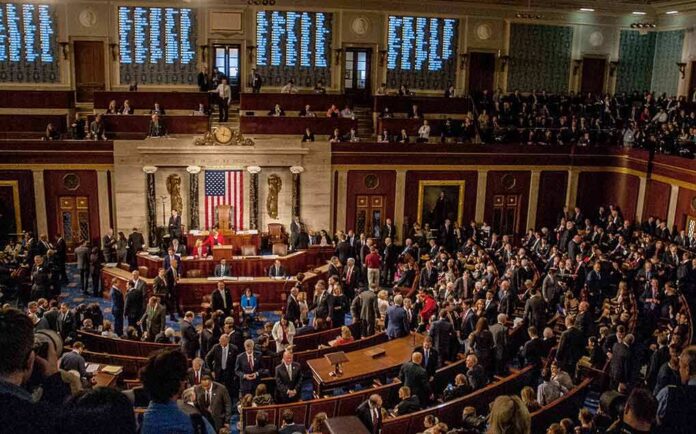
House Democratic Leader Hakeem Jeffries urged Congress to slow artificial intelligence development now, saying delay puts Americans at risk.
Story Highlights
- Jeffries called for urgent congressional action to slow AI development and set safety rules.
- Democrats cite a new party commission and related proposals like an “AI kill switch” as paths forward.
- Speaker Mike Johnson favors industry-led safety and guardrails without a federal slowdown.
- The fight echoes a larger clash over federal control versus state action and industry influence.
What Jeffries Said And Why It Matters
House Democratic Leader Hakeem Jeffries said Congress must “act urgently” on artificial intelligence and “slow down the pace of development” to protect the public. He argued that waiting invites harm from bad actors and unsafe tools. He also said Republicans dismantled a prior bipartisan House task force, which he framed as a risk to health and safety. His remarks raise the stakes by tying speed to safety, not just innovation.
Jeffries tied his push to a formal party process. He pointed to a House Democratic Commission on Artificial Intelligence and the Innovation Economy, which he launched in late 2025 to craft an “aggressive framework” for benefits and risks. He said Democrats would prioritize artificial intelligence in caucus meetings, signaling a plan to move ideas toward bill text. That gives his message more structure than a sound bite, even if full legislative text is not yet public.
The Democratic Policy Path Taking Shape
Jeffries’s camp highlights allied bills and ideas that would give the federal government new safety tools. One example is the “AI Kill Switch Act,” reported in July 2026, which would grant authority to throttle or shut down dangerous models under defined conditions. Supporters say such powers are needed if a system enables major cybercrime or critical failures. Critics warn blunt powers could chill research and push jobs and investment overseas.
Democrats also point to support for a federal framework from outside Congress. A 2025 letter from California lawmakers opposed a federal moratorium but urged “targeted, smart regulation” of high-risk artificial intelligence at the national level. That view reflects a common theme: set strong federal rules for the riskiest systems, while letting lower-risk tools proceed. The open question is how to define “high risk” and who decides when a model crosses that line.
How Republicans Frame The Stakes
House Speaker Mike Johnson backs guardrails and safety measures but rejects an outright slowdown. He argues developers must make products safe and that Congress should focus on talks with companies to build consensus on rules. He also stresses competition with China as a reason to avoid heavy-handed limits that could stall U.S. innovation. That stance sets up a clear policy split with Jeffries over pace and who carries the main duty to act.
Republicans have also pushed federal preemption ideas. Reporting shows House Republicans advanced a plan to block states from regulating artificial intelligence for ten years, which drew backlash from state leaders. The language would have barred substantive state rules on models and automated systems, shifting power to Washington and, critics said, leaving gaps if Congress does not move fast. That fight sharpened the debate over who sets the rules and how soon.
Why This Fight Resonates Beyond Partisans
Both sides say they want safety. The divide is over speed, enforcement power, and trust. Many Americans feel the federal government moves too slowly, listens to industry first, and protects insiders. Artificial intelligence adds a new worry: a few firms control key models, and mistakes can spread fast. That fuels support for clear rules with teeth, but also fear that the wrong rules could crush small builders and lock in today’s giants.
WATCH LIVE: Jeffries holds news conference as calls for AI regulation grow https://t.co/uJMzSFVh4h
— PBS News (@NewsHour) September 14, 2026
Today’s reality is unsatisfying to many. Jeffries offers urgency, but the public has not seen a full bill with line-by-line safeguards yet. Johnson offers talks and industry duty, but that can look like delay when risks feel real. The shared concern is simple: if Washington drags its feet or defers to lobbyists, families pay the price. The next step to watch is whether leaders release concrete text that sets tests, triggers, and real penalties—and then schedule votes.
Sources:
facebook.com, politico.com, cryptobriefing.com, congress.gov, nytimes.com