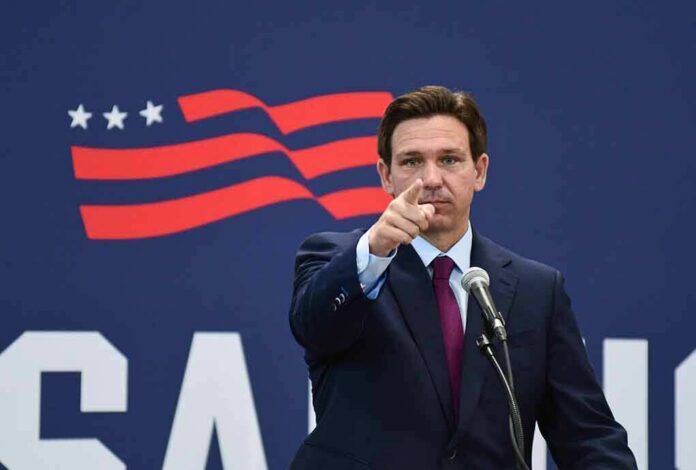
Ron DeSantis warned Republicans face “political extinction” after heavy midterm losses, then pointed to Florida’s resilience as a survival playbook.
Story Snapshot
- DeSantis said the midterms were “close to an extinction-level event” for Republicans in many states.
- He argued Texas is essential to national Republican viability and called it the party’s “crown jewel”.
- He warned the fallout could last a decade or more, not just one cycle.
- Florida stood out as a Republican stronghold while others faltered.
DeSantis’s Warning and Where He Said Republicans Fell Short
Florida Governor Ron DeSantis told reporters that the midterm results were “close to an extinction-level event” for Republicans in many parts of the country. He said defeats across large states would leave Florida as one of the only big states under firm Republican control. His message centered on structural losses, not just one bad night. He argued the outcome showed weak party infrastructure in key places and warned the damage could linger well beyond the next session.
DeSantis tied the warning to geography. He said Republican setbacks clustered in major population centers. He described the map as shifting under the party’s feet and urged Republican officials to rebuild coalitions now. He highlighted candidate quality, turnout, and ground game as problem areas. He also said Republicans must compete better with suburban and independent voters. He framed the problem as fixable, but only with faster action and a clearer plan.
Texas as the Test of National Viability
DeSantis called Texas the “crown jewel of Republican politics.” He said if Republicans lose Texas, they will not be nationally viable going forward. He linked Texas to the party’s base in the Electoral College and to congressional math. He argued that losing that anchor would force Republicans into constant defense. He did not present a formal model but used Texas to stress how one state can tip national power for years.
That warning lines up with broader election history and how big states shape national outcomes. Large states influence fundraising, media attention, and candidate pipelines. When parties fall back in these places, they lose more than votes. They lose talent, donors, and policy influence. DeSantis’s focus on Texas, and on other large states, underscored that point. He argued that party leaders must shore up core states before chasing marginal gains elsewhere.
Florida as a Counterexample and Why It Matters
DeSantis said Florida held the line for Republicans while other large states shifted. Coverage showed Republicans retained key statewide positions there. He pointed to Florida’s coalition-building, policy agenda, and voter outreach as reasons for stability. The Florida example does not prove that one state’s model will copy over to others. But it does show that strong state machines can blunt national waves and keep a party in the game.
For conservatives, the takeaway is hard but clear: organization and turnout still decide elections. For liberals, the story shows how durable state-level coalitions can be. For everyone frustrated with Washington, this is another sign that national leaders often misread local data. When leaders chase headlines instead of ground truth, they miss where power is really won: school boards, county offices, and statehouses that shape who votes and how well campaigns connect.
How Big Midterm Losses Usually Work, and What Is Different Now
History shows the party in the White House often loses seats in midterms. Over many cycles, the president’s party has lost about 28 House seats and four Senate seats on average. Analysts use those baselines to judge whether a setback is normal or a real shift. DeSantis’s language went further, suggesting a longer, deeper slide. The open question is whether losses in large states build into a trend across several cycles.
DeSantis said the consequences could last a decade or more. That time frame matters. Parties recover when they recruit better candidates, invest in turnout, and adjust messages to local needs. They falter when they rely on national brands alone. The governor’s warning challenges both parties to focus on state strength. Voters across the spectrum, tired of elites and gridlock, will watch whether leaders rebuild from the ground up or keep talking past the problem.
Sources:
fox13news.com, huffpost.com, thehill.com, nbcmiami.com