Federal safety officials said the Learjet may have started breaking apart before it exploded on impact, after a near-vertical plunge over a Florida neighborhood.
Story Snapshot
- National Transportation Safety Board (NTSB) is leading the crash investigation with Federal Aviation Administration (FAA) support.
- FAA data show the jet fell from about 35,250 feet to 8,750 feet in just over a minute.
- Nine people were on board the Learjet 60, which crashed near homes around 12:50 p.m. on November 1, 2026.
- NTSB scheduled a public briefing in Palm Beach County to share initial facts and next steps.
What Investigators Confirmed So Far
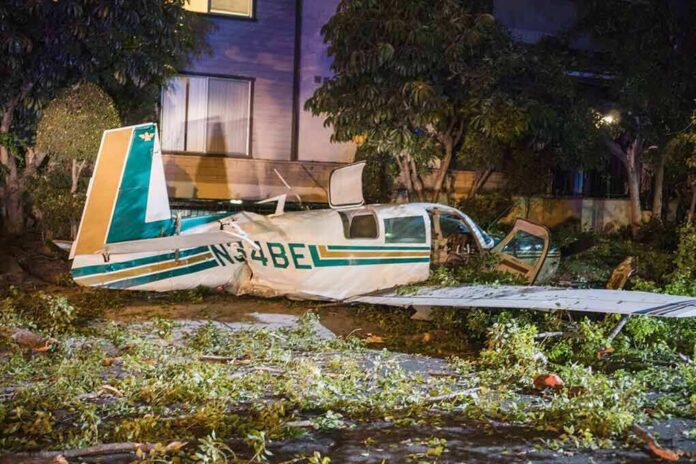
The National Transportation Safety Board is in charge of the inquiry, with help from the Federal Aviation Administration. Officials identified the aircraft as a 22-year-old Learjet 60 flying from Austin, Texas, to North Eleuthera in the Bahamas. The jet went down near homes in the Greenacres and Lake Worth area at about 12:50 p.m. on November 1, 2026. Local reports stated all nine people aboard died in the crash, which sparked a fire on impact.
The Federal Aviation Administration released early flight details used by multiple outlets. The jet descended from roughly 35,250 feet to about 8,750 feet in a little over one minute. That implies a very high descent rate, on the order of hundreds of feet per second. Crews reported a crater and debris near residential streets. Officials cautioned that these are preliminary facts and do not show what caused the loss of control or the final break-up and explosion.
Why a Public Briefing Matters
The National Transportation Safety Board scheduled a news conference at the Palm Beach County Emergency Operations Center. Board Member Tom Chapman was set to lead the update at 1 p.m. on November 2. Early briefings share confirmed facts from the field and outline the work ahead. They do not decide probable cause. A preliminary written report usually arrives within about two weeks and contains only the factual record gathered on scene.
The early stage of an aviation probe follows a set process. Investigators secure the wreckage, map the site, and document key parts. Teams gather weather data, maintenance history, air traffic control recordings, and any flight recorder information. Federal rules also limit what participants can release while the probe is active. That system aims to cut speculation and protect evidence until the full analysis is complete.
The Descent, The Explosion, and Open Questions
Multiple reports described a near-vertical descent that ended with a large explosion near Military Trail and nearby streets. The speed and force fit with the rapid altitude loss reported by the Federal Aviation Administration. Some outlets noted the possibility of in-flight structural damage before impact based on debris patterns, but investigators have not released a cause. Officials have not confirmed the operator, registration, or maintenance history at this time.
SHE BECAME A PILOT AT JUST 17. FOUR YEARS LATER, HER LIFE ENDED IN A TRAGIC PLANE CRASH. 💔
20-year-old Nathalia Gadelha Filgueiras was the co-pilot aboard a Learjet 60 that crashed in Florida on November 1, killing all nine people on board.
She had earned her private pilot’s… pic.twitter.com/7f2j2Ozf3N
— LUCK7773 (@Luck_7773) November 2, 2026
Families and neighbors now wait for answers that only data can supply. Investigators will examine control continuity, engines, and any recording devices. They will compare wreckage clues with radar tracks and weather snapshots from the same minute. They will also review pilot training and medical information. That full picture can reveal whether weather, a system failure, pilot incapacitation, or another event led to the final dive and violent impact.
How This Fits a Larger Pattern
Early aviation coverage often moves faster than the facts. The National Transportation Safety Board warns that first briefings are snapshots, not verdicts. They exist to set guardrails while the team collects data. The agency’s process, from on-site work to analysis to a final report, can take months. The preliminary report that appears within about two weeks offers a factual timeline, but it will not assign probable cause or policy fixes.
Why This Resonates With Many Americans
When a jet falls from cruise altitude into a neighborhood, people want straight answers. They also want to know that institutions will do the hard work, not spin the story. This case shows the system at work: federal teams sharing confirmed details, naming what they do not yet know, and promising records to come. That is how public trust should be built—through facts, not theater—and how safety lessons reach pilots, operators, and every community under a flight path.
Sources:
youtube.com, abcnews.com, wpbf.com, fox5atlanta.com, cbsnews.com, ecfr.gov