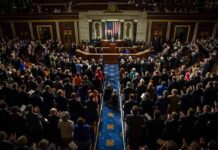

President Trump blamed Republicans’ midterm collapse on his absence from the ballot as Democrats captured both chambers of Congress.
Story Highlights
- Democrats won control of the Senate and the House for the rest of Trump’s term.
- Democrats flipped Senate seats in several Republican-leaning states and gained dozens of House seats.
- Voters backed abortion rights in Nevada and Virginia; Missouri rejected tighter limits, while Idaho voted the other way.
- Trump said the losses would not have happened if his name were on the ballot.
Democrats Seize Congress With Broad Gains
Election results showed Democrats winning 54 Senate seats and 228 House seats, shifting control of both chambers away from Republicans for the remainder of President Trump’s term. Reported flips included Senate races in Kansas, Iowa, Texas, Ohio, Maine, North Carolina, and South Carolina, while Democrats also held key battlegrounds like Georgia and Michigan. House gains crossed into districts that backed Trump by large margins in 2024, signaling a broad map of losses for Republicans in places they expected to hold.
State-level results pointed to further Democratic momentum. The Associated Press reported wide gains in state governments, moving several battleground and right-leaning states toward Democrats. That shift could shape policies on taxes, schools, and energy for years. It also gives Democrats more control over redistricting fights and voting rules. Republicans now face a harder path to advance national priorities from the White House without reliable partners in many state capitols.
Abortion Rights Ballot Measures Cut Across Party Lines
Voters approved abortion-rights protections in Virginia and Nevada, including a right to abortion until fetal viability in Nevada, and rejected efforts to restore broad abortion limits in Missouri. Idaho moved the other way, voting against an abortion-rights measure. The mixed map shows voters separating party labels from specific rights questions. That pattern tracks past cycles in which abortion-rights measures have often outperformed expectations, including in culturally conservative areas.
Democrats highlighted these results to argue that reproductive rights energized their coalition. Republicans noted the Idaho outcome and said the picture is not uniform. Both points can be true at once. Ballot measures focus voters on a single issue, while congressional contests blend views on prices, wars, schools, immigration, and trust in leaders. The split outcomes suggest voters wanted more say over personal decisions but also had diverse views on who should run Washington.
Why Midterms Often Punish The President’s Party
Historical research shows midterms often function as a check on the sitting president, with the president’s approval and the economy driving results. That pattern has spanned many decades and both parties. Voters use midterms to rebalance power, send a warning, or demand course changes. The 2026 results fit that mold. They can reflect frustration over prices, foreign conflicts, and daily costs, not only one issue. The outcome reduces President Trump’s room to pass major bills.
Destiny reads the Woke fatwa issued by the Democrats on Republicans and explains why this blue wave is just the beginning
"Mandatory sx change surgeries begin tonight, republican voters please report to your local abortion clinic voluntarily, or a bis-xul MS13 member will be… pic.twitter.com/7csNOdBk5B
— yeet (@Awk20000) November 4, 2026
Democrats will now set the congressional agenda, control committee gavels, and shape investigations. That control affects budgets, border and immigration debates, energy policy, and oversight of federal agencies. Republicans still hold the White House and can push policy through executive actions, but confirmations, spending priorities, and many high-impact laws now run through Democratic leaders. Divided government raises the odds of standoffs and short-term deals rather than sweeping reforms.
Trump’s Blame And The Voter Mood
President Trump told supporters the defeat would not have happened if his name were on the ballot, placing the loss on turnout and enthusiasm rather than policy direction. Democrats cast the results as a repudiation of Trump and the Republican Party’s agenda, echoing live election coverage that framed the night as a sharp rebuke. Both parties now face a public that spans right and left but shares deep doubts that Washington serves ordinary people’s needs on costs, security, and basic fairness.
What Changes Next For Daily Life
Congressional leaders will reopen fights over prescription costs, insurance rules, and limits on hospital billing. They will press for more oversight of federal contracts and pandemic-era spending. Energy policy will lean toward more renewables and grid upgrades, while fossil fuel backers push for reliability and lower prices. Border and immigration bills will again face gridlock without a shared plan. Families hoping for quick fixes should expect slower, noisier progress and more bargaining from both sides.
Sources:
youtube.com, us.cnn.com, apnews.com, krem.com, bbc.com, houstonchronicle.com