Federal agents say an Oklahoma man mailed more than 700 white‑powder letters with a “Declaration of War,” triggering hazmat responses from coast to coast.
Story Snapshot
- Federal complaint charges Robin Patrick Martin with hoax and threat crimes tied to white-powder mailings.
- Investigators say more than 700 letters shared markings and content linking them to one sender.
- Surveillance video and retail records allegedly place Martin buying supplies and mailing envelopes.
- Tested powders were inert, but the law targets threats and false biological hoaxes that cause fear.
What Prosecutors Allege In The Case
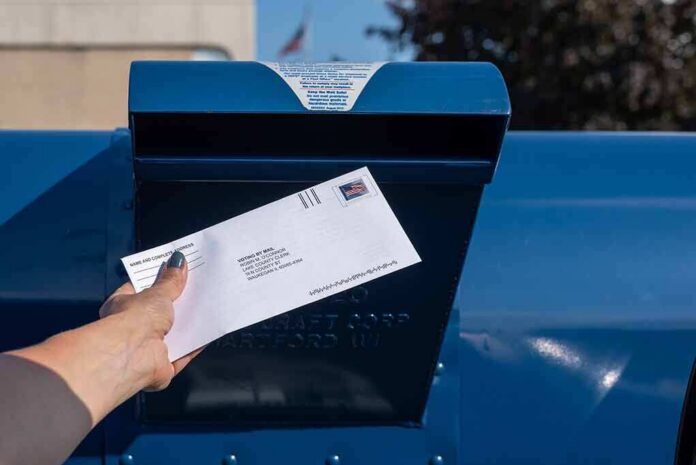
Federal prosecutors charged Robin Patrick Martin with conveying false information and a hoax, and with mailing threatening communications, after a two-year investigation into white-powder letters sent before the 2024 and 2026 elections. The criminal complaint says the letters carried white powder and a three-page message titled “Declaration of War,” which officials treated as a threat. Agents say they linked more than 700 envelopes to the same sender, reaching election offices and public officials across several states.
Investigators say many letters shared unusual details that stood out. The envelopes allegedly had hidden writing that glowed under ultraviolet light, and the contents followed a common format across mailings in 2024 and 2026. Some letters arrived close to election events and led to evacuations and hazardous-material responses. The complaint states these facts support probable cause that Martin committed both offenses under federal law, which addresses mailed threats and hoaxes about dangerous substances.
Key Evidence Cited By Investigators
Agents say surveillance video showed Martin depositing mailings at a United States Postal Service facility during both the 2024 and 2026 episodes. The complaint also points to a single day of retail activity that allegedly lined up with the mailings. Walmart records from August 23, 2026, show purchases of privacy envelopes, stamps, a Motorola phone, and a prepaid phone card, which investigators say could support the preparation and sending of the letters. These retail details are part of the probable-cause basis, not a final verdict.
Laboratory checks did not find biological agents in the tested powders; officials reported yeast or flour in samples, while noting that not all letters had been fully tested at the time of the filings. Under federal law, the powder’s danger is not the only issue. The law also covers threats and hoaxes that a reasonable person would see as dangerous and that trigger costly emergency responses. Prior federal cases have led to prison sentences even when the powder was inert.
How The Law Treats White-Powder Hoaxes
Federal courts have long treated white-powder scares as crimes that harm public safety, even when no toxin is found. A Tennessee case sent an inmate to prison for three years for mailing an inert powder with a threat that looked like a biological attack. A Massachusetts case ended in guilty pleas after letters with suspicious powder went to high-profile recipients. A Washington case produced a two-year sentence for about 100 letters with fake biological threats. These cases underline why responders treat each envelope as real.
Election offices and public buildings must shut down and call hazardous-material teams when white powder arrives. That costs time, money, and trust. The Brennan Center has reported that many local election officials have faced threats or abuse since 2020, adding strain to a system already under pressure to run secure, on-time elections. White-powder hoaxes hit that stress point. They slow work, scare staff, and feed the sense that the system is not protecting people who show up to do their jobs.
Why This Matters Beyond One Case
This case lands in a country tired of threats and spectacle and worried about basic competence. When hundreds of hoax letters force evacuations, regular people lose faith that leaders can keep order while also protecting speech and due process. The law draws that line: it punishes mailed threats and hoaxes because they weaponize fear, tie up police and firefighters, and disrupt core civic work like counting votes, regardless of party. That is about safety and function, not politics.
An Oklahoma man faces federal charges after allegedly sending hundreds of letters containing white powder to public officials and media outlets ahead of both the 2024 and 2026 elections. https://t.co/jjSBr3HsnD
— CBS Mornings (@CBSMornings) November 3, 2026
The complaint quotes messages that agents say reflect claims about the 2020 election and warnings about 2024, which they associate with the accused. That political content may draw headlines, but it is not what decides the case. The core question is whether the government can prove, with evidence, that Martin sent threatening communications and knowingly staged a false biological scare. The complaint says there is probable cause. A court will test that claim and the defense will answer.
Sources:
cbsnews.com, twincities.com, sentinelcolorado.com, newsnationnow.com, newson6.com, newser.com, storage.courtlistener.com, rmb.reuters.com