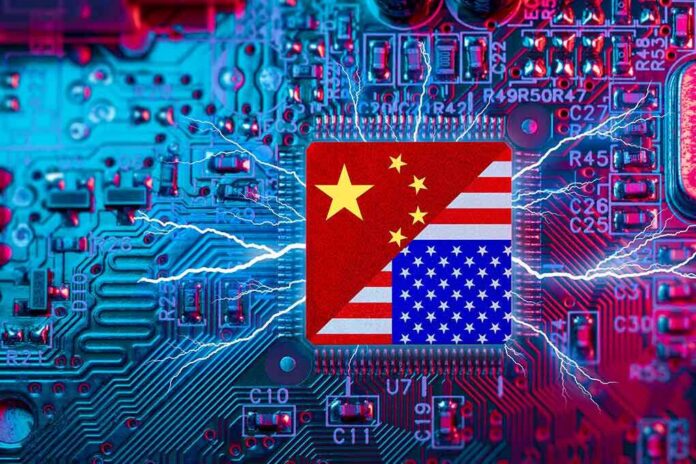
Bernie Sanders is urging direct U.S.-China cooperation on artificial intelligence even as security agencies warn Beijing is exploiting American AI work.
Story Snapshot
- Sanders called for U.S.-China AI safety talks and scientist collaboration on technical “red lines.”
- Security reviews say China uses legal and illegal methods, including economic espionage, to gain AI tech.
- A Justice Department case showed theft of AI trade secrets linked to Chinese state interests.
- Major U.S. AI firms plan to coordinate against Chinese-linked industrial espionage.
What Sanders Proposed And Why It Matters
Senator Bernie Sanders said the United States and China should work together on artificial intelligence safety. He urged both sides to let top scientists share technical information and set clear “red lines” to prevent a “cataclysmic” outcome. He linked his call to upcoming talks between President Trump and China’s leader, and to a Capitol event where U.S. and Chinese experts warned the world is unprepared for advanced AI risks. His office posted the statement on May 11, 2026.
Sanders’s stance breaks from the growing view in Washington that treats AI as a race with China. He argues safety demands dialogue even with rivals. News outlets described how he convened researchers from both countries and faced backlash for it. Supporters say high-stakes tech needs guardrails that no nation can set alone. Critics fear any opening could leak know-how that boosts a strategic competitor at U.S. expense.
National Security Concerns Driving The Pushback
U.S. reviews warn that China blends legal and illegal tools to speed up its technology drive. Analysts report likely use of economic espionage and foreign talent efforts to advance artificial intelligence and chipmaking. A federal commission also ties future advantage to control of large, high-quality datasets. These assessments explain why many in both parties resist deep technical sharing that could shift leverage in data, models, or compute.
A 2026 case shows the risk in sharp detail. The Department of Justice secured a conviction of a former Google engineer on counts tied to economic espionage and trade theft. Analysis of the case says he worked with Chinese talent programs and aimed stolen technology at state firms in China. The case is cited by hawks as proof that cooperation without strict lines can be turned into a pipeline for theft.
How Industry Is Responding On Its Own
Major American artificial intelligence companies also moved to tighten defenses. Reporting says OpenAI, Anthropic, and Alphabet announced plans to share indicators of Chinese-linked industrial espionage. The companies will coordinate to detect and publicly report efforts to steal their proprietary work. This step shows private firms do not trust ad hoc cooperation to protect their crown jewels and are building collective early-warning systems.
At the same time, U.S. and Chinese researchers still work together in some areas. Studies describe deep ties in papers and venture activity over the years. That record supports a narrow lane for cooperation on safety protocols, testing, and terms that do not expose trade secrets. Some policy work argues both nations signed global statements on AI risk and can discuss guardrails, even as rivalry shapes almost every choice.
Why This Debate Hits A Nerve For Voters
Americans across parties resent a pattern where elites make deals that promise safety but deliver losses at home. They remember past pledges on trade and tech that hurt factories, paychecks, and trust. Sanders’s plan promises shared safety, but many fear it could hand tools to a strategic rival or to unaccountable bureaucrats. That worry grows when cases show stolen code and when companies feel forced to band together to stop theft.
Silicon Drama Episode 19 is live.
Jensen Huang moves to own Hugging Face. Sam Altman hands GPT-6 Astra the controls. Behind them, the AI stack starts financing itself.
The stack is closing. The agents are moving.
Read the complete episode.#eTatos https://t.co/gPPsDyJSmu
— Dirk R. Bartz (@DirkBartz) September 5, 2026
The practical question is narrow and urgent: what can be safely shared, with whom, and under which laws. Clear rules, strong enforcement, and bright technical lines would help. That could include cooperation on testing dangerous model behavior, without sharing weights, core code, or unique data. It could also mean audit trails, visas tied to compliance, and tough penalties for violations. Without that rigor, cooperation feels like risk, not safety.
Sources:
washingtonpost.com, semafor.com, uscc.gov, fdd.org, afn.net, brookings.edu, nytimes.com