Scientists are floating a plan to dam the Bering Strait—an eye-popping geoengineering idea that could either “stabilize” a major ocean current or backfire into a faster collapse if the timing is wrong.
Story Snapshot
- Dutch researchers propose three linked dams across the 82-kilometer Bering Strait to reduce freshwater flow into the Arctic and protect the weakening Atlantic Meridional Overturning Circulation (AMOC).
- The model’s central warning is a narrow window: if the AMOC has already weakened too far, closing the strait could worsen outcomes instead of improving them.
- Multiple experts and prior modeling raise red flags, arguing that strait closure can trigger abrupt shifts and slow recovery, making the proposal a high-stakes gamble.
- Even supporters frame the concept as a stopgap that does not replace emissions reductions, while the geopolitical reality of U.S.-Russia cooperation makes it largely theoretical.
Why the Bering Strait Is Now in the AMOC Debate
Researchers at Utrecht University modeled a provocative intervention: block a major pathway that sends relatively fresh Pacific water through the Bering Strait into the Arctic. The logic is simple but consequential—freshwater can reduce salinity in key North Atlantic regions, weakening the sinking action that helps power the AMOC “conveyor belt.” Their study, published April 24, 2026, argues that limiting that freshwater input could help stabilize circulation under certain conditions.
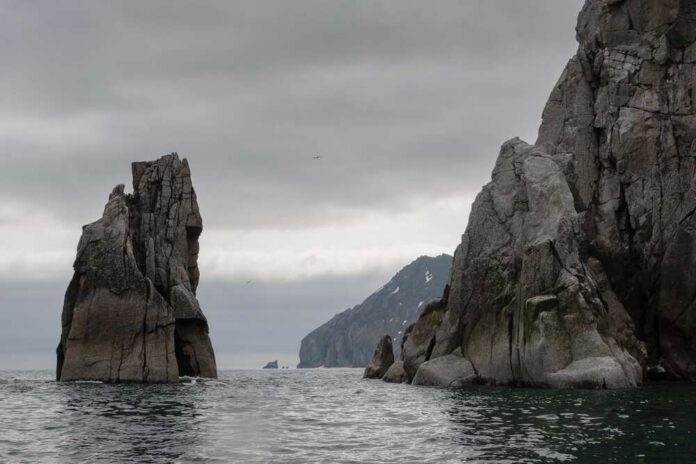
The Bering Strait is not a symbolic chokepoint; it is a real, physical corridor between Alaska and Russia that is roughly 82 kilometers wide with relatively shallow depths. The proposal envisions three connected dams, using the Diomede Islands as natural stepping stones, with the longest segment around 38 kilometers. Engineers point to large dam projects in the Netherlands and elsewhere as proof that building at this scale is technically possible, at least on paper.
The “Timing Trap” That Makes This Plan So Risky
The Utrecht modeling does not sell the dam as a guaranteed fix. It suggests the outcome depends heavily on how weakened the AMOC already is at the time of intervention. The coverage of the research highlights a specific threshold: if the AMOC declines beyond about 6.1% of its current strength, closing the strait could shift from being helpful to being harmful. That kind of cliff-edge condition makes the policy stakes unusually high for decision-makers.
Another complication is the broader record of climate modeling on this exact idea. A prior modeling line cited in reporting, including work associated with NCAR, warns that closing the Bering Strait can trigger abrupt transitions and even accelerate collapse under some scenarios—while also slowing recovery. In other words, the same lever that might strengthen AMOC in one modeled future could destabilize it in another. That contradiction is not a minor footnote; it is the core uncertainty.
Costs, Commerce, and the Human Reality in the Arctic
Media coverage has attached a rough price tag of $100 billion-plus, along with major disruption risks. A physical barrier across the strait would not just redirect ocean water; it would also alter Arctic ecosystems that local communities rely on and complicate already sensitive fishing patterns across U.S. and Russian waters. Shipping is another practical concern. The Arctic has seen changing navigation conditions, and any permanent structure would reshape routes and regulations.
These are the kinds of real-world tradeoffs that often get shortchanged when policy debates happen at a “planetary systems” level. For many conservatives, it also raises a familiar concern: elites and institutions discussing grand, top-down interventions that ordinary people will live with—without clear accountability if the models are wrong. Even readers who are skeptical of climate alarmism can recognize the governance risk when a proposal carries irreversible consequences and unclear ownership.
Geoengineering vs. Governance: Who Decides and Who Pays?
No government has endorsed construction, and the geopolitical hurdles are obvious: the dams would sit between U.S. territory and Russia’s Chukotka region. In 2026, U.S.-Russia cooperation on a mega-project is not a normal assumption; it would require unprecedented negotiations, security guarantees, and long-term enforcement. That alone helps explain why the idea remains theoretical, even as headlines amplify it. A project can be “technically feasible” and still politically implausible.
Experts quoted in coverage also stress that even a successful dam would not “solve” warming or replace emissions reductions; it would at best buy time or reshape risk. That framing matters. If policymakers treat geoengineering as a substitute for responsible governance—sound energy policy, honest budgeting, and transparent risk management—public trust will degrade further. Americans across the spectrum already suspect the federal government struggles to manage complex systems; this proposal is the definition of complex.
A vast dam across the Bering Strait could stop the AMOC collapsinghttps://t.co/EJGRGaWmw3
— WholeLifeCarbon (@wholelifecarbon) May 9, 2026
The most grounded takeaway is not that the Bering Strait dam is imminent, but that it reveals how far the climate conversation has shifted—from incremental policy disputes to planetary-scale engineering proposals with uncertain outcomes. When models disagree and consequences are irreversible, prudence is not denial; it is basic stewardship. The public deserves straight answers on uncertainties, not slogans, because a misstep here would not be a normal policy failure—it would be a global one.
Sources:
Can Damming the Bering Strait Save the AMOC?
Building a massive dam between Alaska and Russia could prevent AMOC collapse, scientists say
A climate fix or a dangerous gamble? The case for closing the Bering Strait