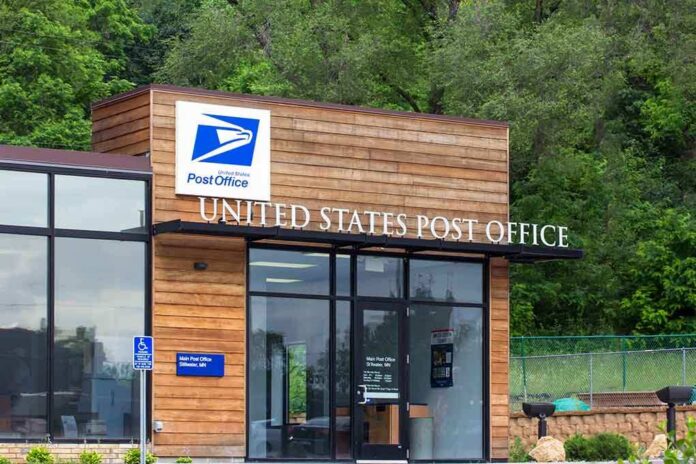
Federal judges and the Justice Department pulled the post office gun ban in opposite directions, leaving millions unsure what rules actually apply where they mail a letter.
Story Snapshot
- Texas and Florida federal courts said broad post office gun bans fail under the Supreme Court’s Bruen test.
- Judges limited relief to the plaintiffs, so most people still face enforcement unless covered by injunctions.
- The Department of Justice (DOJ) withdrew an appeal, signaling a tactical retreat but not a nationwide rule change.
- Two different legal tools still underpin the policy: a federal statute and a Postal Service rule.
What the Texas and Florida rulings actually did
U.S. District Judge Reed O’Connor in Texas ruled that the government did not show a historical tradition for a blanket firearms ban at ordinary, public-facing post offices. He held the ban unconstitutional as applied to the plaintiffs, which included advocacy groups and their members, and blocked enforcement against them. Earlier, a federal judge in Florida reached a similar result in a criminal case, dismissing part of a prosecution under the same post office rules after applying the Supreme Court’s Bruen test.
These decisions turn on the Supreme Court’s 2022 Bruen framework. That test shifts the burden to the government to prove modern gun limits match the nation’s historical tradition of firearm rules. The courts found the record thin for a sweeping ban at ordinary mail counters and parking lots. The rulings did not question well-secured areas like court facilities. They focused on customer spaces that look more like normal civic or retail sites than high-security locations.
Why most Americans still face the ban today
Both courts limited relief to the parties before them. That means the postal gun ban remains enforceable against people who are not covered by those injunctions. Reporting on the Texas case warned, “For now, nothing changes for most Americans,” and non-plaintiffs can still be charged under the existing statute and regulation where applicable. This narrow scope keeps the day-to-day legal risk high for most visitors to post offices, despite headline wins for the plaintiffs.
Two separate legal tools continue to anchor enforcement. First, a federal law from 1988 bars weapons in a “federal facility,” which includes buildings where federal employees work. Second, a United States Postal Service regulation from 1972 bans weapons on “postal property,” a term broad enough to reach parking lots. The Postal Service rule has fewer exceptions than the statute. Together, they create overlapping coverage unless and until a court blocks them for a given person or place.
The DOJ move that muddied the picture
The Department of Justice started to appeal the Texas injunction but then withdrew that appeal. That left the limited injunction in place for the plaintiffs and removed a near-term chance for a binding ruling in the Fifth Circuit. Commentators read the withdrawal as a tactical retreat, not a national policy change. The move reduced momentum for a quick, uniform answer while leaving most post office sites under the same posted rules for the general public.
🚨 BREAKING: DOJ's Office of Legal Counsel just dropped a bombshell opinion — federal law banning licensed dealers from selling handguns to 18- to 20-year-olds is UNCONSTITUTIONAL.
In a memo dated Sept. 17, 2026, Assistant AG @ElliotGaiser tells @AGToddBlanche that 18 U.S.C. §§…
— Shermichael Singleton (@MrShermichael) September 18, 2026
The split outcome feeds frustration across the spectrum. Gun-rights supporters see courts saying the ban lacks historical support, yet everyday carriers still risk charges if they guess wrong about coverage. Gun-control supporters see public spaces where families stand in line, and they want stable, safety-first rules. Both sides face an uneven map shaped by where cases are filed and who is named as a plaintiff, which looks like government by courtroom zip code more than by clear national law.
What to watch as the legal fight continues
Appeals or new suits in other regions could set broader rules. A circuit court opinion, or a Supreme Court ruling, could decide whether post offices qualify as “sensitive places” under history and tradition. The government could try to salvage parts of the policy by drawing tighter lines between interior work areas and public lots. Until an appellate court speaks, the mix of a federal statute, a postal regulation, and narrow injunctions will keep rules unstable from state to state and even location to location.
Sources:
washingtontimes.com, courthousenews.com, nraila.org, ammoland.com, ca10.uscourts.gov, concealedcarry.com