The Supreme Court just gave President Trump broad power to fire Federal Trade Commission commissioners, ending a New Deal-era shield that limited White House control.
Story Highlights
- The Court struck down “for-cause” limits on removing Federal Trade Commission commissioners.
- The ruling reverses a lower-court order and expands presidential control over the agency.
- Chief Justice John Roberts wrote that officials who use the President’s power can be removed by him.
- The decision caps years of cases moving power from “independent” agencies back to the Presidency.
What The Supreme Court Decided
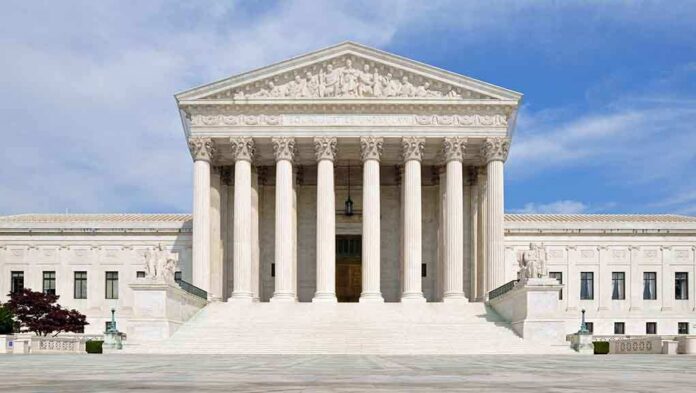
On June 29, 2026, the Supreme Court ruled that the Federal Trade Commission’s removal protections are unconstitutional. The law had allowed removing commissioners only for “inefficiency, neglect of duty, or malfeasance.” The Court held that this “for-cause” limit conflicts with the Constitution’s design for the executive branch. The justices reversed and remanded the case, clearing the way for the President to remove commissioners at will. This ends a major restraint on direct presidential control of the Federal Trade Commission.
Chief Justice John Roberts wrote the opinion, joined by Justices Samuel Alito, Neil Gorsuch, Brett Kavanaugh, and Amy Coney Barrett, with Justice Clarence Thomas joining most parts. The opinion stated that “subordinates who exercise the President’s power are subject to removal by him”. That line explains the logic: when officials wield executive authority, the President must be able to replace them. The decision rejects the old compromise that tried to keep some regulators outside day-to-day White House control.
How The Case Reached The Court
The case began after President Trump removed Commissioner Rebecca Kelly Slaughter in March 2025, despite the statute’s protections. A lower court blocked the removal and said she could keep doing her job. The Supreme Court took the case and asked parties to brief whether the removal protections violated the separation of powers. The justices ultimately reversed the lower court’s judgment and returned the case for further action under the new rule.
The decision marks a sharp turn from the 1935 case Humphrey’s Executor, which had once allowed Congress to protect Federal Trade Commission commissioners from at-will removal. Recent cases had already narrowed that approach. In 2020 and after, the Court limited similar protections at other agencies. Congress’s own legal analysts describe a steady retreat from strong “independence” toward clearer presidential control over officers who execute federal law.
Why This Shift Matters Beyond One Agency
This ruling strengthens the White House hand over a powerful regulator that touches prices, mergers, data privacy, and competition. Presidents can now align leadership faster with their policy goals. Supporters say that improves accountability: voters know who to blame or credit. Critics fear it invites pressure on regulators and weakens expertise. Either way, this change moves authority away from long-serving boards and back to elected leadership at the top of the executive branch.
The bigger story is the doctrine. For years, the Court has moved from the New Deal model of “independent” commissions toward a “unitary” executive. The Court has said that when officials exercise executive power, the President must be able to remove them. Today’s decision fits that arc. It signals that attempts to wall off powerful regulators from at-will removal will face tough scrutiny, with limited exceptions for functions not tied to core executive power.
What Could Happen Next
President Trump and future presidents can now replace Federal Trade Commission commissioners without proving cause. That could shift the agency’s stance on mergers, antitrust lawsuits, and rulemaking. Companies planning deals may see faster swings in policy after elections. Congress could try to redesign agencies, but options are narrow if they still exercise executive power. Courts will likely see follow-on cases testing other commissions that long claimed “independence” under statutes like the one just struck down.
For many Americans, this will confirm a concern that power collects at the top while agencies feel distant and unaccountable. Others will see a win for accountability after years of regulatory drift. The practical test comes soon: can a White House-directed Federal Trade Commission lower costs, curb abuses, and act faster without favoritism? The promise is clearer lines of responsibility. The risk is more swings with each election. Voters will judge the results in their bills and paychecks.
Sources:
supremecourt.gov, constitution.congress.gov, congress.gov