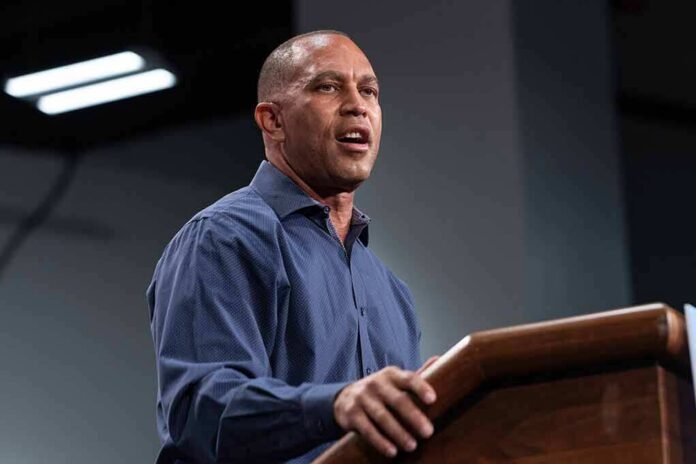
House Democrats formally nominated Representative Hakeem Jeffries for Speaker, positioning him to become the first Black lawmaker to lead the chamber if he wins the full House vote.
Story Highlights
- House Democrats placed Hakeem Jeffries in formal nomination for Speaker on the House floor.
- Caucus voting showed broad Democratic support in a closed-door process.
- The Speaker is chosen in a public roll call; nomination signals party backing but is not the final election.
- The move sets up a high-stakes floor vote that will test party unity and control of the House.
Democrats Place Jeffries in Formal Nomination
House Democrats placed Representative Hakeem Jeffries of New York in nomination for Speaker during a public House session. Representative Joe Neguse delivered the nomination at the direction of the Democratic Caucus, marking the party’s official choice going into the floor vote. Jeffries, who serves as the Democratic leader, has been the caucus’s standard-bearer through recent Speaker contests. The nomination sets his name for the roll call that will decide control of the House gavel.
Jeffries’s office previously confirmed his nomination and celebrated the breadth of support inside the caucus. Press statements from Democratic leadership have framed his bid as a unifying choice after internal votes showed strong backing. Those internal votes occurred behind closed doors, as is common for both parties. Public remarks from party leaders highlighted the goal of stable House operations after past disruption during leadership fights.
What a Party Nomination Means—and What It Does Not
Congressional researchers explain that each party usually selects its Speaker candidate in a private meeting before the House votes in public. A member from each party then places the nominee in nomination on the floor, and Representatives cast roll call votes for any person they choose. This process means a nomination signals party support, but it does not elect the Speaker. The actual outcome depends on the floor majority at the time of the vote.
The House has sometimes needed multiple ballots to elect a Speaker when no candidate wins a majority in the first round. In those cases, lawmakers repeat roll calls until one person secures a majority of members present and voting. That history shows why caucus unity and attendance matter as much as the initial nomination. The separation between private selection and public vote is a guardrail that preserves the House’s final say on leadership.
Why This Moment Matters Across the Aisle
Jeffries’s nomination carries historic weight. If elected, he would become the first Black Speaker in United States history, a milestone noted by national and local outlets covering the vote counts inside the caucus. Democrats argue his leadership would steady the chamber’s work on budgets, oversight, and national priorities. Republicans counter that their policy vision should guide the House agenda. The floor vote will reveal which message has the votes to run the chamber.
"The Congressional Black Caucus congratulates Democratic Leader Hakeem Jeffries on his historic and decisive nomination for Speaker of the House.
— Rev. Dr. Kelcey A. West – Motivational Speaker (@kelceywestmdiv) November 18, 2026
For many Americans, this fight is about more than one leader. People across the political spectrum see a Congress that struggles to deliver on basics like safe communities, fair markets, and predictable energy and food costs. The Speaker controls the floor schedule, sets committee priorities, and helps shape which ideas get a vote. That power can either ease gridlock or deepen it. The final outcome will signal how Congress plans to govern in the months ahead.
Sources:
theamericanconservative.com, jeffries.house.gov, congress.gov, abc7news.com, nbcnews.com, katherineclark.house.gov, history.house.gov