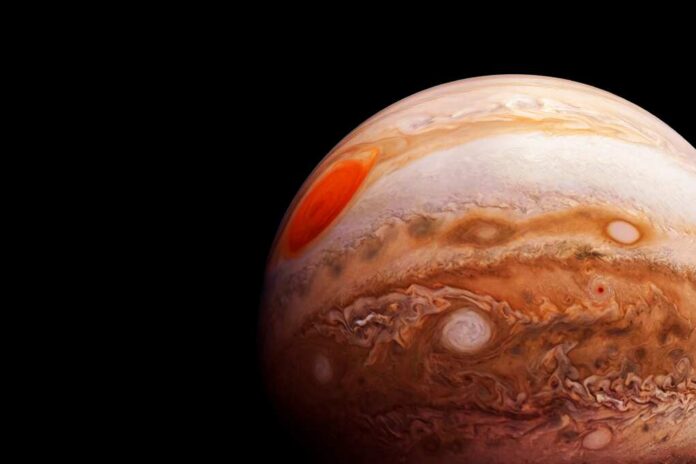
NASA scientists have finally pierced Jupiter’s massive storm clouds to reveal hidden secrets about water abundance and planetary formation that could fundamentally reshape our understanding of gas giants across the universe.
Story Snapshot
- January 2026 breakthrough model reveals Jupiter’s storms concealed water abundance and atmospheric composition for centuries
- NASA’s Juno mission continues safe orbital observations after Galileo probe’s 2003 failure in impenetrable clouds
- Great Red Spot continues accelerated shrinkage and “flaking,” potentially dissipating by 2040
- New findings challenge existing theories of planet formation and advance exoplanet research capabilities
Breakthrough Model Unveils Hidden Atmospheric Secrets
Scientists published a groundbreaking atmospheric model in January 2026 that effectively “peels back” Jupiter’s dense cloud layers to expose the planet’s true composition beneath its iconic storms. The research reveals significant water abundance and internal dynamics previously masked by violent winds reaching 432 kilometers per hour and opaque storm systems including the Great Red Spot. NASA’s Juno mission provided critical remote sensing data for this modeling breakthrough, operating safely in orbit after the 2003 Galileo probe was lost attempting to penetrate the impenetrable cloud barriers that have obscured Jupiter’s depths since telescopic observations began.
Great Red Spot Shows Accelerating Changes
Jupiter’s most famous storm continues its dramatic transformation, shrinking from a historical 25,500-mile long axis in the 1800s to approximately 10,250 miles by the 2010s. Hubble Space Telescope observations confirmed the acceleration after 2012, measuring shrinkage rates of 580 miles per year as the storm becomes increasingly circular. NASA planetary scientist Amy Simon documented small eddies feeding into the Great Red Spot’s vortex, potentially sapping energy and accelerating changes. The storm has also exhibited unusual “flaking” behavior since 2019, with edge fragments dissipating into Jupiter’s atmosphere, raising questions about whether this centuries-old feature faces terminal decline within decades.
Historical Failures Drive Current Research Approach
Giovanni Cassini first documented the Great Red Spot as a “permanent spot” in 1665, establishing centuries of observational tradition that confronted technological limitations. The 2003 Galileo probe’s catastrophic failure while attempting atmospheric entry demonstrated the deadly risks of direct investigation through Jupiter’s storm systems. This loss motivated NASA’s decision to keep the Juno mission in safe orbital distance while employing advanced remote sensing technology. The Hubble Space Telescope’s OPAL program, led by researchers including Michael H. Wong at UC Berkeley and Glenn Orton at JPL, builds comprehensive atmospheric maps comparable to Earth oceanographic studies, providing crucial comparative data without risking expensive spacecraft.
Implications for Planet Formation Science
The 2026 model’s revelation of hidden water and compositional data beneath Jupiter’s storms directly challenges existing theories about gas giant formation and solar system development. These findings provide essential insights for understanding exoplanet atmospheres detected by the James Webb Space Telescope and other advanced observatories. Researchers note the storm-concealed water abundance offers clues about Jupiter’s formation location and migration history within our solar system. The model advances capabilities for characterizing potentially habitable exoplanets by demonstrating how dense atmospheres can mask critical compositional signatures. While NASA’s billion-dollar-plus Juno investment faces scrutiny in an era demanding fiscal responsibility, these findings justify continued space exploration funding through practical applications advancing planetary science and American technological leadership.
Jupiter’s clouds are hiding something big – https://t.co/JS2TZALwCS
— Ken Gusler (@kgusler) January 31, 2026
The Great Red Spot’s projected transformation into a circular formation by 2040 will alter Jupiter’s appearance for future generations while providing unprecedented opportunities to observe storm system evolution. Scientists continue monitoring the storm’s drift of 1.75 to 2 degrees per month across Jupiter’s latitude bands, building predictive models for both immediate atmospheric behavior and long-term planetary dynamics that inform broader astrophysics research advancing American scientific excellence.
Sources:
NASA Reveals Changes to Jupiter’s Great Red Spot
Hubble Shows That Jupiter’s Great Red Spot is Smaller Than Ever Seen Before
Transit Times of Jupiter’s Great Red Spot
Great Red Spot – Wikipedia
Jupiter’s Clouds Are Hiding Something Big – ScienceDaily
New Findings on Jupiter Could Change Our Understanding of Planet Formation