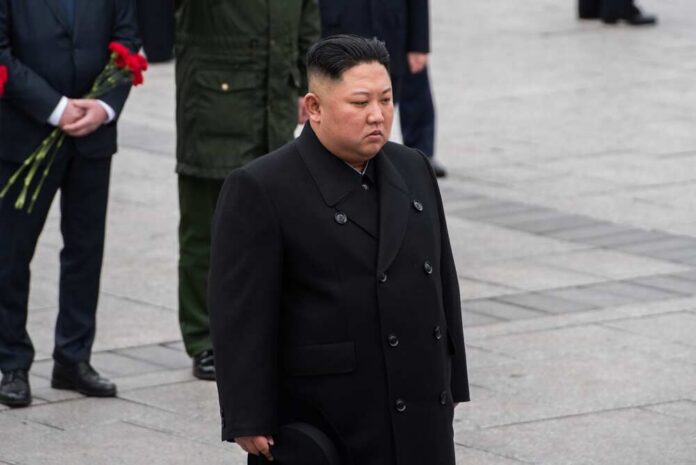
Kim Jong Un is putting his teenage daughter front-and-center at missile tests, signaling that North Korea’s nuclear threats may be getting a long-term “family dynasty” upgrade.
Quick Take
- Kim Jong Un attended a live-fire drill of 12 “600mm” multiple rocket launchers on March 14, 2026, alongside his daughter Kim Ju Ae.
- North Korean state media framed the test as showcasing “tactical nuclear” destructive capability within roughly 420 km.
- South Korea reported detecting about 10 ballistic missiles launched toward the eastern sea (Japan Sea), calling it a U.N. violation.
- The repeated public placement of Kim’s daughter at weapons events is fueling renewed succession speculation.
What North Korea Tested—and What Pyongyang Claims It Proves
Kim Jong Un observed a live-fire test on Saturday, March 14, 2026, involving twelve 600mm-caliber “ultraprecision” multiple rocket launchers, according to North Korea’s state media. KCNA presented the drill as a demonstration of battlefield (“tactical”) nuclear strike power, with messaging focused on targets within about a 420-kilometer range. South Korea separately reported detecting roughly 10 ballistic missiles fired from the capital region toward the eastern sea.
KCNA said the salvos struck targets about 364 kilometers away in the sea, and state imagery showed Kim and Kim Ju Ae near olive-green launch vehicles. Analysts have highlighted that these “large-caliber” systems blur the line between classic artillery and missile technology because they can combine guidance and range in ways that make them more strategically threatening. The basic military reality is simple: a system that is mobile, accurate, and repeatedly tested increases pressure on neighbors and raises the stakes during any crisis.
Why Kim’s Daughter’s Presence Matters to the Regime’s Strategy
Kim Ju Ae, estimated to be around 13, has now appeared repeatedly at high-profile weapons events since late 2022, a major change from the regime’s previous secrecy about family members. The March 14 appearance again placed her not merely in the background but alongside her father during inspection-style moments, which is why outside observers keep debating whether she is being positioned for future leadership. Independent confirmation of her exact status remains limited, but the visual pattern is real.
North Korea’s system is dynastic, with the Kim family controlling the state’s political identity and security apparatus. In that context, public imagery is not random—it is a tool. Showcasing a child at strategic weapons events can serve multiple aims at once: internal elite signaling, propaganda aimed at citizens, and a message to adversaries that the nuclear program is not tied to one man’s lifespan. For Americans who prefer clear deterrence over wishful thinking, the succession angle is a reminder that time does not automatically weaken hostile regimes.
Freedom Shield, Escalation Cycles, and the Risk of Miscalculation
The drill unfolded as U.S.-South Korea Freedom Shield exercises continued through March 19, 2026. Pyongyang often portrays these drills as invasion rehearsals and frequently responds with weapons tests, creating a predictable but dangerous cycle. In this episode, North Korea’s rhetoric emphasized that the weapon system can impose “uneasiness” and threaten military infrastructure within range—language designed to shape allied decision-making as much as to impress domestic audiences.
South Korea has said the launches violate U.N. restrictions on North Korean ballistic missile activity, and U.S. officials indicated they were monitoring developments. Even when both sides expect these tit-for-tat actions, the volume of launches, compressed timelines, and ambiguous system categories can increase the chance of a misread signal. During major exercises, a launch meant as propaganda can still force real-world alert decisions—especially when the regime hints at nuclear capability tied to short-range strike systems.
What’s Known, What’s Not, and What Comes Next
Multiple reports align on the basic facts: the date, Kim’s attendance, the presence of his daughter, and launches toward the eastern sea. Some details remain inherently uncertain because KCNA is a state propaganda outlet and outside access is limited—such as precise locations and the full technical performance of the system. Even so, South Korea’s detection provides external corroboration that launches occurred, and the regime’s chosen messaging clearly sought maximum strategic effect.
North Korea has also signaled it will continue drills, and recent activity included cruise missile testing observed by Kim earlier in March. The strategic takeaway for the U.S. and allies under President Trump is not to panic, but also not to pretend these are harmless “tests.” A regime that advertises tactical nuclear options and elevates the next generation in front of launchers is telling the world it intends to keep this program central for years—regardless of sanctions or speeches.
Sources:
North Korean leader Kim observes test of rocket launch systems with his daughter
kim-jong-un-watches-cruise-missile-tests-with-teenage-daughter