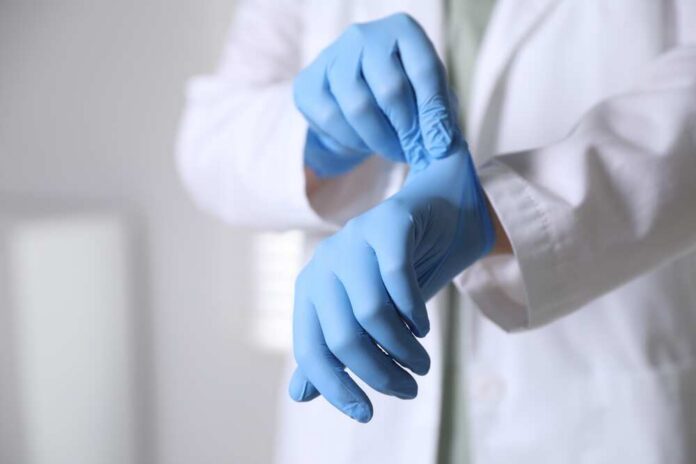
Lab gloves meant to prevent contamination are instead pumping fake microplastic data into environmental studies, potentially fueling overblown green agendas that burden American families with costly regulations.
Story Snapshot
- University of Michigan study uncovers nitrile and latex gloves releasing stearate salts that mimic microplastics, causing up to 2,000 false positives per mm² in lab tests.
- Cleanroom gloves slash false readings to about 100 per mm², offering a simple fix for skewed research.
- Overestimation hits small particles under 10 µm hardest, complicating real health and pollution assessments.
- Researchers provide workflows to clean up past data, restoring trust without denying plastic threats.
Gloves Trigger False Microplastics Readings
University of Michigan researchers tested seven glove types including nitrile, latex, and cleanroom varieties under lab conditions mimicking routine handling. Nitrile and latex gloves shed stearate salts, soap-like manufacturing residues, during dry contact with filters and slides. These particles average 2,000 false positives per square millimeter when detected by infrared and Raman spectroscopy. The contamination occurs from standard 30 Newton pressure, common in sample preparation. Cleanroom nitrile gloves reduced counts to roughly 100 per mm². This discovery arose after procedural blanks showed unexpectedly high microplastic levels in unrelated experiments.
Stearates Mimic Real Plastics Spectrally
Stearate salts visually and spectrally imitate high-density polyethylene microplastics, especially particles smaller than 10 micrometers. These tiny sizes matter most for health studies on inhalation risks and environmental spread. Prior research focused on airborne or water-based contamination but missed glove residues from dry handling. Stearates, used since the 1990s as mold-release agents in glove production, transfer easily. The study confirmed origins using advanced O-PTIR and Raman spectroscopy. Lead researcher Madeline Clough traced the issue during her PhD work, highlighting overlooked lab practices.
Researchers Develop Fixes for Skewed Data
Senior author Anne McNeil and team created workflows integrating stearate reference libraries to distinguish contaminants from true microplastics. They applied these to legacy environmental datasets, slashing false positives in the under-10-micrometer range. McNeil stated real microplastics remain a concern: “We may be overestimating, but there should be none.” Clough noted contaminated datasets can be recovered for accurate quantities. The peer-reviewed paper appeared in RSC Analytical Methods in early 2026, following a ChemRxiv preprint. U-M funded the work through its Meet the Moment initiative.
Recommendations urge switching to cleanroom nitrile gloves or skipping gloves where feasible, plus enhanced procedural blanks. Glove variability persists as a minor uncertainty, with some types shedding more than others. No major prior studies flagged dry-contact issues at this scale.
Implications for Policy and Science
Short-term, labs must reanalyze datasets tied to health risks from small particles. Long-term, standardized protocols and spectroscopy libraries will prevent repeats. Environmental regulators and the public gain from precise data, avoiding panic-driven policies like expansive plastic bans that raise costs for everyday goods. Researchers face rework, but accuracy bolsters credible science over alarmism. Coastal communities benefit indirectly through reliable monitoring. Glove makers may reformulate stearates. Socially, this restores faith in microplastics reports without dismissing plastic pollution threats. Politically, sound data supports practical environmental stewardship over globalist overreach.
Tiny particles from certain lab gloves look like microplastics, and they can contaminate samples, new study finds.https://t.co/XHSkOzxp3h
— The Conversation U.S. (@ConversationUS) March 26, 2026
Stakeholders include U-M’s Madeline Clough, Anne McNeil, graduate student Eduardo Ochoa Rivera, and statistics professor Ambuj Tewari. RSC Analytical Methods published the findings. No conflicts noted; focus stays on methodological gains. Field-wide updates continue as of March 2026.
Sources:
Nitrile and latex gloves may cause overestimation of microplastics, U-M study reveals.
RSC Analytical Methods peer-reviewed paper
TBS News study on lab gloves inflating counts
RSC Analytical Methods article HTML