
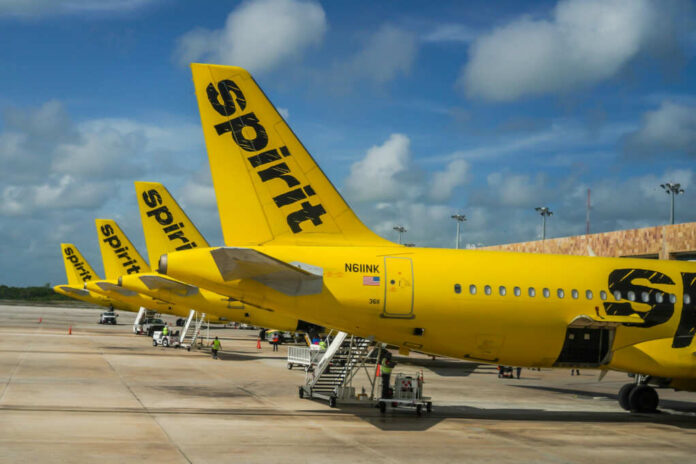
Spirit Airlines teeters on the brink of liquidation as soaring fuel costs and crippling debt push the ultra-low-cost carrier toward an imminent collapse that could strand thousands of travelers and trigger industry-wide fare hikes.
Story Snapshot
- Bloomberg and CNBC report Spirit Airlines faces potential shutdown within days due to fuel price surges and cash depletion during its second bankruptcy in under two years
- The carrier burned $90 million in cash during September 2025 with a catastrophic -52% operating margin, leaving reserves critically low at approximately $250 million
- Competitor airlines are preparing contingency plans to absorb Spirit’s routes, anticipating 10-15% fare increases across the industry if the budget carrier collapses
- Spirit’s $1.1 billion in senior debt due in 2025 and $1 billion in convertible bonds maturing in 2026 create an insurmountable financial wall for the struggling airline
Repeated Bankruptcy Signals Terminal Crisis
Spirit Airlines entered its second Chapter 11 bankruptcy proceeding in late August 2025, just months after emerging from its first filing in March 2025. The rapid return to bankruptcy protection reveals fundamental flaws in the carrier’s restructuring efforts, which included a $795 million debt-to-equity swap and $350 million in new equity. Despite aggressive cost-cutting measures—furloughing 330 pilots, demoting 140 employees, and deferring aircraft deliveries—the airline’s operating margins remained catastrophically negative, reaching -18.1% in the second quarter of 2025 before plummeting to -52% by September.
Fuel Costs Deliver Knockout Blow
Skyrocketing jet fuel prices in early 2026 have accelerated Spirit’s descent toward potential liquidation, according to unnamed sources cited by Bloomberg and CNBC. The airline’s business model, built on razor-thin margins and ultra-low fares, cannot withstand the dual pressures of elevated fuel costs and declining leisure travel demand. Spirit’s liquidity collapsed 53% to $407.5 million by the second quarter of 2025, with analysts projecting a $600 million cash deficit. The carrier’s non-denial response to collapse rumors—”We don’t comment on market rumors and speculation”—has done little to reassure passengers or investors about its viability.
EUROPE: 6 WEEKS LEFT OF JET FUEL
FLIGHT CANCELLATIONS LOOM
LUFTHANSA TO CUT CAPACITY
SPIRIT CRUSHED; RISKS IMMINENT COLLAPSE— Citizen Watch Live (@Citizenwatchrep) April 17, 2026
Failed Business Model Overhaul
Spirit’s desperate attempts to salvage profitability through business model transformation have backfired spectacularly. The carrier abandoned its pure ultra-low-cost approach by introducing first-class seating and bundled fares, hoping to attract higher-paying customers. However, these changes alienated Spirit’s core budget-conscious customer base while failing to generate sufficient revenue to offset mounting losses. Revenue per available seat mile plunged 20% in the second quarter of 2025, while capacity dropped 11.8% by September as the airline slashed routes and renegotiated employee contracts. The strategic pivot represents a cautionary tale about abandoning proven competitive advantages during financial distress.
Industry Prepares for Fallout
Competitor airlines are actively preparing contingency plans to backfill Spirit’s routes, anticipating the carrier’s shutdown could occur as early as this week. Industry sources indicate legacy carriers view Spirit’s potential collapse as an opportunity to reduce price competition and capture market share, particularly on routes where Spirit provided the only low-cost option. Analysts predict fare increases of 10-15% across affected markets, disproportionately impacting budget-conscious travelers who relied on Spirit’s rock-bottom prices. The airline’s disappearance would eliminate the “Spirit Effect”—the phenomenon where Spirit’s entry into markets forced competitors to lower fares—potentially costing consumers billions annually in higher ticket prices.
Government Policies Sealed Spirit’s Fate
Federal antitrust regulators bear significant responsibility for Spirit’s precarious position, having blocked merger attempts with both Frontier Airlines and JetBlue Airways that could have provided the financial stability and operational synergies needed for survival. These government interventions, ostensibly protecting competition, may paradoxically result in less consumer choice and higher fares if Spirit liquidates. The regulatory obstruction prevented market-driven consolidation that could have preserved jobs and maintained service to underserved communities. Spirit’s creditors hold $1.1 billion in senior debt and $1 billion in convertible bonds, with equity holders facing near-zero recovery prospects, while bankruptcy court proceedings determine the carrier’s fate amid speculative credit ratings of Caa3 from Moody’s and CC from Fitch.
Sources:
Uh Oh: Spirit Could Collapse Within Days, Report Says – Thrifty Traveler
Spirit Airlines Bankruptcy Imminent: Strategic Alternatives, Liquidity Crisis – AInvest
Spirit Airlines Responds to Competitors Reportedly Preparing for Airline to Collapse – WKRC
Spirit Airlines Warns of Potential Collapse Just Months After Bankruptcy Exit – NTD