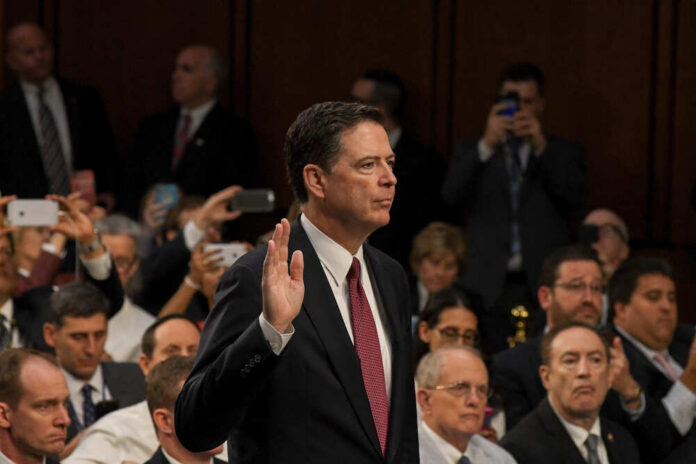
A key federal prosecutor just walked away from the Justice Department’s seashell “86 47” case against James Comey, raising fresh questions about how far Washington should go in policing political speech online.
Story Snapshot
- Lead federal prosecutor Matthew Petracca has been removed from the Justice Department’s case accusing James Comey of threatening President Trump with an “86 47” Instagram post.[1][2]
- The indictment claims Comey’s seashell photo was a coded threat to “get rid of” the 47th president under federal threat statutes.[2][3]
- Legal experts across the spectrum question whether prosecutors can prove a true threat rather than protected political expression.[3]
- The shuffle inside the Justice Department deepens public concern about politicized prosecutions and unequal enforcement of the law.[1]
Lead Prosecutor Steps Aside In High-Profile Seashell Threat Case
Court filings show that Assistant United States Attorney Matthew Petracca, the federal lawyer who presented the grand jury case against former Federal Bureau of Investigation director James Comey, has now been removed as the lead attorney on the prosecution.[1] The documents filed late Friday in federal court ask that Petracca be taken off the case and replaced by prosecutor Timothy Severo, a switch that comes just months before trial. CBS reporting describes Petracca as the prosecutor who originally endorsed the indictment.[1] For many observers, seeing the architect of such a politically explosive case step aside midstream only heightens doubts about how solid the government’s theory really is and whether internal unease is finally bubbling to the surface.
According to the Justice Department’s own press release, a federal grand jury in the Eastern District of North Carolina returned a two-count indictment charging Comey with threatening President Donald Trump’s life and transmitting a threat in interstate commerce.[2] Prosecutors say a May 15, 2025 Instagram post showed seashells arranged to read “86 47,” and that a reasonable viewer who knew the context would see it as a serious expression of intent to harm the President.[2] The government is proceeding under statutes that carry up to ten years in prison, a level of punishment that underscores how aggressively it is treating what began as a single social media image.[2]
How ‘86 47’ Became A Federal Threat Charge Against A Former FBI Director
The entire case turns on the government’s interpretation of the number “86” as slang for “get rid of” combined with “47,” a reference to Trump as the forty-seventh president.[2][3] Merriam-Webster defines “86” as slang for “throw out” or “get rid of,” and notes some emerging use tied to killing, which prosecutors are using to argue the seashell display crossed the line from opinion into threat.[3] Comey’s critics point out that this is not some random internet user but a former Federal Bureau of Investigation leader who knows exactly how coded language can be read in a security context.[2] Supporters counter that the same slang has multiple nonviolent meanings, making it a thin reed on which to hang a felony threat case.[3]
News reports from North Carolina describe how local federal prosecutors and agents initially developed the case before the Justice Department in Washington publicly backed it.[1][3] Acting Attorney General Todd Blanche has rejected claims that the indictment was ordered from the top down for political revenge, insisting that “local prosecutors” and “local agents” brought the matter forward and that he does not even know all of their names.[1] In the official announcement, Blanche framed the prosecution as part of a broader effort to cool down violent rhetoric, warning that anyone who dials up the temperature by threatening the life of the President will be held accountable.[2] That message resonates with many Americans who are tired of violent talk, but it also raises serious First Amendment questions about when edgy or symbolic political speech becomes a federal crime.
Legal Skepticism, Internal DOJ Turmoil, And What It Means For Equal Justice
Legal analysts quoted in national coverage have expressed skepticism that the government can meet the “true threat” standard that the Supreme Court has repeatedly applied to political speech.[3] They point out that the indictment, reportedly only a few pages long, lacks any explicit violent words, weapons references or direct statement of intent to kill the President.[3] The absence of such language forces prosecutors to lean heavily on inference and context, which courts often treat cautiously when speech about public officials is involved.[3] For Trump supporters who watched years of open “86 45” rhetoric under past administrations with little federal response, the sudden criminalization of “86 47” looks less like neutral law enforcement and more like selective outrage.
The Comey case is not happening in a vacuum; it follows earlier indictments that were thrown out after a judge found that a previous Trump lawyer, Lindsey Halligan, had been unlawfully appointed when she took over a prior prosecution effort. Reporting also describes how a senior Justice Department prosecutor was fired after being unwilling to re-prosecute Comey, further fueling the perception that internal resistance to these cases exists and is being punished. At the same time, a separate federal judge recently blocked prosecutors from accessing data from Comey’s former lawyer, calling aspects of the government’s conduct illegal and criticizing how investigators handled privileged material. When Americans see missteps like these stacked on top of a speech-based threat case, trust in the department’s judgment erodes even further.
Free Speech, True Threats, And The Stakes For Political Dissent
Courts have long struggled to draw the line between protected political hyperbole and punishable threats, especially when symbolic or coded language is involved. The Justice Department’s position is that a reasonable person familiar with today’s political climate would see “86 47” from a high-profile Trump critic as a serious call for violence, not just a snarky slogan.[2] Comey insists he and his wife simply found the shells arranged that way on a beach and posted the image without any intent to threaten, denying any desire to harm the President.[3] That defense underscores what many conservatives worry about: a world where intent can be read into almost any post after the fact, depending on who is in power and who is being targeted.
🚨🇺🇸 BREAKING: The lead prosecutor in the James Comey seashells case has withdrawn from the prosecution…
Matthew Petracca, the lone prosecutor assigned to former FBI Director James Comey's case over an Instagram photo of seashells the DOJ claims was a threat against Trump, has… pic.twitter.com/4qSyT9iL9b
— Mario Nawfal (@MarioNawfal) May 30, 2026
For readers who care deeply about the Constitution, this case is a reminder that political winds should never decide what speech is allowed and what speech is criminal. If the government can stretch slang and numbers into a felony threat when it suits its narrative, the same tools can easily be used against ordinary citizens, parents at school boards, gun owners, or anyone who criticizes those in office. As the Comey seashell case moves forward with a new prosecutor at the helm, conservatives will be watching not just what a jury decides about one former official, but what precedent this sets for every American who dares to speak bluntly about politics online.
Sources:
[1] Web – Lead prosecutor leaves DOJ’s case accusing James Comey of threatening …
[2] YouTube – Judge dismisses Comey, James indictments after finding …
[3] Web – Pallone Welcomes Dismissal of Comey and Letitia James Cases …