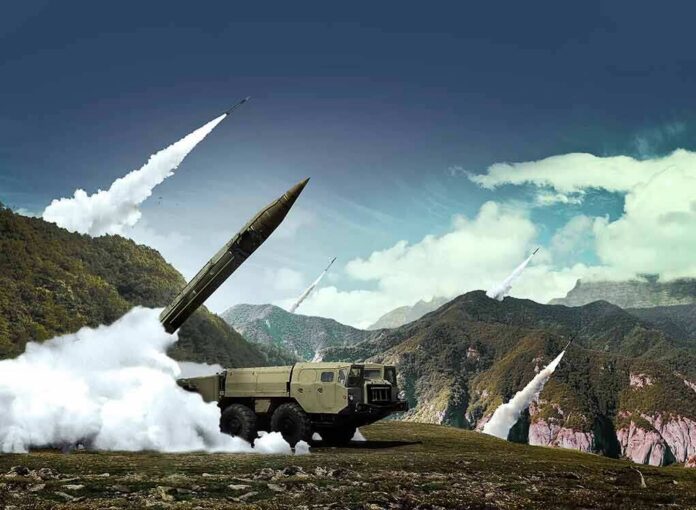
An Army unit assigned to Europe fired a Tomahawk cruise missile from its new Typhon launcher in a live test at China Lake, marking a first for that Europe-focused battalion and a clear signal about long-range reach.
Story Highlights
- An Army Europe–assigned battery launched a Tomahawk from the Typhon system at China Lake.
- The unit is the 3rd Battalion, 12th Field Artillery Regiment under Multi-Domain Command–Europe.
- The test followed about five weeks of joint training with Navy and industry teams.
- The event was a training milestone, not a European-based launch or combat use.
What the Army Did and Where It Happened
Multi-Domain Command–Europe said a Europe-aligned Army unit fired a Tomahawk Land Attack Missile from the Typhon Mid-Range Capability system on September 28, 2026. The live launch took place at Naval Air Weapons Station China Lake in California, not in Europe. The Army described the launch as successful and tied it to the unit’s first Tomahawk firing since activation late last year. Officials later publicized the event in mid-October as part of the battery’s training path and certification steps.
The unit that pulled the trigger was the Mid-Range Capability Battery of the 3rd Battalion, 12th Field Artillery Regiment. The battalion falls under Multi-Domain Command–Europe, which oversees integrated capabilities across cyber, space, intelligence, and long-range fires for the European theater. Reports noted this was the first Tomahawk launch by this Europe-assigned battery, even though prior Typhon launches had occurred in the United States with other units and test teams.
Why This Test Matters for U.S. and European Security
Ground-launched Tomahawk capability offers a mobile, road-deployable strike option across long ranges. Reporting places Tomahawk’s reach above 1,500 kilometers, which covers key distances inside Europe if the system deploys there. That reach, plus Typhon’s ability to employ other missiles, helps fill a gap created after the Intermediate-Range Nuclear Forces Treaty ended, which had once banned ground-launched missiles in this range band during the Cold War.
NATO’s past experience shows that missile deployments can shape politics as much as tactics. In 1979, the alliance paired talks with plans to deploy systems in Europe to counter Soviet missiles, a move that set the stage for the 1987 Intermediate-Range Nuclear Forces Treaty. That treaty later banned entire classes of ground-launched missiles. Today’s tests occur in a different legal setting, but similar debates about deterrence and escalation may follow any future basing decisions.
What Was Proven and What Was Not
The China Lake event proved that this specific Army Europe–assigned battery can prepare, load, and launch a Tomahawk from Typhon. The unit trained for about five weeks with United States Navy personnel and industry field-service representatives before the live fire. That timeline points to close joint coordination and contractor support during early fielding. However, one test does not show endurance under combat pressure, electronic attack, or large-salvo demand, which require more exercises and data to confirm.
The Army and outside reports did not provide the full flight profile, target details, or post-impact assessment. They also did not state a European base location for Typhon or a deployment date. Those limits do not change the fact of the firing, but they do keep the milestone in context: it is a step in training, not proof of a ready force package in Europe. Coverage emphasized that this was the battery’s first Tomahawk launch since its activation in November 2025.
How This Fits Wider Concerns at Home
Defense programs often test far from where they may one day operate. That can look like fanfare without follow-through to many Americans who want clear results for their tax dollars. People on the right worry about waste and mission creep. People on the left worry about escalation and cost tradeoffs. This launch shows progress on a stated goal, but it also highlights the need for plain updates on basing, budgets, and readiness so the public can see value and risk in full.
The Road Ahead for Typhon in the European Theater
Next steps likely include more crew drills, maintenance checks, and command-and-control tests. The Army will need to show that the launcher, missiles, and targeting networks work together under stress. Host-nation arrangements will also matter if the system deploys abroad. Clear communication from the Army and allies can lower confusion, avoid hype, and keep focus on verified milestones. For now, the message is simple: a Europe-assigned battery has fired Tomahawk from Typhon in training on U.S. soil.
Sources:
youtube.com, taskandpurpose.com, armyrecognition.com, dnyuz.com, defence-industry.eu, article.wn.com