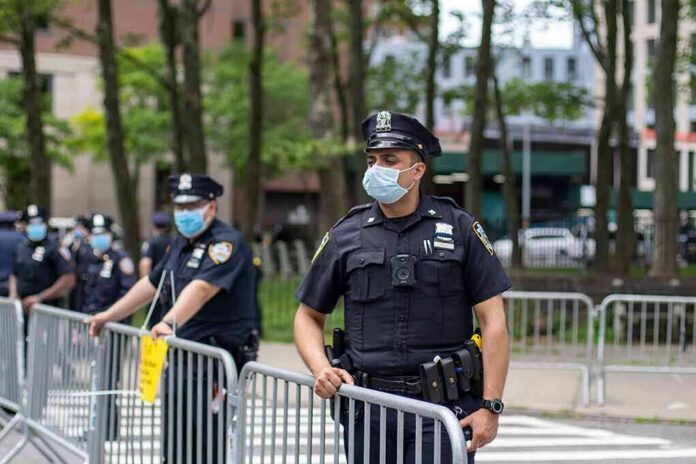
The decisive issue in Seattle was not simply that a police chief left office after a mass-casualty shooting; it was that his absence, the city’s delayed public briefing, and the political need to restore command credibility converged in the same crisis window. That is why Shon Barnes’s departure was framed less as routine personnel churn than as a verdict on leadership under pressure.
Key Points
- Mayor Katie Wilson asked Police Chief Shon Barnes to resign after intense criticism of Seattle’s response to the Bite of Seattle shooting.
- Barnes was out of town at a law-enforcement conference when the shooting happened, and that fact became central to the public debate.
- Seattle’s first detailed public briefing came nearly five hours after the shooting, turning communication delay into a major political liability.
- The controversy was not only about the shooting itself but about visibility, command presence, and whether the chief could credibly lead the department through the aftermath.
What actually triggered the removal
Seattle’s mayor moved after a weekend shooting at the Bite of Seattle food festival that killed three people and injured others, then drew sustained criticism over the city’s response. Barnes was not on scene when gunfire erupted; reporting places him out of town at a law-enforcement conference, while Assistant Chief Tyrone Davis handled the first public briefing. That absence did not matter in a legal sense, but it mattered immediately in the political one: crisis leadership is judged in public by who appears to be in command, not only by who formally holds the title.
What made the episode combustible was the communication lag. Multiple reports say police did not hold a substantive press briefing until nearly five hours after the shooting, even though the public had already been told there had been multiple victims. By then, confusion had filled the vacuum. Wilson later said there were “multiple factors” behind the decision to remove Barnes, and reporting indicates the aftermath of the shooting was a central one. In municipal crisis management, delay is never just delay; it becomes evidence of dysfunction.
Why Barnes’s absence mattered so much
The case against Barnes was not that a police chief must physically stand at every crime scene. It was that, in a mass-casualty event, the chief’s presence is part of the city’s symbolic architecture of control. Seattle’s own reporting shows that Barnes acknowledged he was away at a National Organization of Black Law Enforcement Executives conference in Dallas when the shooting happened. Later, he was pressed publicly about why he was not in the city, and that line of questioning became a flashpoint in its own right. Once a chief becomes the subject of the story, the office itself begins to look unstable.
This is where perception and operations overlap. A department can run an incident through assistant chiefs, command staff, and scheduled protocol; that is normal. But the public does not experience a hierarchy chart. It experiences a press conference, a time gap, a visible absence, and the sense that the city is still assembling its facts while the community is demanding answers. That is why Barnes’s defenders could argue, plausibly, that command was distributed, while his critics could still say the leadership posture looked late, remote, and defensive.
The communication failure became the real political offense
The longest shadow over the episode was not merely Barnes’s travel but the city’s delayed and inconsistent messaging. NBC reported that questions lingered for days over the release of information after the shooting, and AP reporting likewise described criticism of Seattle’s response as the backdrop to Barnes’s resignation. KIRO’s coverage noted that the first public announcement was not posted until hours after the shooting and that the city’s update process was widely questioned. Once that pattern is established, every later explanation is judged against the original silence.
That is the deeper mechanism at work here: after a chaotic public safety event, people infer competence from speed, coherence, and visible command. A five-hour gap, followed by debate over who knew what when, tells the public that the system was reacting more slowly than the event itself. Even if the operational reality is more complicated, the political reality becomes simpler. The mayor has to decide whether the chief is the person who can restore trust or the person who now embodies the trust deficit. Wilson chose the latter reading.
🚨#BreakingNews Chief Shon Barnes Out, Andre Sayles Now Leads SPD
24 hours after rumors swept the Puget Sound of the firing of Seattle Police Chief Sean Barnes, Mayor Katie Wilson announced at 3.30 p.m. On Thursday that she accepted his resignation.
"It has been an honor to… pic.twitter.com/26WOaqNSiw
— Lynnwood Times (@LynnwoodTimes) July 31, 2026
The controversy over race and leadership
Because Barnes is Black, his removal immediately drew support from Black community leaders and civil-rights advocates who saw a broader pattern in how leadership accountability is applied. Community Passageways and allied groups rallied at City Hall, objecting to the dismissal and arguing that Barnes had contributed to department stabilization. That response matters, but it does not erase the underlying management failure the mayor was responding to. The strongest reading of the evidence is that both things are true at once: Barnes had supporters, and the city’s crisis response gave his opponents a powerful case.
Seattle’s reporting also places the controversy inside a familiar American script. In high-profile shootings, the public rarely separates policy, communications, and symbolism cleanly. Instead, the chief becomes the face of the city’s preparedness, even when responsibility is actually shared across the mayor’s office, police command, and incident-management procedures. That dynamic can produce unfairness, but it is not imaginary. It is the price of governing a city through a trauma event under live public scrutiny. Barnes’s removal, then, is best understood as a political judgment about command confidence, not as a clean technical ruling on one officer’s tactical performance.
What this means for Seattle going forward
Wilson’s appointment of interim chief Andre Sayles was meant to stabilize the department quickly and move the conversation away from personality and toward continuity. That is the usual municipal playbook after a leadership rupture: replace the figurehead, reassure the public, and try to separate the investigation from the governance crisis. Whether that works depends on whether the new chief can speak with greater clarity and whether the mayor’s office can avoid the same communication mistakes that damaged Barnes.
The larger lesson is that police leadership in a mass-shooting aftermath is judged in two registers at once. One is operational: how quickly did the department secure the scene, account for suspects, and investigate? The other is political: who was seen, who spoke, who explained, and who looked in control? Barnes lost on the second register first, and in local government that is often enough to end a tenure. The episode is a reminder that in crisis politics, visibility is not cosmetic. It is part of the job.
Sources:
townhall.com, youtube.com, nbcnews.com, abc13.com, abcnews.com, facebook.com, komonews.com, instagram.com, pbs.org