More than 200 Catholic priests have been kidnapped in Nigeria in a decade—and at least four are still missing as entire communities watch faith, safety, and basic order collapse.
Quick Take
- Church reporting says at least 212 Catholic priests were kidnapped in Nigeria from 2015–2025, with four still believed to be in captivity.
- Violence is concentrated in northern and north-central regions where jihadist groups and armed bandits exploit weak security and a thriving ransom economy.
- Local church leaders and protesters accuse authorities of failing to protect rural villages, priests, and displaced families living in IDP camps.
- Numbers vary across reports because some counts include seminarians and some cases remain unverified, but the overall trend is consistent: kidnappings are persistent and escalating.
A decade-long campaign that targets clergy and fractures communities
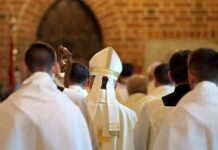
Reports compiled from Nigeria’s Catholic leadership and international church aid groups describe a sustained kidnapping campaign aimed at priests—often taken for ransom, intimidation, or to drive Christians out of contested areas. The most recent accounting says at least 212 priests were abducted from 2015 to 2025, with most eventually released or escaping, but some murdered and others dying after captivity-related trauma. At least four priests were still being held as of the latest 2025 updates.
Targeting clergy hits a community’s “spinal cord” rather than just its perimeter. Priests are public figures with predictable routines, moral authority, and connections to parish networks that can raise funds quickly—making them valuable hostages. Church reporting also describes repeat kidnappings, showing how insecurity becomes normalized when the state cannot consistently prevent abductions or punish perpetrators. In some dioceses, the fear is no longer hypothetical: parishes close, services stop, and local Christians relocate to safer towns.
Who is driving the violence—and why attribution is often murky
Multiple sources point to a mix of actors: Boko Haram, Islamic State West Africa Province (ISWAP), jihadist-aligned Fulani herdsmen, and criminal bandits who operate like insurgents in rural corridors. Some attacks are clearly ideological, while others look primarily financial. The problem for investigators is that many incidents are not publicly claimed, and on-the-ground reporting can be limited by danger and poor access. That uncertainty does not erase the pattern: clergy and Christian civilians remain recurring targets.
In areas where Christians and Muslims live side-by-side, violence has also swept up moderate Muslims, reinforcing that lawlessness—once unleashed—rarely stays “contained” to one group. Still, church leaders argue that Christians face disproportionate pressure, particularly in rural farming zones where land, grazing routes, and political control collide. Researchers and church statements describe kidnappings as both revenue generation and psychological warfare: ransom funds keep armed groups running, while fear pushes families to abandon vulnerable villages.
Protests, warnings, and a public credibility crisis for Nigeria’s security services
Public anger has shown up in demonstrations, including protests in the Auchi diocese calling for security and an end to kidnappings and killings. Catholic leaders have also delivered stark warnings abroad, describing assaults that do not look like random crime but like a systematic pressure campaign. Meanwhile, sporadic rescue operations—such as the reported freeing of dozens of abducted worshippers after church attacks—show that security forces can succeed, even as many communities say those successes are too rare and too late.
Why this matters beyond Nigeria: faith, sovereignty, and the limits of “international concern”
From an American perspective, the Nigeria crisis is a reminder that “global security” debates are not abstract. When governments cannot protect citizens from kidnapping rings and ideological militants, basic liberties disappear first at the local level—freedom of worship, freedom of movement, property rights, and the ability to raise a family without paying protection money. The social cost is severe: displaced people crowd into IDP camps, farms go untended, and a cycle of dependency replaces local self-sufficiency.
Kidnapped Priests and Christian Civilians Still Held by Islamists in Nigeria
READ: https://t.co/MeDvRiOg8V pic.twitter.com/H2t1xqOYr5
— The Gateway Pundit (@gatewaypundit) April 15, 2026
The available reporting also contains limits that should be acknowledged. Some datasets count priests only, while others include seminarians; some incidents have unconfirmed victim totals; and the timeline in public summaries does not always provide abduction dates for those still held. Yet the broad picture is consistent across church sources, watchdog reporting, and academic work: kidnappings and killings are frequent, the incentive structure rewards the abductors, and the failure to impose consequences leaves ordinary families—Christian and Muslim alike—paying the price.
Sources:
Nigeria: A Decade of Terror for Catholic Priests
Theologia Viatorum (printer-friendly article)
Protests over kidnapping and killing of priests, farmers and others in Nigeria
SAGE Journals article (doi:10.1177/20503032241254376)