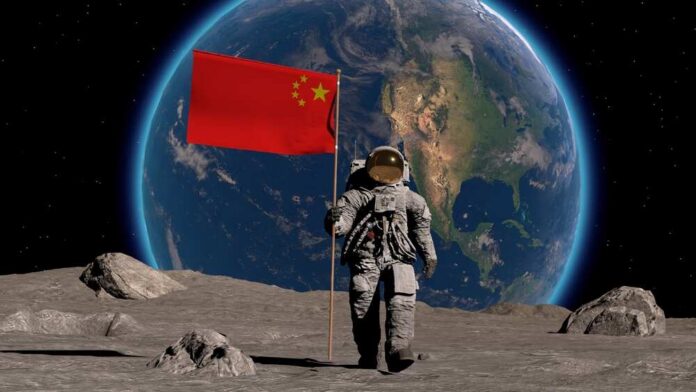
China’s taikonauts could plant their flag on the lunar surface before American astronauts return, reversing 60 years of space dominance in a race that will determine who controls the pathways to Mars and beyond.
Story Snapshot
- China targets 2030 for crewed lunar landing with successfully tested hardware including the Long March 10 rocket and Mengzhou spacecraft, while NASA aims for 2028 despite $90 billion spent and repeated Artemis delays
- The lunar south pole’s billions of tons of water ice represents the strategic prize, providing fuel and oxygen for permanent bases and Mars missions, with China planning its International Lunar Research Station by 2035
- China’s steady progress through robotic missions, including the only far-side landing and sample return, contrasts with NASA’s transparent struggles, though Artemis II’s April 2026 flyby success renewed American momentum
- The winner of this race will likely set the rules for space resource extraction and deep space exploration for decades, making this competition far more consequential than Cold War-era prestige contests
The Hardware Race Heats Up
China completed a critical integration test of its Long March 10 rocket in February 2026, the most powerful launch vehicle the nation has ever built. The China Manned Space Agency verified abort systems for the Mengzhou crew spacecraft shortly after, demonstrating that the two-launch architecture needed to reach the Moon functions as designed. This approach splits the mission between the Mengzhou capsule carrying taikonauts to lunar orbit and the separate Lanyue lander that will ferry them to the surface. NASA has watched these milestones accumulate while wrestling with its own technical challenges on the Space Launch System and Orion capsule.
The Chinese program operates with a clarity that American space efforts once possessed. Officials confirmed in October 2025 and again in early 2026 that the schedule remains intact. Long March 10A’s maiden flight is slated for mid-2026, followed by Mengzhou tests in the second half of the year. Contrast this with Artemis III, which has slipped repeatedly since its original 2024 target date. NASA now realistically aims for 2028, acknowledging the pattern of delays that has plagued the program since its 2017 inception. The $90 billion price tag reflects not just hardware costs but the inefficiencies of shifting goalposts and political pressures that redirect resources away from engineering priorities.
Robotic Scouts Prepare the Battlefield
China’s Chang’e-7 mission launches in August 2026 to survey the lunar south pole’s water ice deposits and test technologies for resource extraction. This robotic scout carries international payloads from Italy and Egypt, expanding China’s coalition while NASA faces restrictions under the Wolf Amendment that prohibit collaboration with Chinese space entities. Chang’e-7 builds on the Chang’e-6 far-side sample return mission of 2024 and the ongoing Yutu-2 rover operations that began with the 2019 Chang’e-4 far-side landing. No other nation has accomplished a far-side landing, giving China unique operational experience in the Moon’s most challenging terrain.
Chang’e-8 follows in 2028 to test resource utilization technologies that will support the International Lunar Research Station. Sun Zezhou of the China Academy of Space Technology has stated these missions will map ice deposits to enable sustainability for long-term habitation. The water ice at the south pole’s permanently shadowed craters represents billions of tons of hydrogen and oxygen that can be split into rocket fuel, eliminating the need to haul propellant from Earth’s gravity well. Whoever masters this ice-to-fuel conversion gains an insurmountable advantage in establishing permanent infrastructure. China’s methodical progression from far-side exploration to resource surveying to extraction testing follows the logic of engineers unencumbered by budget battles and congressional oversight.
America’s Flyby Milestone Changes the Calculus
Artemis II’s successful crewed lunar flyby between April 1 and 11, 2026 marked the first time humans ventured beyond low Earth orbit since Apollo 17 in 1972. The mission validated the Orion spacecraft and Space Launch System in crewed configuration, demonstrating that NASA retains the ability to execute complex deep space operations. China responded by pledging to accelerate its timeline, with officials stating the 2030 landing is “well within reach” if the 2026 milestones succeed. This reaction reveals that American success still provokes Chinese urgency, suggesting the race remains competitive despite the narrative of inevitable Chinese victory.
NASA’s 2028 target for Artemis III requires SpaceX’s Starship to function as the lunar lander, introducing private sector variables into a government program. Starship’s development proceeds independently of Artemis schedules, creating coordination risks but also potential for acceleration if testing succeeds. China’s state-controlled approach eliminates such coordination problems but lacks the innovation pressure that commercial competition provides. The power dynamics favor different advantages: American experience in crewed spaceflight versus Chinese ability to commit resources without annual budget negotiations. Neither side holds a decisive edge, though China’s visible progress on dedicated lunar hardware contrasts with NASA’s dependence on unproven commercial systems.
The Mars Connection Raises the Stakes
China openly links its 2030 lunar landing to a 2033 Mars mission, using the Moon as a testing ground for technologies and procedures required for the Red Planet. The International Lunar Research Station planned for initial construction around 2035 will serve as a proving ground for long-duration habitation, resource extraction, and spacecraft assembly using lunar materials. CNSA head Bian Zhigang has outlined this progression publicly, framing the Moon not as a destination but as infrastructure for deeper space access. This strategic framing elevates the competition beyond flags and footprints to questions of who establishes the norms for off-world resource rights and base construction.
NASA also views the Moon as a Mars rehearsal, but the Artemis Accords governing American partnerships emphasize transparency and international cooperation that China’s ILRS coalition with Russia explicitly rejects. These competing frameworks for space governance will shape how nations extract resources and establish territory beyond Earth. The side that builds functioning infrastructure first gains credibility to argue its approach represents the practical standard. Economic implications ripple through commercial space industries, where fuel depots supplied by lunar ice could reduce launch costs and enable private deep space ventures. Political prestige domestically drives funding for both programs, but the militarization risks inherent in dual-use technologies add security dimensions that Cold War space competition lacked.
Can China Still Win the Second Race to the Moon?https://t.co/zyh8VsWdDX
— PJ Media (@PJMedia_com) April 14, 2026
Lian Jie, deputy chief of the Lijian-2 rocket program, has stated that achieving the 2026 milestones makes the 2030 landing feasible. Independent analysts note that China’s countdown rhetoric backed by visible hardware tests carries more weight than NASA’s shifting timelines. Yet France 24 and other international observers caution that China’s opacity prevents independent verification of claimed progress, while America’s transparent struggles may obscure genuine capability. Both nations face mutual delays, but China’s steady drumbeat of robotic successes positions it credibly for the crewed leap. The U.S. retains edges in crewed spaceflight experience and commercial partnerships that could compress timelines if execution improves. Common sense suggests declaring a winner prematurely ignores the reality that space missions fail until they succeed, and both programs carry technical risks that could reshape the race overnight.
Sources:
US-China space race shifts into a higher lunar gear – Asia Times