While the media gushes over “historic optics,” Vladimir Putin’s dash to Beijing right after Donald Trump’s summit with Xi Jinping is really a test of whether America under Trump can finally outmaneuver a growing Russia‑China axis that flourished during the globalist years.
Story Snapshot
- Putin will visit Beijing May 19‑20, just days after Trump’s high‑stakes summit with Xi Jinping.
- China and Russia are using back‑to‑back visits to showcase their “strategic partnership” and shrug off Western pressure.
- Trump’s agenda focused on trade fairness, Iran, and reining in Beijing’s ambitions, not appeasement.
- Conservatives should watch whether Washington’s foreign‑policy class tries to spin this as failure to justify more globalist deals.
Putin’s Beijing Trip: Timing That Sends a Message
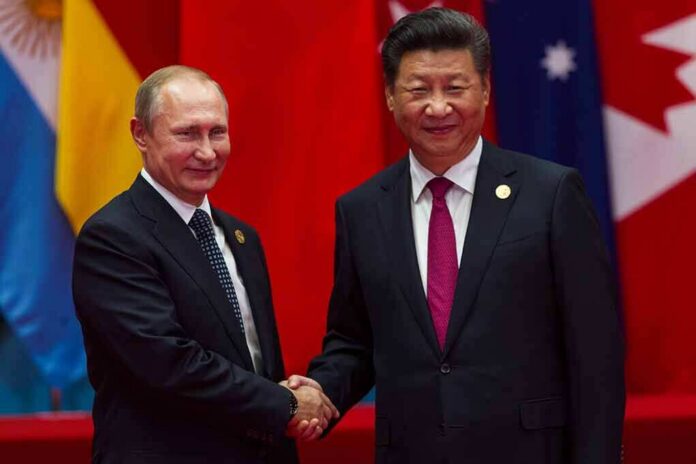
Russian President Vladimir Putin is heading to Beijing for a two‑day state visit on May 19 and 20, just after President Donald Trump concluded his own visit with Chinese leader Xi Jinping in the Chinese capital.[3][6] The Kremlin and multiple news outlets say Putin and Xi will discuss bilateral relations, economic cooperation, and key international and regional issues, with a joint statement and several agreements expected.[3][6] That sequencing is not accidental; Beijing wants the world to see it hosting both rivals back‑to‑back.
Reports describe the visit as a formal state trip at Xi’s invitation, with talks also involving Chinese Premier Li Qiang and a focus on expanding trade and strategic coordination.[5][6] Kremlin readouts and Chinese announcements emphasize “comprehensive partnership and strategic cooperation,” language both sides have repeated for years as they deepen ties amid Western sanctions on Moscow and ongoing U.S.–China tensions.[5][4][6] While officials avoid calling it a full military alliance, they clearly intend to showcase political alignment and economic resilience.
How Beijing and Moscow Are Framing Their Partnership
Chinese and Russian officials have spent years describing their relationship as a long‑term strategic partnership, reinforcing it with frequent leader‑level visits.[4] Xi Jinping traveled to Russia in 2023 and again in 2025, while Putin has made China his priority destination after key domestic milestones, including his 2024 inauguration and now this 2026 visit.[4][5] This pattern sends a clear diplomatic message: both regimes see each other as central partners in challenging the Western‑led order, even if they stop short of a formal defense pact.
Putin’s current trip also coincides with anniversaries that Beijing and Moscow are eager to exploit symbolically. Previous visits have been timed to milestones such as the seventy‑fifth anniversary of diplomatic relations and major World War Two commemorations.[4][6] This year, officials again highlight historical friendship and “no‑limits” cooperation, portraying their partnership as stable and inevitable. That narrative is aimed not just at domestic audiences but at countries in Asia, Africa, and the Middle East that are weighing whether to lean toward Washington or Beijing’s orbit.
Where Trump’s Agenda Diverges from the Old Globalist Playbook
Trump’s just‑completed summit with Xi focused heavily on trade, the war in Iran, and unresolved geopolitical tensions, including the fallout from Russia’s conflict in Ukraine.[1][6] Unlike prior administrations that treated engagement with Beijing as an excuse for endless concessions, Trump’s team has pushed for fairer trade terms, onshoring critical supply chains, and a stronger stance on Chinese military and technological expansion. That posture clashes directly with the old bipartisan establishment that tolerated outsourcing, intellectual‑property theft, and dependency on communist China.
Media coverage from legacy outlets is already trying to cast Putin’s follow‑on visit as proof that Trump is “losing” Asia to a unified Russia‑China bloc. Yet the underlying facts show something different: Moscow’s trip was announced in advance, framed as routine bilateral cooperation, and structured around broad diplomatic themes rather than an explicit anti‑U.S. manifesto.[6] What alarms the foreign‑policy class is not a sudden shift, but that Trump refuses to bless their managed‑decline strategy built on cheap Chinese goods, weak borders, and endless wars.
What Conservatives Should Watch For as the Dust Settles
For constitutional conservatives at home, the real question is whether Washington’s permanent bureaucracy uses the optics of this Moscow–Beijing show to push dangerous “solutions.” That could mean new multinational economic schemes that undercut American jobs, expanded security commitments that drag our troops into fresh entanglements, or surveillance powers justified in the name of competing with autocracies abroad. None of those fix the core problems voters care about: illegal immigration, inflation, and attacks on traditional values here at home.
At the invitation of Chinese President Xi Jinping, Russian President Vladimir Putin will pay a state visit to China from May 19 to 20, a Chinese foreign ministry spokesperson announced on Saturday. pic.twitter.com/35FZChnqqk
— Consulate General of PR.China in Manchester (@ConsulateChnMan) May 18, 2026
Putin’s China trip days after Trump’s summit proves that great‑power politics is very much alive, but it does not erase American leverage. With energy independence, secure borders, and a government that serves citizens rather than global institutions, the United States still holds the strongest hand. The task now is holding Trump’s own appointees and the wider federal bureaucracy accountable so that foreign‑policy decisions support sovereignty, prosperity, and peace instead of reviving the failed globalist consensus.
Sources:
[1] YouTube – BREAKING: Putin to visit China days after Trump visit
[3] Web – Days after Trump’s summit in Beijing, Putin will meet with China’s Xi
[4] Web – 2024 visit by Vladimir Putin to China – Wikipedia
[5] Web – State visit to China – President of Russia
[6] Web – Russian President Putin to visit China days after Trump’s trip – CNA