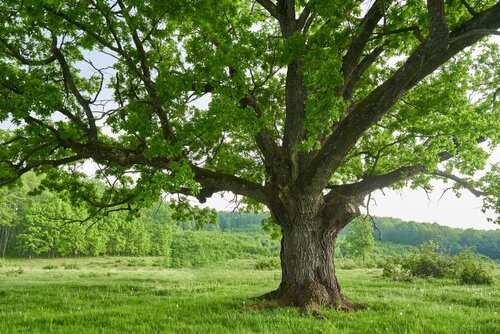
Oak trees have evolved a remarkable defensive strategy that challenges our understanding of plant intelligence: they deliberately delay spring leaf emergence to starve hungry caterpillars, reducing tree damage by up to 55 percent.
Quick Take
- German researchers discovered oak trees delay leaf emergence by approximately three days following years of heavy caterpillar infestation
- The strategy reduces caterpillar survival rates and tree damage by up to 55%, making it more energy-efficient than chemical defenses
- Caterpillars cannot adapt to this variable, context-dependent defense because the timing changes year to year based on actual infestation pressure
- The finding demonstrates natural adaptive capacity to environmental stress and offers insights into forest resilience amid climate change
Nature’s Timing: How Oak Trees Outsmart Caterpillars
Scientists at the University of Würzburg conducted a multi-year satellite analysis of German oak forests and identified a sophisticated survival mechanism. Oak trees respond to heavy caterpillar infestation by delaying their spring leaf emergence in subsequent years. When caterpillars hatch expecting tender young leaves, they find nothing to eat and starve before reaching maturity. This three-day delay, though seemingly modest, creates a critical mismatch between insect emergence and food availability, reducing damage substantially.
Why Delay Works Better Than Chemical Defense
Lead researcher Soumen Mallick explained the evolutionary advantage: “The delaying tactic is more effective for the oak than a chemical defense, such as bitter tannins in the leaves. This is because the tree would have to expend a great deal of energy to increase tannin production.” Oak trees face a fundamental trade-off between defense and growth. Producing more defensive chemicals drains resources needed for expansion and reproduction. The temporal avoidance strategy achieves protection while minimizing energy expenditure, representing an elegant evolutionary solution to a recurring threat.
A Defense Caterpillars Cannot Crack
Co-senior author Andreas Prinzing highlighted the brilliance of this approach: “As the trees only sprout later following an actual infestation, the insects cannot adapt permanently.” Unlike fixed chemical defenses that insects can evolve resistance to over generations, the phenological delay is variable and context-dependent. Caterpillars cannot evolve a consistently earlier hatching time because the oak’s response changes based on actual pressure. This adaptive flexibility gives trees a permanent advantage in the ongoing evolutionary arms race with herbivores.
Climate Change and the Coevolutionary Challenge
The research gains significance against the backdrop of climate disruption. Rising global temperatures have pushed spring forward, causing oak trees to leaf out earlier. However, caterpillar hatching times have not shifted in sync, creating a phenological mismatch that occasionally favors trees. Yet this advantage may not persist indefinitely. If warming continues accelerating, caterpillars may eventually evolve earlier emergence times, forcing oaks to develop new defensive strategies. The study reveals nature’s adaptive capacity but also highlights the precarious balance climate change threatens.
Implications for Forest Management and Natural Systems
These findings suggest that natural regulatory mechanisms may be more effective and cost-efficient than chemical pest management interventions. Forest managers could potentially reduce reliance on synthetic pesticides by understanding and supporting these innate defenses. The research validates decades of ecological theory about plant-herbivore coevolution and demonstrates that ecosystems possess resilience mechanisms we are only beginning to understand. For communities dependent on forest health and productivity, this represents hope that nature retains adaptive capacity even under stress.
Oak trees are delaying spring to starve caterpillars
Oak trees have a surprising trick to fight back against hungry caterpillars: they simply wait. When trees are heavily attacked one year, they delay leaf growth by just three days the next spring—long enough to leave newly…
— The Something Guy 🇿🇦 (@thesomethingguy) May 6, 2026
The oak tree’s ability to “remember” previous infestations and adjust its phenology accordingly reveals complexity in plant biology that challenges conventional assumptions about plant cognition and adaptation. While the mechanism remains incompletely understood—whether epigenetic changes, persistent chemical signals, or genetic variation drives the response—the practical effectiveness is undeniable. As human-induced climate change accelerates environmental disruption, understanding how natural systems self-regulate becomes increasingly valuable for both ecological science and practical conservation.
Sources:
Study finds oak trees delay leaves to outwit hungry caterpillars
Keep Your Distance: These Fuzzy Caterpillars