A deadly virus is tearing through rebel-held forests in Congo, and the real question is not whether authorities are responding, but whether their race against guns, rumors, and time can possibly be enough.
Story Snapshot
- Ebola Bundibugyo has triggered an international public health emergency with no approved vaccine on the shelf.
- Congo’s government and global agencies are trying to run a modern outbreak response through areas controlled by armed groups.
- Contact tracing and treatment centers exist on paper and in some towns, but security and mistrust punch holes in the safety net.
- The outcome will test whether high-tech health systems can function where the rule of law barely exists.
How a Remote Death Became a Global Alarm
The latest Ebola emergency did not start with sirens but with a quiet funeral in northeast Congo. Health officials now link a death on April 20 to a later super‑spreader event on May 5, when mourners gathered in a remote, insecure village where malaria is common and Ebola was not suspected.[7] Early tests missed the culprit because they were tuned to a different Ebola species. By the time Bundibugyo virus showed up on lab screens, chains of infection were already snaking toward larger towns and across rebel lines.[7][1]
When the Ministry of Health finally declared an outbreak in Ituri Province, the World Health Organization (WHO) Director‑General escalated it to a Public Health Emergency of International Concern.[1] That label is not just bureaucratic jargon; it pulls a global fire alarm. Money, logisticians, and disease trackers start moving. Yet they land in a place where roads can be ambushed, clinics burned, and health workers shot at. WHO’s own previous response plan for eastern Congo flatly states that insecurity and community resistance are the two primary barriers to reaching patients.[3]
The Playbook: Eight Pillars Versus A Thousand Problems
On paper, the response looks formidable. WHO’s outbreak framework in eastern Congo rests on pillars: surveillance, case management, vaccination where possible, risk communication, safe burials, logistics, coordination, and security support.[3] During earlier Ebola waves, vaccination campaigns launched within two weeks of declaration, and experimental therapeutics became available under special emergency protocols, giving doctors tools that barely existed during the West Africa crisis.[3][5] That history matters, because it proves the system can move quickly, even in a place the world too often writes off as ungovernable.
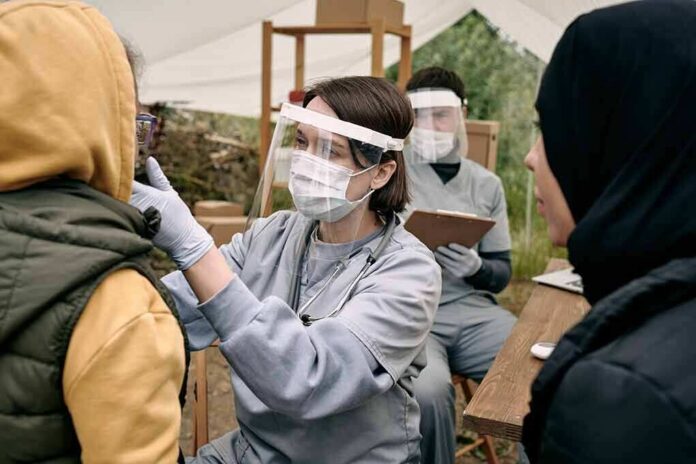
The Bundibugyo strain changes the equation. No licensed vaccine or specific treatment exists for this virus yet.[1][7] That means authorities must lean on the unglamorous basics: isolate patients fast, track every contact for 21 days, protect nurses and burial teams, and persuade families to cooperate. WHO reports that health authorities in Congo and neighboring Uganda have activated emergency coordination cells, boosted lab testing, and set up specialized treatment units near outbreak hotspots.[1][4] The technical architecture is there; the problem is getting it through the last mile of fear, rumor, and gunfire.
Rebel Roads, Weak Borders, and Uneven Protection
Rebel‑held territory in eastern Congo turns a standard outbreak into a three‑dimensional chess match. Armed groups tax road traffic, control some mining areas, and sometimes see health convoys as either targets or leverage. WHO acknowledges that contact tracing is brutally uneven: while South and North Kivu can reach high coverage, Bunia has managed only about 11 percent of contacts, largely because security teams cannot safely reach whole neighborhoods.[7] A virus only needs those gaps; every untraced contact is a walking roll of the dice.
The same patchwork shows up in infrastructure. In Goma, officials are renovating a former COVID‑19 facility, planning 120 Ebola beds with power already on and water being connected.[1] That is tangible progress, not spin. Yet “in the coming days” is a dangerous phrase with a hemorrhagic virus measured in hours and days, not quarters and years. Conservative common sense says announced plans are not protection until doors are open, staff show up for their night shifts, and supplies keep crossing those shaky roads.
Trust, Rumors, and the Politics of Outbreaks
Viruses exploit biology; outbreaks exploit human weakness. Doctors on the ground report that some residents believe prior exposure to another Ebola species makes them immune, while others see treatment centers as places people go to die.[7] Humanitarian organizations like Doctors Without Borders describe a region where repeated Ebola waves since 2018 have never fully erased structural vulnerabilities.[5] When families hide the sick or conduct secret burials, they are not defying science in the abstract; they are responding to years of conflict, broken promises, and outsiders passing through with clipboards.
The Democratic Republic of Congo, Uganda and South Sudan co-ordinate their response to the Ebola outbreak as the number of suspected cases in the DRC surpasses 900. 🎧 #GlobalNewsPod https://t.co/7ufYK4jghW
— BBC World Service (@bbcworldservice) May 25, 2026
Global agencies sometimes underestimate how fast trust can be lost and how slowly it returns. WHO has deployed dozens of experts within days, and laboratory capacity built during previous outbreaks now extends to many sites.[3][7] Yet no surge team can instantly fix the deeper problem: many communities do not trust the state, the rebels, or the foreigners. That fog of suspicion lets conspiracy theories travel faster than official messages, and in that fog, people die who might have lived with earlier care.
What Success Would Really Look Like
Assessing this response demands more than counting press conferences. Authorities and partners have clearly stepped up: emergency cells activated, treatment centers readied, cross‑border coordination with Uganda and South Sudan underway, and travel screening in larger hubs.[1][4] These are the markers of a serious operation, not indifference. From a conservative, reality‑based lens, governments should be expected to do exactly this when a lethal virus threatens to spill across borders.
The uncomfortable truth is that even a serious operation can still fall short in territory where the rule of law is contested and basic medical tools are missing. No approved Bundibugyo vaccine, patchy contact tracing, and recurring violence create a ceiling on what any response can achieve.[1][7] The real test in the coming months will not be the number of coordination meetings held, but whether time‑to‑isolation shortens, unsafe burials shrink, and new clusters stop appearing in places that today feel very far away, but could tomorrow be one flight away from everyone else.
Sources:
[1] YouTube – Aid agencies step in as Ebola case confirmed in rebel-hit …
[3] Web – [PDF] WHO’s response to the 2018–2019 Ebola outbreak in North Kivu …
[4] Web – Ebola outbreak tests conflict-hit eastern DR Congo as cases reach …
[5] Web – DRC Ebola outbreaks | MSF medical response
[7] YouTube – Ebola Confirmed in Dr Congo’s M23 Rebel-held Goma City