
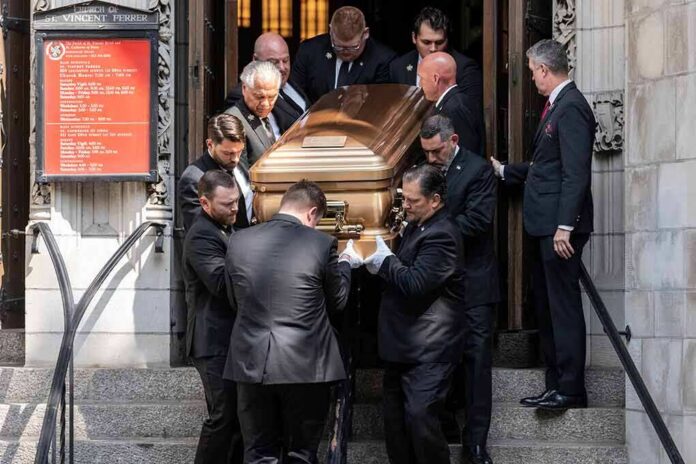
World leaders and royal families filled Oslo Cathedral as Norway honored King Harald V with a full state funeral that doubled as a quiet summit of global power and tradition.
Story Highlights
- Norway held a state funeral for King Harald V at Oslo Cathedral.
- The Royal House said visiting royals, heads of state, and prime ministers would attend.
- Crowds lined Oslo’s streets as foreign dignitaries paid their respects.
- The event mixed national mourning with high-level diplomatic symbolism.
State Funeral Draws Royals and Leaders to Oslo Cathedral
Norway laid King Harald V to rest in a state funeral at Oslo Cathedral, completing days of formal mourning and processions in the capital. The Royal House announced that the service would bring together family, visiting royals, heads of state, prime ministers, and representatives of Norway’s key institutions, underscoring the ceremony’s national and international weight. The setting placed grief and protocol side by side. It also put Norway at the center of a rare gathering that blended tradition, diplomacy, and public remembrance.
Attendance reflected deep ties across Europe and beyond. Reporting listed Britain’s Prince William and Princess Anne, Japan’s Crown Prince Akishino and Crown Princess Kiko, Spain’s King Felipe, Queen Letizia, and Queen Sofia, Sweden’s royal family, and Denmark’s King Frederik and Queen Mary among the guests. The mix of reigning monarchs, heirs, and senior royals showed how state funerals serve as both personal farewells and public markers of alliance and respect.
Protocol, Procession, and the Public’s Role
The Royal House’s guidance framed the day in clear protocol terms. It specified that official Norway would attend alongside visiting heads of state and foreign royal families, with the President of the Storting, the Prime Minister, and the Chief Justice among those representing national institutions. That structure is typical of state funerals, which follow a known rhythm of lying in state, procession, and religious service that balances ceremony with security and public access. The approach aims to honor a monarch while keeping focus on national unity.
Crowds gathered along the route as the coffin moved between palace and cathedral on earlier days, and mourners continued to pay respects in the capital. Local coverage described flowers, flags, and steady lines of citizens outside the Royal Palace during the mourning period. The images matched a familiar pattern seen at royal funerals across Europe: visible grief, careful staging, and a guest list that signals both history and current ties. For many Norwegians, the moment was both civic and personal.
Why Attendance Matters Beyond Ceremony
Foreign delegations often use royal funerals to show continuity in relations without the glare of formal summits. The presence of multiple European royal houses and senior figures from Asia illustrated how these events can serve as soft diplomacy in plain sight. The Royal House’s emphasis on heads of state, prime ministers, and official institutions confirmed that the funeral was both a family farewell and a state occasion with global attention built into its design. That blend is common, but each nation’s ceremony carries its own meaning.
For Norway, the choreography honored a monarch widely seen as a steady figure across decades. International turnout suggested respect for that record and for Norway’s role in Europe’s political and security landscape. While the service remained solemn, the guest list itself communicated status, trust, and shared interests. Coverage stressed who attended because that is how these rare events often tell their wider story to the world. The formality did not hide the message; it delivered it.
A Moment of Unity in a Distracted World
In a time when many citizens doubt powerful institutions, this funeral offered a brief counterpoint. The protocol was transparent. The plan was public. The leaders showed up. The event focused on service, duty, and a nation’s identity rather than on partisan fights or spin. The Royal House’s clear categories for attendance, and visible roles for Norway’s elected leaders and courts, pointed to a civic order larger than any one person or party. That is part of why these ceremonies still resonate.
Thousands of people gathered in Oslo today to say last goodbye to King Harald V. Estonian President @AlarKaris was among those attending the dignified and moving funeral ceremony.
📷 Stortinget, Statsministerens kontor pic.twitter.com/XBKu2CUQ7Q— Estonian Embassy in Norway (@EstembassyOslo) September 9, 2026
Yet the day did not ignore real-world stakes. Security was tight. Schedules were precise. Public access remained central, even as high-level guests moved through the city. Those choices reflect how open societies try to balance respect, safety, and accountability. Norway’s send-off for King Harald V showed that balance. It told citizens that traditions can still hold, that institutions can still rise to the moment, and that the world still pays attention when a country puts duty first.