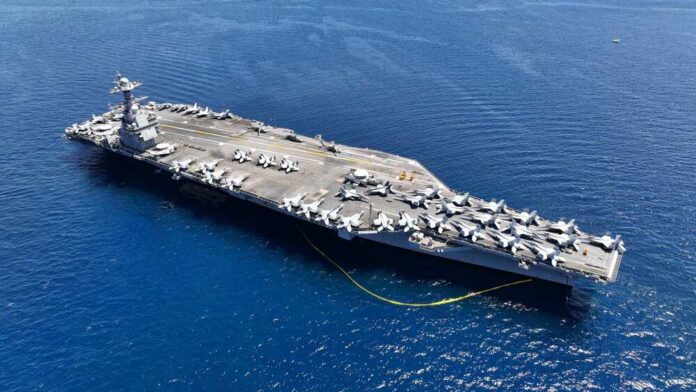
A $13 billion supercarrier designed to dominate the seas is plagued by sewage leaks and catapult failures, exposing taxpayers to elite mismanagement in defense spending.
Story Highlights
- USS Gerald R. Ford (CVN-78) ditches proven Nimitz-class steam systems for risky innovations like EMALS catapults and cruise-ship vacuum sewage, causing repeated breakdowns.
- Early trials revealed EMALS failing after just 181 launches versus designed 4,166, and sewage clogs requiring 19-hour crew repairs during intense ops.
- Despite $13B cost, the carrier deployed in 2026 Caribbean drug interdiction, but ongoing issues strain sailors and question readiness against China and Russia.
- Sailors praise EMALS precision for drones, yet critics highlight rushed tech echoing past naval overambitions, fueling bipartisan frustration with government waste.
- Long-term promise of 25% more sorties and doubled power remains unproven, underscoring deep state priorities over reliable national defense.
Revolutionary Design Breaks from Naval Tradition
U.S. Navy commissioned USS Gerald R. Ford on July 22, 2017, as the lead Ford-class ship succeeding Nimitz-class carriers. Builders at HII’s Newport News Shipbuilding introduced electromagnetic aircraft launch system (EMALS), advanced arresting gear (AAG), relocated command island, smaller reactors, and vacuum sewage systems. These changes aimed to boost sortie rates by 25 percent, enable drone operations, and cut crew needs through automation. The 100,000-ton nuclear-powered vessel, homeported in Norfolk, Virginia, represents the world’s largest warship. Post-9/11 demands for power projection justified the $13 billion investment. Yet, this departure from steam catapults and manual systems invites scrutiny over untested civilian-inspired tech in combat environments.
Early Trials Expose Critical Reliability Failures
Sea trials from 2016 to 2017 uncovered severe flaws. EMALS catapults, meant for 4,166 launches between failures, broke down after only 181 cycles, far below expectations. Sewage systems, borrowed from cruise ships, clogged repeatedly under warship stresses, forcing sailors into 19-hour repair shifts. Weapons elevators lagged, with GAO reports in 2020 noting persistent issues. These teething problems delayed full combat readiness, as DoD assessments in 2021 confirmed EMALS required off-ship support. Crews reported vacuum plumbing inadequate for 4,600 sailors, averaging daily maintenance calls during 2025 deployments. Such failures contrast sharply with reliable Nimitz designs refined over decades.
Stakeholders Bear Burdens of Innovation Push
U.S. Navy operators seek enhanced strike power through 24,000-pound elevators, doubling Nimitz capacity for heavier loads and drones. HII, the sole nuclear carrier builder, advances next-gen tech to secure contracts. Sailors in Carrier Air Wing 8 appreciate EMALS smoothness for lighter aircraft and 155 mph launches with reduced stress, yet endure repair burdens. Congress and DoD fund the program to counter China’s growing carrier fleet. Taxpayers foot the bill amid concerns over rushed deployment. Navy leadership, via Southern Command, directs ops like the January 19, 2026, Caribbean transit for drug interdiction, proving partial readiness despite fixes.
Expert Views Balance Promise Against Risks
Analyst Rebecca Grant praises EMALS precision, noting sailors’ enthusiasm and deck optimizations from the relocated island. Ford’s reactors provide twice Nimitz electrical power for future radars and weapons, prioritizing drone threats. Critics argue civilian sewage mismatches warship demands, with clogs costing $400,000 per chemical clean per GAO. Diverse opinions frame Ford as a game-changer for efficiency yet rushed like early Forrestal innovations. Recent 2026 operations suggest resolutions, but long-term reliability stays unproven. Bipartisan unease grows over elite decisions favoring hype over sailor safety and fiscal prudence.
Forget the History Books: The USS Gerald R. Ford Aircraft Carrier Is Breaking All the Ruleshttps://t.co/9IDWb74WI8
— 19FortyFive (@19_forty_five) April 22, 2026
Implications for Taxpayers and National Security
Short-term woes delay capabilities, straining 4,000 sailors with repair demands and exposing vulnerabilities. Long-term, higher sorties and UAV versatility could reshape naval aviation against rivals. Norfolk shipyards gain jobs, but $13B costs fuel frustration with government overspending. In Trump’s 2026 second term, with GOP congressional control, scrutiny intensifies on DoD priorities amid Democrat obstruction. Both conservatives decrying waste and liberals questioning inequality see deep state failures eroding American strength. Ford’s path underscores need for proven systems safeguarding liberty and sovereignty.
Sources:
https://www.slashgear.com/1628449/innovative-aircraft-carriers-led-to-uss-gerald-r-ford/
https://www.fordlibrarymuseum.gov/exhibits/taking-seas-rise-american-aircraft-carrier
https://hii.com/what-we-do/capabilities/aircraft-carriers/