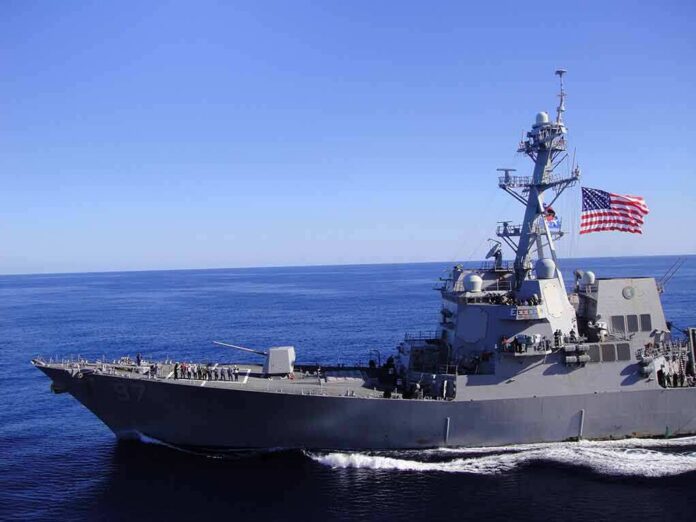
The U.S. military says it has redirected 100 commercial ships in two months to enforce a blockade on Iran, a show of force with global economic stakes and sharp legal debate.
Story Snapshot
- U.S. Central Command reported 100 ship redirections under a maritime blockade of Iran.
- Officials frame the action as lawful enforcement tied to Iran’s moves around Hormuz.
- Iran and some commentators call the blockade illegal under the United Nations Charter.
- Energy markets and supply chains face renewed risk as traffic skirts Iranian ports.
What CENTCOM Says It Did and Why It Matters
U.S. Central Command said forces reached a milestone by redirecting 100 commercial vessels while enforcing a blockade against Iran, marking an aggressive phase in Gulf maritime control. The command’s public updates describe ship redirections and limited interdictions aimed at cutting revenue streams tied to Iranian ports. The scale signals a shift from escorting tankers to shaping routes away from Iran. That operational turn raises costs, extends voyages, and pushes pressure onto a chokepoint that moves a large share of the world’s oil.
Analysts link the U.S. push to Iran’s earlier efforts to close or constrain the Strait of Hormuz, which hit global energy flows and spiked prices. International law experts note that closing an international strait breaches core transit rights, while blockade law permits severe steps only under strict rules and in armed conflict contexts. That legal line is now the fight: Washington says it is enforcing compliance; Tehran says it is economic warfare dressed up as patrols.
The Legal Fight: Blockade Rules Versus Transit Rights
Under the law of the sea, ships enjoy transit passage in straits used for international navigation. Under the law of naval warfare, a blockade can be legal only if declared, effective, impartial, proportionate, and respectful of humanitarian needs. Commentators arguing Washington’s case say Iran’s interference with neutral shipping broke these norms, opening room for enforcement steps that steer vessels clear of Iranian control. That argument hinges on portraying U.S. actions as targeted enforcement, not a blanket choke on neutral trade.
Iran rejects that framing. Its officials call the U.S. blockade a gross breach of sovereignty and a violation of Article 2(4) of the United Nations Charter, which bars the threat or use of force against states. Legal critics echo that view, saying a blockade without a United Nations Security Council mandate, or a clear self-defense case, flouts the Charter even if it follows naval warfare manuals. The split leaves shippers and insurers stuck between two readings of the same sea lanes.
Economic Stakes for Families and Firms
Every extra day a tanker spends avoiding Iranian ports adds cost that can show up at the pump and in power bills. Earlier disruptions around Hormuz shook markets that depend on steady oil and gas flows. A redirection campaign of this size can ripple outward: higher freight rates, longer delivery times, and wider insurance spreads. For families already squeezed by prices, that feels like one more bill for a fight among governments that many see as remote and unaccountable.
Business leaders face tough choices. Do they risk transit near contested waters, or reroute and pass along costs? Smaller firms have less room to absorb shocks. When policy fights at sea hit shipping lanes, they often hit working people next. That is why many across the political spectrum now question whether Washington, Tehran, or any “security” bureaucracy is measuring success by public outcomes, not by internal metrics and press releases.
What To Watch Next: Rules, Risks, and Results
Watch whether the United States publishes clearer rules of engagement, humanitarian carve-outs, and neutral shipping protections. Those steps would test compliance with blockade law and could lower insurance costs. Also watch whether Iran scales back threats around the strait. Any easing there would strengthen the U.S. case that redirections are narrow, temporary, and tied to safety, rather than open-ended economic coercion framed as security work. Markets will read those signals fast.
⚡ DECIS ALERT — OCCURRED: US redirects 100 ships during Iran blockade
US Military Redirects 100 Ships During Iran Blockadehttps://t.co/lgSuuRDqbc pic.twitter.com/hde1ZG0m5C
— Decis Intelligence (@decisintel) September 12, 2026
Congressional oversight will also matter. If lawmakers force transparent metrics beyond “ships redirected,” the public can judge whether the campaign protects trade or prolongs risk. The broader lesson is plain: when vital routes turn into legal battlegrounds, families pay first. Clear limits, clear goals, and clear end conditions are the minimum standard the public should demand—because slogans about “security” do not fill gas tanks or lower utility bills.
Sources:
insiderpaper.com, centcom.mil, iranintl.com, arabnews.com, moneycontrol.com, tass.com, thenation.com