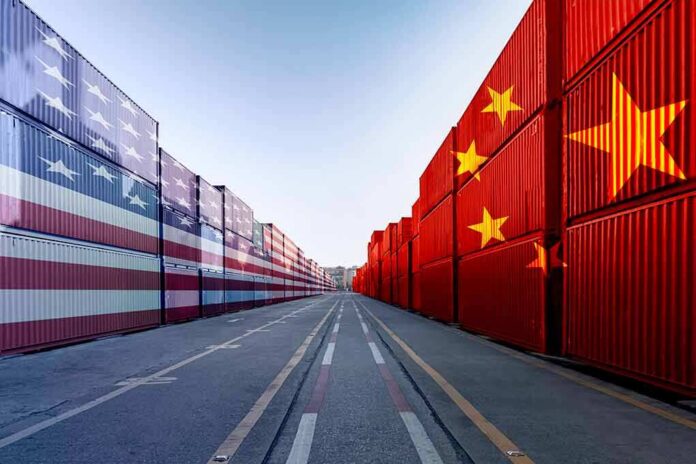
Washington moved to slap targeted new tariffs on China, the European Union, and a dozen other economies, signaling a broader fight over “excess factory capacity” that could raise trade tensions and prices at home.
Story Snapshot
- The U.S. Trade Representative proposed new Section 301 tariffs after formal investigations.
- Rates vary by economy, with up to 20% on some Chinese goods and 15% on European Union goods.
- Officials say structural “excess capacity” is the core problem; China rejects that claim.
- The plan is proposed, not final, and faces a public comment process and likely pushback.
What the administration formally proposed
The Office of the United States Trade Representative (USTR) said it completed Section 301 investigations into structural excess capacity across 16 economies and proposed actions against 14. The agency said the record includes public comments, hearing testimony, and input from advisory groups. Proposed tariff rates differ by economy. The United States outlined up to 20% on covered Chinese goods and 15% on European Union goods, apart from listed exclusions, framing the steps as targeted rather than blanket.
Reuters reporting described the package as part of a global push that reaches allies and partners, including the European Union, Japan, and South Korea. The administration has pointed to negotiated ceilings for several partners, such as an expected 15% cap for the European Union, to present the plan as calibrated and within prior understandings. This structure aims to show discipline while taking a harder line on production surges the United States links to excess capacity abroad.
Why “excess capacity” is the stated target
U.S. officials argue that when countries build far more factory capacity than their markets can absorb, extra output floods into exports and pressures U.S. producers. The new actions focus on that pattern, not just trade deficits, marking a shift in justification compared with past tariff rounds. The USTR notice on China cites a detailed administrative record, including hearing testimony and committee input, as the basis for a determination and request for public comments on the proposed remedies.
Independent reviews have also flagged long-running concerns about overcapacity, especially in sectors like steel and solar. European Parliament research and policy literature have tracked the issue since the mid-2000s, tying persistent overproduction to price pressure in world markets. A World Trade Review article likewise describes China as producing more than it consumes in some industries, which can push exports outward at scale. These studies give context to the policy idea, though they are not the same as case-specific U.S. findings.
How China and others are responding
Chinese officials reject the excess-capacity charge and call it a false issue used for political aims. Beijing argues its exports reflect competitive strengths rather than unfair production practices. Chinese statements also warn that tariff wars do not serve either side and urge dialogue to stabilize trade ties. The available record does not include a direct European Union on-record rebuttal in the supplied sources, though the United States is proposing a lower cap for European Union goods than for China.
The proposed tariff on Chinese goods would sit on top of earlier duties that date back to President Trump’s first term. Reports note that the new up to 20% rate could add to earlier tariffs near 25% on some categories. That stacking could complicate later efforts to judge which policy changed prices, redirected imports, or helped U.S. factories most. The administration will take public comments and may adjust the scope before final decisions.
What it could mean for prices, jobs, and the next steps
Studies of past tariffs find that U.S. firms and consumers often bear much of the cost through higher import prices. A National Bureau of Economic Research paper found that earlier tariff rounds were passed through largely to U.S. buyers. A New York Federal Reserve analysis reached a similar conclusion for the 2025 tariffs, estimating that nearly 90% of the burden fell on American firms and consumers. These findings matter as the United States weighs another round of duties.
The USTR process still has several steps. The agency requested public comments and will face legal and diplomatic pushback, especially because treaty allies are included alongside China. Supporters will welcome a tougher stand on subsidized output and factory gluts. Critics will warn of higher costs for families and smaller manufacturers that buy imported parts. Many Americans across the spectrum will see a familiar pattern: big trade moves rolled out fast, while clear proof of benefits for workers lags behind the headlines.
Sources:
insiderpaper.com, reuters.com, ustr.gov, mlex.com, uscc.gov, europarl.europa.eu, libertystreeteconomics.newyorkfed.org