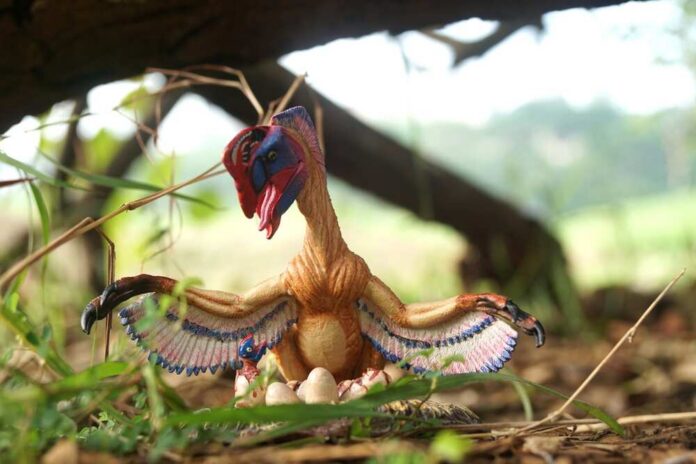
Scientists built a life-sized dinosaur nest from foam and resin to crack a 70-million-year-old mystery that challenges everything we thought we knew about how these ancient creatures raised their young.
Story Snapshot
- Taiwanese researchers constructed a full-scale oviraptor model to test incubation theories, revealing dinosaurs relied on sunlight alongside body heat
- The experiment proved oviraptors couldn’t warm all eggs like modern birds, explaining why fossil nests show staggered hatching patterns
- A high school student co-authored the groundbreaking study, demonstrating how hands-on experimentation beats computer simulations
- Findings challenge evolutionary assumptions about dinosaur parenting and highlight adaptation to environmental conditions over uniform efficiency
Building a Dinosaur From Scratch
Dr. Tzu-Ruei Yang and high school student Chun-Yu Su at Taiwan’s National Museum of Natural Science constructed a 1.5-meter, 20-kilogram oviraptor torso using polystyrene foam, wood, cotton, bubble paper, and fabric. They positioned it over resin eggs arranged in the exact double-ring pattern found in 70-million-year-old fossil nests from China. The team embedded thermometers and heat sources to measure temperature distribution across the clutch. This hands-on approach addressed a critical limitation: computer models couldn’t accurately predict how an oviraptor’s physical body transferred warmth to eggs positioned at varying distances.
The Co-Incubation Discovery
Experiments revealed oviraptors used “co-incubation,” combining adult body heat for inner eggs with environmental warmth from sunlight for outer rings. Temperature differences reached six degrees Celsius in cooler conditions and 0.6 degrees in warmer settings. This proved the dinosaurs couldn’t achieve thermoregulatory contact incubation like modern birds, whose compact nests allow uniform egg warming. Dr. Yang noted oviraptors evolved semi-open nests adapted to Late Cretaceous climates, prioritizing environmental heat over full parental control. The findings explain asynchronous hatching patterns in fossils, where some eggs developed faster than others based on placement.
Challenging Evolutionary Assumptions
The study published in Frontiers in Ecology and Evolution on March 19, 2026, settles debates over whether oviraptors incubated like birds or reptiles. Paleontologists had long puzzled over nest geometry that made complete egg contact impossible, unlike efficient bird brooding. Yang emphasized “nothing is better or worse” in evolutionary terms—adaptation depends on environment, not a linear progression toward modern bird strategies. This contradicts narratives that portray dinosaur-to-bird evolution as straightforward improvement. The research also contrasts with troodontid dinosaurs from 74 million years ago, which used higher body temperatures for full brooding, showing diverse reproductive strategies among ancient species.
Student Achievement and Scientific Innovation
Chun-Yu Su’s involvement as a high school student highlights Taiwan’s commitment to STEM education, even without local dinosaur fossils. Su developed the resin eggs and quantified incubation efficiency as lower than birds, demonstrating how practical experimentation outpaces theoretical modeling. The use of low-cost materials—foam, fabric, and bubble wrap—proves groundbreaking science doesn’t require massive government spending or wasteful grants. This approach opens doors for similar physical reconstructions of extinct species, advancing paleontology through common-sense problem-solving rather than reliance on computer simulations that often miss real-world complexities. The museum-funded project exemplifies efficient resource use, a refreshing contrast to bloated federal research budgets.
https://twitter.com/thesomethingguy/status/2034521974408442204
The study reframes dinosaur parenting evolution by linking nest architecture shifts to environmental reliance rather than inherent superiority. Researchers acknowledged limitations like modern climate differences from the Cretaceous period and estimated incubation periods, maintaining scientific integrity. The findings influence ornithology by contrasting ancient brooding methods with modern birds, offering insights into evolutionary trade-offs. While the research carries no political implications, it underscores how innovation thrives outside bureaucratic constraints—a Taiwanese museum with no dinosaur fossils produced cutting-edge paleontology through creativity and determination, proving local initiative surpasses federal overreach in advancing knowledge.
Sources:
Scientists recreated a dinosaur nest to solve a 70-million-year-old mystery
Scientists Built a Life-Size Dinosaur Nest and the Results Were Surprising