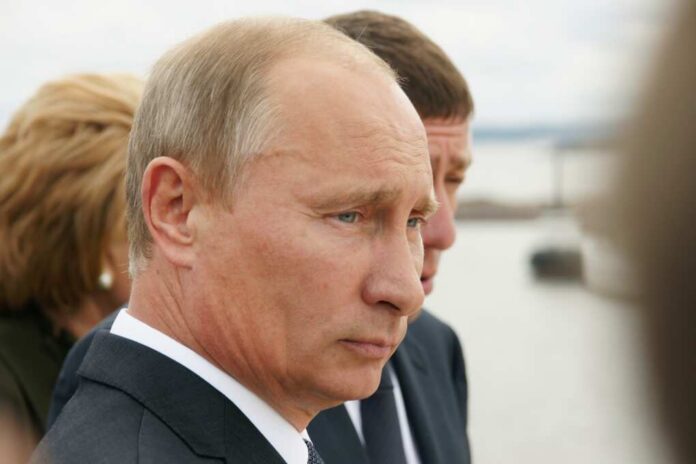
President Putin threatens to cut off Europe’s natural gas supplies early, exposing the self-inflicted vulnerabilities of EU sanctions and globalist energy policies that now risk blackouts and economic chaos amid Middle East war disruptions.
Story Snapshot
- Putin signals premature halt to 38 bcm Russian gas to EU, redirecting to profitable Asian markets ahead of EU’s March 25 restrictions.
- Europe’s gas storage sits below 30% capacity, mirroring 2022 crisis levels, as Iran-US-Israel conflict blocks Strait of Hormuz LNG flows.
- Global LNG shortage of 110 bcm/year from Persian Gulf amplifies threat, with Asian buyers paying $3.40-$6/MMBtu premiums over European prices.
- Putin cites commercial reasons only, blaming EU policies while tanker sinking adds market instability.
Putin’s Direct Threat
Russian President Vladimir Putin stated on March 4, 2026, in Moscow that Russia may stop natural gas supplies to the European Union immediately for commercial gain. He emphasized redirecting volumes to more profitable markets like Asia, where spot LNG prices exceed European TTF hub rates. This preemptive move precedes the EU’s planned restrictions starting March 25, 2026, and full ban by 2027. Putin framed the decision without political subtext, positioning Russia as a reliable supplier mistreated by EU sanctions.
Putin eyes 'more profitable' markets for Russian gas amid Middle East chaos https://t.co/HqVk29efSD
— Jazz Drummer (@jazzdrummer420) March 6, 2026
Europe’s Vulnerable Position
EU gas storage levels hover under 30% capacity in early March 2026, echoing the 2022 Ukraine war crisis. In 2025, the EU imported 38 billion cubic meters (bcm) from Russia, comprising 20 bcm LNG and 18 bcm pipeline via routes like TurkStream to Hungary and Slovakia. Pipeline gas remains harder to divert than LNG, which Russia can reroute north to Asia during spring and summer. Current Russian flows continue at the 2025 baseline, but markets anticipate price spikes.
Middle East Chaos Exacerbates Crisis
An escalating Iran-US-Israel war disrupts the Strait of Hormuz, halting tanker traffic except for Russian and Chinese vessels. This blockade impacts 110 bcm per year of LNG from Qatar, UAE, and others, representing a massive global shortfall. European gas prices have doubled as a result. On March 3, 2026, a Russian LNG tanker sank in the Mediterranean after explosions, which Putin called a terrorist attack worsening Europe’s instability. Asian LNG premiums persist at $3.40-$6/MMBtu over TTF.
Expert Analysis on Market Risks
ING analysts Warren Patterson and Ewa Manthey warn the threat endangers 38 bcm of supply, unmanageable amid the 110 bcm Gulf shortfall. LNG redirection proves logistically feasible via northern routes, creating upside risks for TTF prices and energy stocks. Pipeline supplies to select EU nations like Hungary and Slovakia appear safer. Putin leverages EU diversification failures post-Ukraine war, where sanctions reduced Russian gas from dominant levels.
Putin eyes 'more profitable' markets for Russian gas amid Middle East chaos https://t.co/8RkvXaqMg9
— Automation Workz (@AutomationWorkz) March 6, 2026
Broader Economic and Political Fallout
Short-term impacts include TTF price surges, industrial strains, and higher household heating costs across Europe. Long-term, Russia secures Asian footholds while the EU accelerates diversification amid global tightness. Political tensions rise, highlighting sanction blowback and energy weaponization precedents like 2022 Nord Stream sabotage. EU consumers and industries face doubled bills, with ripple effects to global agriculture like Indian fertilizer cutbacks. As of March 5, 2026, no halts confirmed, but markets price in volatility.
Sources:
Putin’s gas threat to the EU adds to upside risk for markets
Russia may halt EU gas supplies early amid planned sanctions, says Putin
Energy Intel report on Putin’s statement
Putin warns Russia could halt gas supplies to Europe amid Iran crisis
Oil and gas stocks rise amid Iran-Israel tensions