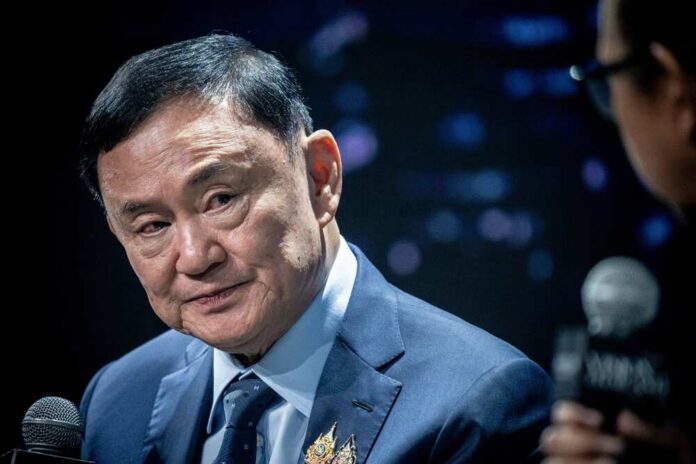
Thailand just let one of its most polarizing political power-brokers walk out of prison early—fueling fresh doubts that the rules apply equally to elites and ordinary citizens.
Story Snapshot
- Thaksin Shinawatra, 76, was released May 11 on parole after serving about eight months of a one-year corruption sentence in Bangkok’s Klong Prem Central Prison.
- Thailand’s Corrections Department cited his age and the short time remaining on his sentence as reasons for parole, with a four-month probation and electronic monitoring.
- His return to public view revives a long-running national divide between Shinawatra-aligned populists and Thailand’s military-royalist establishment.
- The release lands amid recent political setbacks for the Shinawatra family, including the 2025 court removal of Thaksin’s daughter, Paetongtarn, as prime minister.
What happened at the prison gates in Bangkok
Thai authorities released former Prime Minister Thaksin Shinawatra on May 11 after he served roughly eight months of a one-year sentence tied to corruption and abuse-of-power convictions. Reports described Thaksin leaving Klong Prem Central Prison around 7:40 a.m., wearing a plain white shirt and sporting closely cropped hair. Family members greeted him outside, alongside crowds of supporters chanting and gathering to watch the moment that reintroduces him to Thailand’s tense political arena.
Thailand’s Corrections Department pointed to two practical reasons for the parole decision: Thaksin’s age, 76, and the fact that less than a year remained on his sentence. The terms also underscore that this is not a clean slate. Thaksin must wear an electronic monitoring device and remain under probation for four months, a constraint that can limit travel and make overt political activity harder to sustain without triggering backlash.
The long road back: exile, royal pardon, and renewed controversy
Thaksin’s release cannot be separated from the unusual arc that brought him back to Thailand in the first place. After being ousted in a 2006 military coup, he spent 17 years in self-imposed exile and remained a defining figure in Thai politics from afar. When he returned in August 2023, he was sentenced to eight years in prison, but a royal pardon reduced that term to one year, instantly reigniting arguments about privilege.
The controversy deepened when Thaksin spent much of the post-2023 period in a hospital rather than in a prison cell, prompting critics to allege special treatment for a powerful billionaire with deep political connections. In September 2025, Thailand’s Supreme Court ruled that his hospital time did not count toward his prison sentence, and he was transferred to Klong Prem Central Prison to serve the one-year term. That court ruling was supposed to restore credibility; the early parole now reopens the credibility question.
Why this matters: legitimacy, “elite” politics, and public trust
Thailand’s political system—shaped by a monarchy, a powerful military, and an activist judiciary—often leaves citizens feeling that outcomes are negotiated among insiders rather than earned through equal application of the law. Thaksin’s case puts that perception on display. Supporters frame his parole as routine compassion for an elderly prisoner and evidence that the legal process ran its course. Skeptics see a familiar pattern where status and networks shape consequences.
What comes next for Thai politics—and why Americans should pay attention
Thaksin’s release also lands at a sensitive moment for his family’s political brand. His daughter, Paetongtarn Shinawatra, was removed as prime minister by a court order in August 2025, weakening the Shinawatra faction even as it remains a force in parliament. Whether Thaksin tries to steer events publicly or acts as an informal “backroom” influencer, his return to the spotlight can energize loyalists and provoke opponents, raising the risk of renewed street politics.
For American readers—especially those frustrated by government that appears to protect insiders—Thailand offers a cautionary tale. The heart of the dispute is not just left versus right, or populists versus establishment. It is whether institutions can persuade the public that rules apply evenly. The available reporting does not establish new wrongdoing beyond the known legal record, but it clearly shows how quickly trust erodes when high-profile figures receive outcomes many citizens would never expect.
Sources:
Thailand’s former prime minister Thaksin released on parole
Thailand’s ex-PM Thaksin released from prison
Thailand’s former PM Thaksin Shinawatra released from prison