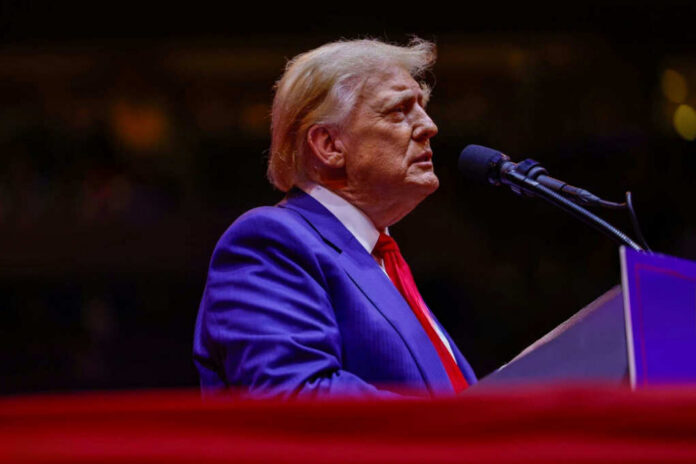
President Trump’s newly launched “Board of Peace” is accomplishing what decades of bureaucratic UN inaction and NATO indecision couldn’t—taking decisive action on conflict resolution while the old guard of globalist institutions scrambles to protect their irrelevance.
Story Highlights
- Trump formally launched the Board of Peace in January 2026 at Davos, with approximately 35 countries signing on to bypass UN inefficiency
- Multiple NATO allies including France, UK, Norway, Sweden, Slovenia, and Netherlands rejected participation, exposing alliance fractures
- Board requires $1 billion for permanent membership and grants Trump indefinite chairmanship with veto authority over decisions
- Critics warn the initiative undermines UN authority, while supporters argue it addresses legitimate frustration with failed multilateral institutions
Trump Bypasses Broken International Institutions
President Trump unveiled his Board of Peace at the World Economic Forum in Davos in January 2026, establishing an alternative international body focused initially on Gaza’s post-war reconstruction and ceasefire oversight. The initiative emerged from Trump’s longstanding criticism of UN ineffectiveness, with the President claiming he personally ended eight wars without UN involvement. Trump publicly stated the UN “has got tremendous potential” but has failed to utilize it effectively, justifying his decision to create a new framework that operates outside traditional multilateral bureaucracy that has accomplished little beyond endless meetings and resolutions.
NATO Allies Reject American Leadership Initiative
The Board of Peace has exposed significant divisions within the Western alliance, with France, the UK, Norway, Sweden, Slovenia, and the Netherlands formally rejecting participation. Germany remains undecided while Italy wavers over constitutional concerns about the board’s unprecedented structure. Approximately 35 countries have signed on despite these high-profile refusals, demonstrating that many nations recognize the need for alternatives to sclerotic UN processes. This split reveals the tension between countries committed to defending sovereignty and decisive action versus those wedded to outdated globalist consensus-building that prioritizes process over results.
Unprecedented Structure Grants Executive Authority
The Board of Peace establishes Trump as chairman with indefinite tenure and veto authority over board decisions, representing a fundamental departure from consensus-based international governance. Countries must pay $1 billion for permanent membership, creating a two-tier system where rotating members are limited to three-year terms while wealthy permanent members gain sustained influence. The board’s charter requires only three member states to function operationally, though its legally recognized mandate under UN Security Council Resolution 2803 limits authority to Gaza through December 2027. Critics characterize the financial requirement as turning “peace into a transaction,” though supporters argue this ensures serious commitment rather than symbolic participation.
Legal Authority Challenges Traditional Framework
International law experts emphasize the Board’s actual power remains constrained by fundamental principles requiring state consent and Security Council mandates, despite Trump’s expansive rhetoric about operating beyond Gaza. The UN Security Council adopted Resolution 2803 in November 2025, endorsing the Board of Peace as a transitional administration for Gaza with authority to coordinate reconstruction, oversee administration, and manage humanitarian aid delivery. Trump has publicly stated that “once this board is completely formed, we can do pretty much whatever we want to do,” suggesting aspirations for worldwide mandate beyond the Middle East, though officials characterize this expanded role as aspirational rather than confirmed.
The Board of Peace represents Trump’s commitment to results-oriented foreign policy that prioritizes American leadership over deference to failing international institutions. While critics warn about undermining the UN and fragmenting global governance, the reality is that these institutions have demonstrated their inability to resolve conflicts effectively for decades. The establishment of this alternative framework challenges the post-World War II international order that has become synonymous with bureaucratic paralysis and anti-American sentiment. Whether the Board remains focused on Gaza or expands globally, it signals that America will lead decisively rather than waiting for permission from globalist bureaucrats more concerned with preserving their institutional power than achieving actual peace.
Sources:
Fact check: What is Trump’s Board of Peace and would it have real power – Euronews
Trump Launches Board of Peace; Critics Warn It Could Undermine UN – Democracy Now
Trump’s Board of Peace: Alternative to UN – OSW Warsaw