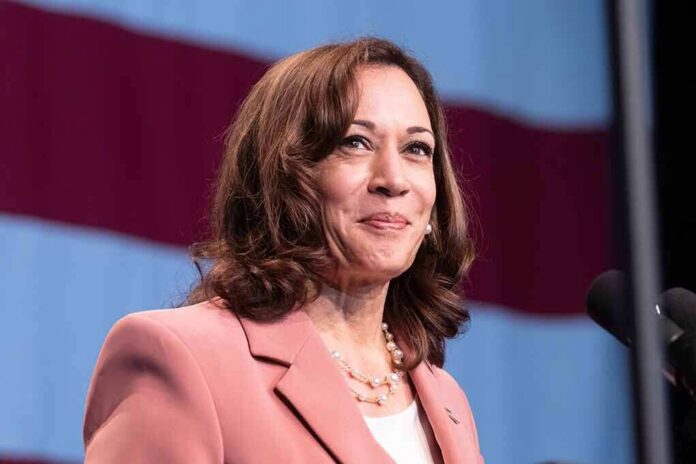
Kamala Harris is warning that a new federal election bill could force voters to show more documents before they can cast a ballot, and that fight is now at the center of a bigger battle over access and control.
Quick Take
- Harris said the SAVE America Act would require people to prove who they are with hard-to-get documents.
- She argued the bill would hit rural and lower-income voters hardest.
- Supporters of the bill say it protects election integrity and blocks fraud.
- The fight shows how a few words about voting can become a national flashpoint.
What Harris Said About the Bill
At the National Action Network convention, Harris said the SAVE America Act would require voters to show a passport or birth certificate to register in federal elections. She described that as a “poll tax” and argued the bill would make voting harder for millions of eligible citizens. Her comments fit a long pattern in which she frames election rules through the lens of access, not just enforcement.
That message matters because Harris did not deny that people must prove identity in some form. She said the problem is making that proof so hard that ordinary voters cannot meet it. Critics have used that wording to say she accepts identity checks in principle while opposing strict rules in practice. Her defenders say she is drawing a clear line between basic verification and heavy barriers to registration.
Why Republicans See an Opening
Republican backers of the SAVE America Act say the bill is common-sense election protection. The House bill would require documentary proof of United States citizenship to register for federal elections and would also mandate photo identification before voting. That gives critics of Harris a simple attack line: if she says proof of identity is needed, they argue, then she is objecting to the same kind of standards they want to expand.
The political fight is sharper because the public record in this package does not show Harris endorsing a strict nationwide voter identification rule. Instead, the material shows her opposing what she sees as burdensome rules and warning that access problems fall hardest on rural voters and people with fewer resources. That makes the charge of hypocrisy more rhetorical than documentary, even if the clip is easy to weaponize.
How the Broader Voting Debate Shapes the Story
This dispute lands in a country where both sides already think the other side is gaming the rules. Voter identification laws are popular with many voters in the abstract, but civil rights groups and voting rights advocates say specific versions can block lawful voters who lack easy access to paperwork, transportation, or copying services. That gap between theory and real life is why a short quote can travel so fast online.
Kamala Harris is out here acting like requiring proof of who you are to vote is some radical attack on democracy.
The SAVE Act simply says: show ID to register and vote. That’s it.
Yet she frames basic voter verification as tyranny.
Millions of Americans use ID every day for… pic.twitter.com/BE2ylLOr9D
— Jan (@Jan812314) August 8, 2026
The Texas voter ID example tied to Harris’s own campaign site adds another layer. It shows a system where voters can present photo identification or use a Reasonable Impediment Declaration if they cannot easily get one. That does not prove Harris personally supports strict voter ID rules, but it does show the real-world middle ground she points to: identity checks can exist, yet election systems can still build in access fixes for people who face real obstacles.
Why the Clip Keeps Spreading
The main reason this story keeps moving is that it fits modern clip politics. A short exchange about photocopying an ID is easy to mock, easy to repost, and easy to strip of context. Once that happens, the debate shifts away from the bill itself and toward who sounds more sincere, more detached, or more realistic. In that sense, the controversy says as much about the media fight as it does about voting law.
Sources:
youtube.com, foxnews.com, hindi.news18.com, wral.com, facebook.com, npr.org, harrisvotes.com, lalota.house.gov