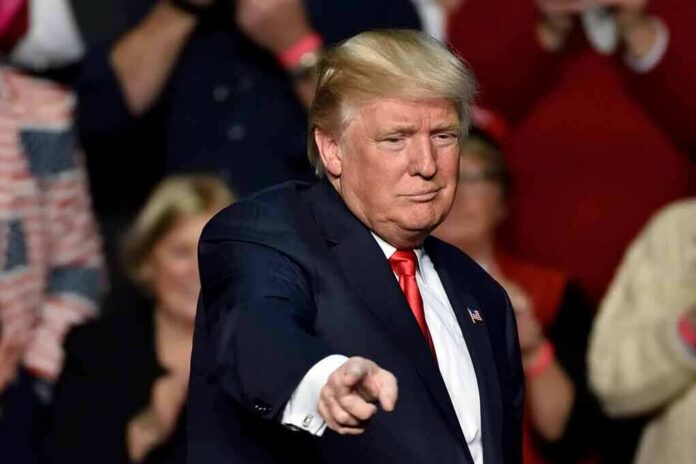
President Trump used a Long Island police academy backdrop to claim a historic national drop in violent crime based on new federal numbers.
Story Snapshot
- Trump visited the Nassau County Police Academy to spotlight national crime declines.
- The White House says federal data show the largest year-over-year violent crime drop, including fewer murders.
- The event paired policy messaging with support for local officials and law enforcement.
- Experts say Federal Bureau of Investigation (FBI) data track trends but have limits when used to claim credit.
Presidential Visit Focused on Crime Trends
President Trump traveled to Garden City, New York, to tour the Nassau County Police Academy and address officers and officials. The White House previewed that he would highlight sharp national declines in violent crime recorded in the FBI’s latest report. Local outlets and national wires framed the stop as a law-and-order message to voters, not just a routine visit. The schedule included a tour of training facilities and public remarks with Nassau County Executive Bruce Blakeman.
The White House has promoted figures showing large drops across major violent crime categories in 2025 compared with the year before. A February release cited steep year-over-year declines in murders, robberies, and aggravated assaults, which officials say reflect the administration’s focus on public safety. During the Long Island stop, Trump aimed to connect those national results to on-the-ground policing and training at the county’s intelligence and training center.
What the Federal Crime Numbers Do—and Do Not—Show
The FBI compiles national crime statistics from thousands of local agencies and fills gaps when some do not report. That system helps show broad trends, but the data are shaped by reporting practices and changes in data systems over time. Analysts warn that year-to-year comparisons can be tricky when participation varies. The numbers can show direction and scale, but they are weaker proof of which policy caused the change or how each community felt it on the street.
Researchers also stress that these figures measure crimes known to police, not the full experience of harm. Local classification rules and officer reports influence what gets counted. That does not erase a large national decline, but it does add caution when leaders make sweeping claims about exact causes. Used carefully, the data support trend statements. Used loosely, they can overstate what any one policy, city, or leader achieved by itself.
Why Nassau County Was the Chosen Stage
Nassau County’s training complex offered a vivid setting where federal claims meet local practice. Reports said Trump would tour the David S. Mack Center for Training and Intelligence and the training village, joining County Executive Bruce Blakeman. The venue let the White House pair an upbeat national message with support for local policing, a classic use of a law-and-order stage during campaign season. Event notices and local coverage previewed crowd control and protests around the visit.
NEW: President Trump boards Air Force One and is now en route to Long Island, where he is set to deliver remarks in Nassau County.
Trump will speak at the Police Academy Center for Training and Intelligence. pic.twitter.com/GezJzKIWBM
— JF KennedyAwakening (@ReaL_JrK_Q) August 14, 2026
Both major parties have long used crime data as political proof points. Scholars note that crime often becomes a symbol for larger fights over government competence, community safety, and fairness in the justice system. Today’s audience, left and right, shares a core worry: leaders celebrate wins while daily life still feels hard. Clear, transparent use of national data—paired with honest limits—helps voters judge what changed, why it changed, and what still needs work.
Sources:
facebook.com, ny1.com, bostonglobe.com, bronx.news12.com, youtube.com, foxnews.com, presidentialprayerteam.org, liherald.com, academic.oup.com, ucr.fbi.gov, fbi.gov, whitehouse.gov, congress.gov, vera.org, ojp.gov