
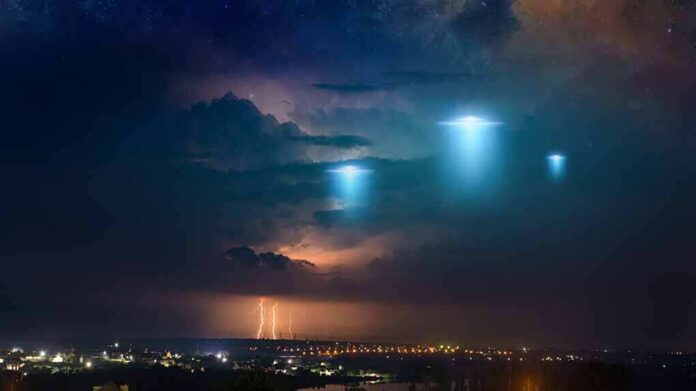
Declassified contractor files show a taxpayer-backed plan for a buried vault to hold “exotic material or tissue,” even as Pentagon investigators say no proof of alien tech exists.
Story Snapshot
- Contractor reports describe a 5,000-square-foot underground vault tied to possible UAP materials.
- The plan linked storage to “recovered hardware and biological samples,” including from overseas sources.
- Public records so far do not show the bunker was built or that exotic materials were stored.
- Pentagon’s anomaly office says there is no verified evidence of extraterrestrial craft or materials.
What the newly surfaced documents actually describe
New reporting highlights contractor records from Bigelow Advanced Aerospace Studies that outline a vault buried 15 to 20 feet underground, with three-foot-thick reinforced concrete walls and a heavy steel door. The space measured about 5,000 square feet and included an access tunnel and layered security measures. The plan placed the vault at a Bigelow Aerospace site in North Las Vegas. Reporters tie these records to work funded through a Defense Intelligence Agency program that examined unusual aerial reports.
The documents use striking language about what the vault might hold. Descriptions mention “exotic material or tissue,” “recovered hardware,” and “biological samples.” The July 2009 reporting says the vault was part of a push to find and acquire such items from companies, private parties, groups, and sources in Brazil. The stated goal was secure storage if materials were obtained in future work. The records read like a concrete design, not a casual idea, with specific construction and security details.
What is confirmed, what is not, and why that matters
The document trail supports that planners took the vault concept seriously. However, the public record today does not confirm that the bunker was ever built. Independent reviews cite property and permit checks that turned up no proof of construction. The same reviews say the documents do not show that any exotic material, recovered parts, or tissue were ever acquired or stored. The evidence points to planning for a capability, not proof of finished construction or actual specimens.
The Pentagon’s All-domain Anomaly Resolution Office adds another hard boundary. In its 2024 historical report, the office said it found no empirical evidence that any program since 1945 verified the recovery or existence of extraterrestrial beings or craft. It also reported that a famous alleged sample was a normal terrestrial alloy. In 2025, the office repeated that it has no evidence that the government or private groups captured or used materials from unidentified craft.
Why a planned vault still raises public trust questions
Many Americans across the political spectrum worry that powerful institutions hide information. These vault plans feed that fear. People see that a contractor, working under a government program, prepared for the day it might receive unusual metals or tissue. They then hear officials state there is no proof of alien technology. The gap between planning and proven results creates frustration, because it looks like a system ready to collect secrets but slow to share answers.
Skeptics argue the vault shows due diligence, not a cover-up. If you research unknown aerial events, you plan for secure storage before you collect anything. Supporters of more disclosure counter that the public funds these efforts and deserves a clear accounting of what was built, what was tested, and what was found. The records we have name a bold goal but stop short of verifying construction, intake logs, chain-of-custody records, or lab results that show anything out of the ordinary.
How to read the claims without getting spun
Readers should draw three clean lines. First, the contractor planned a serious underground vault. That is supported by detailed design language and links to a real government-backed research effort. Second, there is no public proof the vault existed in concrete and steel. Third, there is no verified evidence that exotic materials, non-human tissue, or off-world hardware were ever found or stored there. These lines align with the Pentagon’s broader findings to date about unknown aerial reports.
Secret Pentagon UFO hunt drew blueprints for hidden Nevada bunker to store ‘exotic’ materials
Buried beneath 15 to 20 feet of Nevada earth, behind 3-foot-thick reinforced concrete walls, a steel vault door and a heavily guarded access tunnel, a Pentagon contractor drew up plans…
— JV (@joveg8) November 26, 2026
Here is the bottom line for citizens tired of mixed signals. The files show the government funded a contractor that prepared for a big discovery. But confirmed discoveries have not followed in the public record. That tension is not proof of a conspiracy. It is proof of a trust gap. The fastest fix is simple transparency: release complete reports, building and inspection records, acquisition logs, and test results. Clear records, not rumors, will close the gap.
Sources:
uaptrail.com, cbsnews.com, uapdrop.com, aaro.mil