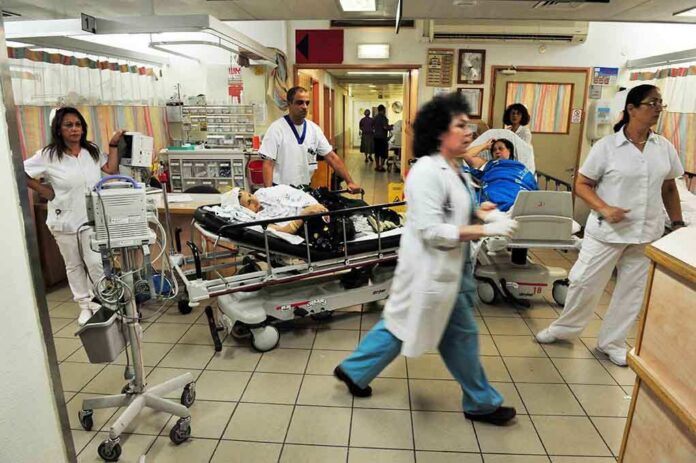
A single bullet that lodged near a young mother’s spine in Yemen shows how civilians keep paying the highest price.
Story Snapshot
- Reuters reported a pregnant woman in Taiz was immobilized after a bullet lodged near her spine.
- Doctors at Al-Thawra hospital could not scan her due to the pregnancy and shortages.
- Secondary outlets repeated the core facts, though wording on “paralyzed” varies.
- Escalating fighting and a strained health system complicate care and accountability.
What Happened Inside a Besieged City
Reuters reported that Amal al-Sabri, a 25-year-old pregnant mother of two, was immobilized after a bullet entered her body and lodged near her spine in Taiz, Yemen. She said the shot came while she was trapped in her home in the village of al-Shaqb on Mount Sabir, overlooking the city. She was later seen at Al-Thawra hospital. The report described a city under heavy strain from fighting and supply cuts that block basic care for wounded civilians.
Medics at Al-Thawra hospital told Reuters they could not perform a scan because she was more than four months pregnant. That limit, paired with shortages of medicine, oxygen, anesthetic, and fuel, left staff with few options for safe imaging or treatment. The account said al-Sabri remained immobilized in the hospital. The reporting did not name a shooter or weapon, which is common in front-line areas where access is dangerous and records are thin.
How Other Outlets Described the Injury
Several outlets echoed the Reuters account, keeping the core facts intact. The Egyptian Gazette repeated that a bullet pierced her body and lodged near her spine. The Australian framed her as paralyzed after a strike to the abdomen that lodged in the spine. These summaries use stronger language than Reuters’ “immobilised,” but they do not add clinical proof, such as imaging or a surgeon’s report. The shared through-line is a pregnant woman seriously injured by a bullet in Taiz.
In conflict coverage, wording can drift as stories spread. That does not change the core event but can blur medical precision. In this case, the available reporting supports that a bullet hit al-Sabri and left her unable to move, but does not establish a confirmed, permanent paralysis diagnosis. In war zones, doctors often cannot run scans or advanced tests because power, machines, and staff are in short supply. That reality leaves patients and families waiting and afraid.
Why Taiz Keeps Suffering Civilian Harm
Taiz has lived under siege and shelling for years. Fighting often cuts roads, stalls aid, and traps people inside their homes. When violence spikes, more civilians get hit, and hospitals struggle to keep up. The World Health Organization has warned that access to emergency care, including trauma and maternal care, remains disrupted. That gap makes injuries worse and pushes small wounds into life-changing harm. The effects are hardest on women, children, and the elderly.
🇾🇪 A pregnant mother of two has been paralyzed by a stray bullet in Yemen’s frontline Taiz province.
Reuters reports that the 25-year-old woman was trapped in her home for two days before she could receive help.
Her injury shows how frontline violence reaches civilians even…
— Ahmad Shah Mohibi (@WarGuy_) October 29, 2026
Recent incidents around Taiz show the same pattern. Attacks on homes and crowded areas have killed and wounded civilians, including teen girls, and driven fresh waves of fear. Local and international groups continue to report large casualty numbers while urging safe access for ambulances and aid convoys. In this environment, identifying the exact shooter in each injury is rare. Yet the toll on families is clear and growing with each new clash.
What This Means for People Far From the Front
Al-Sabri’s case highlights a basic truth: when systems fail, ordinary people pay. A single bullet can end a livelihood, break a family, and burden a fragile hospital. Americans know that unchecked wars and weak oversight often waste money and trust, while elites argue and everyday people suffer. This story is a reminder that clear facts, working clinics, and open roads are not luxuries. They are the floor for human dignity, no matter the flag or faction.
What to Watch Next
Watch whether Al-Thawra hospital receives fuel, oxygen, and imaging help so doctors can scan and treat complex injuries. Track whether roads into Taiz open enough to move patients to safer care. Look for credible updates on al-Sabri’s condition from named medical staff. Better supply lines and transparent records would not only improve care but also help establish what happened in each case. That is how families get answers and how justice can begin.
Sources:
youtube.com, x.com, egyptian-gazette.com, yahoo.com, gulf-times.com, timesofisrael.com, emro.who.int