
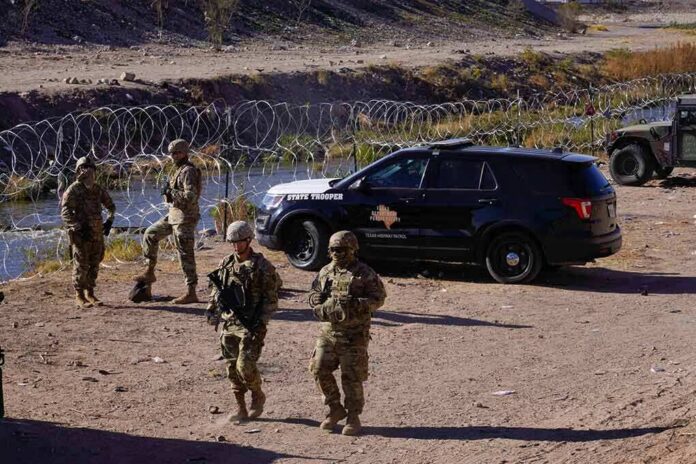
Texas declared nine Rio Grande islands as state property to open them to patrols against cartel misuse, escalating a long-running border and sovereignty fight.
Story Snapshot
- Texas General Land Office identified nine islands, about 66 acres total, as state-owned.
- The agency says ownership enables state police and military access for patrols and clearing.
- Review relied on historical records and surveys, not only a political statement.
- Mexican officials pushed back as treaty rules over river channels complicate claims.
State Action: What Texas Declared And Why It Matters
Texas General Land Office officials said on October 26, 2026, that nine Rio Grande islands totaling about 66 acres are state property. The office framed the move as a way to ensure Texas Department of Public Safety and the Texas Military Department can access, patrol, and clear the sites for public safety. Commissioner Dawn Buckingham told partners to patrol and inspect the islands for illegal activity within the law. The release ties land status to daily security operations on the river.
Texas described how it reached the decision. Officials cited a review of historical records and surveys to support state ownership. Local reporting echoed that the determination followed document and survey checks rather than a simple proclamation. The office argues clear title removes doubt that had slowed patrols and maintenance. The claim extends a pattern of earlier state survey work used to support border security posture on river islands near Roma in 2025.
Security Rationale: Access, Patrols, And Vegetation Clearing
Texas leaders link ownership to on-the-ground access. They say vegetation on the islands can hide smugglers, stash sites, or lookout points. The General Land Office previously called such islands a “smuggler’s paradise” and urged clearing brush to deny cover for criminal activity. The state says patrol authority and land control can speed checks and cleanups. The releases, however, do not list arrests or seizures tied to these nine specific islands to confirm the threat island by island.
Texas argues the new determinations will let patrol units move faster and more often. Clear title can also ease coordination across state agencies. Yet the announcements do not detail the earlier legal barrier that allegedly slowed access, or how federal border authority fits with state ownership. Without those specifics, it is hard to measure whether the new title status will produce more patrols, quicker response times, or better results on the ground in the short term.
Cross-Border Dispute: Treaties And Pushback From Mexico
News reports say Mexican officials pushed back after Texas claimed the nine islands. That reaction tracks with a long record of river boundary disputes. The Texas State Historical Association explains that treaties set the deepest channel of the river as the dividing line, and later rules handle river shifts. That makes each island a technical case that depends on how and when the river changed, not only on where water flows today.
This week, nine islands in the Rio Grande River have been recognized as Texas land.
These border islands met standards for Texas ownership based on their orientation to the river's center line.
The GLO will continue working with @TXMilitary and @TxDPS to ensure Texas maintains… pic.twitter.com/KBrWYNXy6i
— Texas General Land Office (@TXGLO) October 29, 2026
Texas officials also said the state looked at 28 islands and concluded that 11 likely belong to Mexico, based on location in the river channel. That admission shows the process is not one-sided but does not resolve which forum will settle disputed sites. The International Boundary and Water Commission applies boundary treaties and settles differences, often using the concepts of gradual change and sudden change to decide which nation holds title.
What We Know, What We Do Not, And Why It Matters To Voters
The public record shows a clear Texas claim, a stated security goal, and a survey-based review. It also shows limited access to the underlying plats, title history, and legal memos. The state has not published island-by-island files in these sources. That gap fuels doubt across the spectrum, where many already believe powerful actors hide the ball. Releasing maps, metes and bounds, and legal opinions would help citizens judge the claim on evidence, not spin.
For people worried about cartel crime and weak borders, Texas is acting to remove what it calls “safe havens.” For people worried about overreach, treaties, and international friction, the lack of shared records and formal binational agreement is a warning sign. Both concerns are valid at the same time. A practical next step is simple: publish the survey packets and show how the rules were applied, then track patrol activity and outcomes so the public can see real results or real limits.
Sources:
youtube.com, borderreport.com, newsnationnow.com, audacy.com, news4sanantonio.com