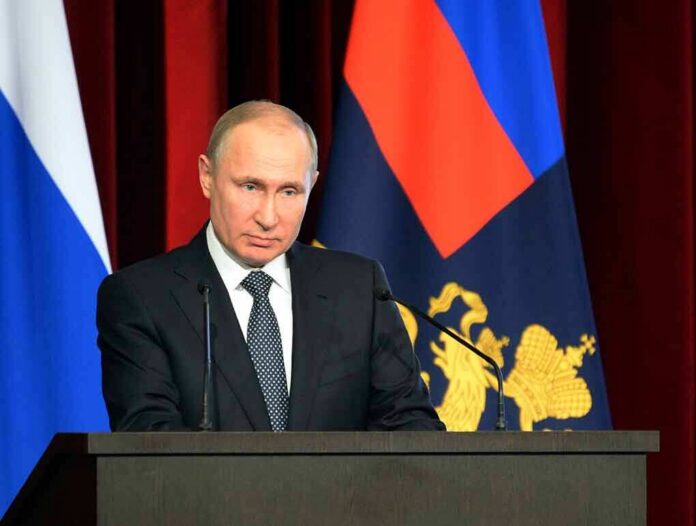
Vladimir Putin told his ruling party that Russia will hold nationwide elections on schedule despite “the most difficult conditions,” framing the vote as proof of order and control.
Story Highlights
- Putin said September elections will proceed “within the established timeframe” and under law.
- He described a “difficult period” and promised measures to protect the vote.
- State-aligned outlets echoed that Russia will not deviate from elections despite pressure.
- Scholars say such elections can signal regime strength in tight political systems.
Putin’s Pledge: Elections On Time, Under Law
President Vladimir Putin addressed the United Russia party congress in Moscow and promised that elections would be held on schedule and in line with the law. He said authorities would take “all measures” to protect the vote. He cast the moment as pivotal for Russia and said the world is in a period of radical change. His message stressed order, continuity, and control during hard times, with the ruling party presented as the anchor of stability.
Russian state-aligned media repeated this theme. Reports stated that Russia would not abandon elections even under severe strain and would hold voting across the country next month. The coverage highlighted appeals for unity and claims that the vote supports national stability during wartime pressures. These messages align closely with the Kremlin’s framing of elections as a sign of normal life and national resolve, not as an optional exercise.
The Security Frame And Political Messaging
Putin linked the pledge to security concerns, saying the state faces tests and external threats. He argued that going forward with elections shows the political system is mature and stable. He said the result should reflect citizens’ will while promising firm protections for the process. He also accused Western countries of trying to destabilize Russia as the vote nears, a claim that fits his broader narrative of pressure from abroad around election periods.
The ruling party congress served as both a campaign launchpad and a loyalty test. Past congresses have set the agenda, presented candidate lists, and underlined the party’s role as the main vehicle for national policy. This year’s gathering repeated that pattern while placing heavier weight on security and unity. Kremlin records from earlier cycles show similar moves to fix dates, mobilize regional teams, and frame the vote as a system check and a show of strength under stress.
Why This Matters Beyond Russia
Political researchers describe Russia as an electoral authoritarian system, where votes continue but real competition is narrow. In such systems, elections help manage elites, show control, and project normalcy, especially during crises. Scholars note that “winning big” signals there is no viable path outside the ruling camp. The logic is simple: steady elections can calm markets, keep officials in line, and assure the public that the state remains in charge.
Putin stated that "the enemy is trying to disrupt the elections to the State Duma"
The Russian president made this statement in an interview with Kremlin journalist Pavel Zarubin.
Putin also stated that "United Russia," the party he created, "has never engaged in populism," and… pic.twitter.com/fdiK4OOOWV
— Sota News (@sotanews) August 22, 2026
For American readers who distrust distant elites, this story highlights a familiar concern. Leaders often use formal processes to claim legitimacy while power remains concentrated. Conservatives may see a warning about central control masked by ritual. Liberals may see a reminder that votes can exist without real choice. Both can agree on the core lesson: when a government under strain leans on the show of order, citizens should look closely at how that order is built and kept.
Sources:
youtube.com, en.kremlin.ru, rt.com, rferl.org, news.sbs.co.kr, archive.government.ru, yahoo.com, css.ethz.ch, socialsciences.cornell.edu, diva-portal.org, journals.sagepub.com, bti-project.org