A $95 billion budget “Reconciliation 3.0” plan is now poised to pull the hottest fight over voter ID and proof of citizenship into a single must‑pass showdown in Congress.
Story Snapshot
- The SAVE America Act, requiring proof of citizenship and photo ID to vote in federal elections, has passed the House three times and is now tied to a new reconciliation push.
- Supporters say the bill will stop noncitizens from voting by forcing states to scrub voter rolls and check federal databases, while critics warn it could block millions of citizens who lack papers.
- The Senate Parliamentarian has ruled key parts ineligible for reconciliation, and a small group of Republicans joined Democrats to block it, showing the fight is not simply left versus right.
- Decades of ID rules and studies suggest noncitizen voting is extremely rare, raising hard questions about whether this sweeping federal mandate targets fraud or everyday voters.
House GOP links proof-of-citizenship fight to big spending package
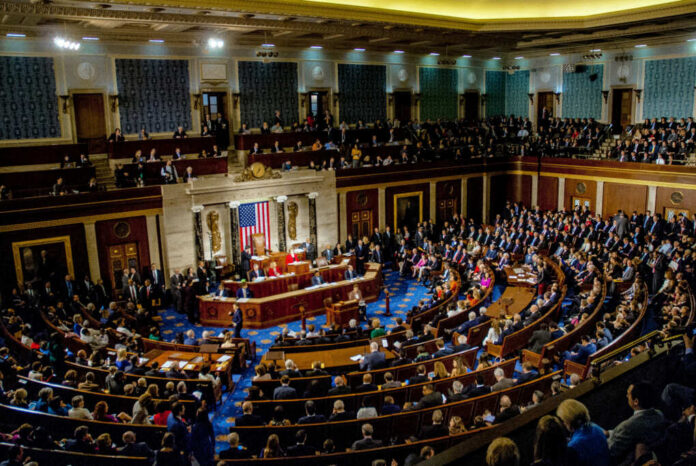
House Republicans have folded the Safeguard American Voter Eligibility (SAVE America) Act into a new $95 billion “Reconciliation 3.0” budget blueprint, turning a voting rules fight into part of a larger pre‑election spending push. The SAVE America Act, listed as H.R.22 in the 119th Congress, has already passed the House three times, most recently in February 2026 by a 218–213 vote with one Democrat crossing the aisle. Tying the bill to reconciliation is meant to bypass normal gridlock, but it also raises the stakes for both parties.
The SAVE America Act would amend the National Voter Registration Act of 1993 to require **documentary proof of United States citizenship** at registration and a **photo ID** at the polls in all federal elections. Supporters frame this as a way to make sure “federal elections are decided by U.S. citizens—and U.S. citizens alone.” The bill also orders states to remove noncitizens from existing voter lists and to build programs that use data from the Social Security Administration and the Department of Homeland Security to flag noncitizen registrations.
What the SAVE America Act would demand from voters and states
The bill’s text lays out a narrow list of documents that count as proof of citizenship. Voters would need things like a U.S. passport, a certified birth certificate paired with government photo ID, a naturalization certificate, or certain special cards issued by federal agencies. The law says a form of identification issued under the federal REAL ID Act can work if it “indicates the applicant is a citizen,” but most REAL IDs do not mark citizenship and are also issued to noncitizens. That makes simple driver’s licenses useless as proof, even for lifelong citizens.
For some voters, the bill would create extra hurdles. Military voters, for example, would need both a military identification card and a service record that shows they were born in the United States. Many government photo IDs do not list place of birth, which means people would have to track down older documents or request new records from bureaucracies that often move slowly. A House Democratic analysis and outside legal groups warn that this could be a heavy burden for older voters, married women who changed their names, and people whose records were lost or never properly filed.
Evidence of fraud versus risk of blocking lawful voters
Supporters say strict rules are needed because they believe noncitizen voting is a serious hidden threat. They point to plans to cross‑check state voter rolls with federal citizenship databases as proof that the federal government must step in. Yet major studies by nonpartisan groups and election officials have found that noncitizen voting in past elections is “exceedingly rare.” One Brennan Center study found only 30 suspected noncitizen votes out of 23.5 million ballots in 42 jurisdictions in 2016, about 0.0001 percent of votes.
At the same time, research from that same Brennan Center and voting rights organizations estimates that about 21 million American citizens lack ready access to key documents like passports or certified birth certificates. Because the SAVE America Act bans registration using a driver’s license alone, even for citizens, these people could struggle to register or might give up entirely. Critics, including Senators Mark Warner and Tim Kaine, warn the bill could “disenfranchise millions” by making legal voters prove citizenship in ways many cannot. That tension—tiny fraud numbers versus large potential barriers—is at the heart of the current clash.
Senate roadblocks, Republican splits, and deep-state worries
Even with Republicans in charge of both chambers, the path forward is not simple. The Senate Parliamentarian has ruled that SAVE America Act provisions do not qualify for budget reconciliation under the Byrd Rule, because their budget impact is only incidental. That means they cannot automatically ride along in a fast‑track spending bill, and supporters would still need 60 votes to beat a filibuster. Four Republican senators—Lisa Murkowski, Susan Collins, Thom Tillis, and Mitch McConnell—joined Democrats in an earlier 48–50 vote against adding the SAVE framework to a budget resolution, showing real division inside the party.
🚨 Senate Democrats Block SAVE America Act Despite House Passage
House Republicans attach the SAVE America Act to legislation, advancing voter ID, proof of citizenship, and election security measures. Senate Democrats, led by Chuck Schumer, vow to kill the bill. Trump and GOP… pic.twitter.com/Co39qMeJCZ
— Morse Report (@MorseReport) July 15, 2026
President Trump has pushed hard for this bill, pressing House leaders to attach it wherever possible and even allowing other legislation, like a bipartisan housing measure, to stall in the process. That kind of bare‑knuckle pressure feeds a picture many Americans already have: a federal system more focused on power plays than problem‑solving. For conservatives worried about illegal immigration and election trust, the SAVE America Act looks like long‑delayed action. For liberals worried about minority rights and the gap between the haves and have‑nots, it looks like a new way to push people out of the voting booth. For a growing number on both sides, it is another sign that Washington is willing to gamble basic rights in order to score political wins.
How this fight fits a long history of voter ID laws
This showdown did not appear out of nowhere. Since the Help America Vote Act in 2002, which required first‑time mail registrants in federal elections to show some form of ID, the debate has shifted from whether we need ID to exactly what kind and how strict. Today, roughly 36 states already require some form of identification to vote, and about 10 use “strict” photo ID rules. The SAVE America Act would go further by setting one of the tightest systems in the country as a federal baseline. That move to nationalize rules—using reconciliation and federal databases—feeds fears on right and left that unelected officials in Washington, the so‑called “deep state,” are tightening their grip on who gets heard.
Sources:
redstate.com, congress.gov, abcnews.com, cnbc.com, washingtontimes.com, youtube.com, bipartisanpolicy.org, issueone.org, democrats-cha.house.gov, kaine.senate.gov, brennancenter.org, bbc.com, americanimmigrationcouncil.org, npr.org