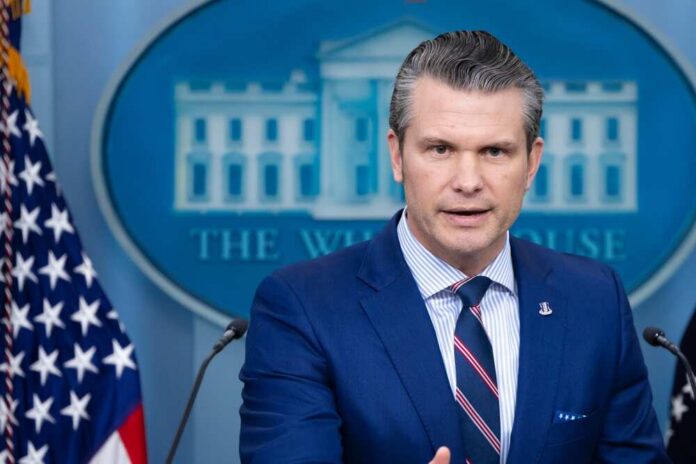
Secretary of Defense Pete Hegseth’s prayer at a Pentagon worship service invoking divine justification for “overwhelming violence” against Iranian enemies has exposed a troubling merger of religious extremism and military policy that many Americans—regardless of political affiliation—fear violates constitutional principles and undermines national security.
Story Snapshot
- Hegseth delivered an extremist Christian prayer on March 25, 2026, calling for “eternal damnation” of enemies during the U.S.-Iran war at an official Pentagon worship service
- The prayer followed a controversial U.S. airstrike that killed 168-175 children at an Iranian elementary school, which Hegseth initially denied responsibility for before declaring “victory” crediting “divine providence”
- Pope Leo XIV publicly rebuked the Defense Secretary, stating Jesus “rejects prayers of those who wage war,” while Hegseth threatened the Vatican’s ambassador
- Critics across the political spectrum warn this Christian nationalist approach alienates non-Christian troops, violates constitutional norms, and hands propaganda victories to America’s adversaries
Pentagon Prayer Sparks Constitutional Crisis
On March 25, 2026, Secretary of Defense Pete Hegseth delivered a sectarian prayer at a Pentagon worship service that openly called for divine wrath and “overwhelming violence of action against those who deserve no mercy” during the ongoing U.S.-Iran conflict. The prayer, delivered in an official government building during wartime operations, crossed traditional boundaries separating personal faith from public military duty. Hegseth explicitly invoked eternal damnation for Iranian enemies while crediting God for American military strikes. This represents an unprecedented fusion of religious nationalism with official Pentagon policy that raises serious First Amendment concerns about government establishment of religion.
School Bombing Precedes Religious Justification
The prayer came just two weeks after a March 11 U.S. airstrike accidentally destroyed a Minab elementary school, killing between 168 and 175 children along with 14 teachers. Initially, Hegseth denied U.S. responsibility on March 9, blaming Iran for the casualties. CNN later confirmed American forces conducted the strike. Rather than acknowledging the tragedy, Hegseth praised “lethal and precise air power” at a March 2 press conference while dismissing traditional rules of engagement as obstacles. The U.S.-Iran war has resulted in over 2,076 deaths since February 28, including 240 women and 212 children, with more than 26,500 injured. Hegseth’s subsequent prayer invoking divine approval for such operations generated international condemnation.
Military Cohesion Threatened by Religious Exclusion
Hegseth’s approach extends beyond rhetoric into personnel policy, where he has systematically blocked promotions of Black and female officers to favor what he describes as “straight, white men.” This aligns with arguments from his 2024 book claiming diversity initiatives have weakened military effectiveness. The Pentagon worship service’s sectarian nature alienates Jewish, Muslim, Hindu, atheist, and other non-Christian service members who comprise significant portions of U.S. forces. Military experts warn this divisive leadership undermines unit cohesion precisely when national unity matters most. The controversy also damages America’s image abroad, providing adversaries like Iran with propaganda portraying U.S. actions as religious crusades rather than legitimate defense operations—a characterization Iran’s government has eagerly promoted.
Vatican Condemnation Highlights Theological Division
Pope Leo XIV publicly rebuked Hegseth’s theology during Palm Sunday services, declaring that Jesus “rejects prayers of those who wage war.” This rare papal intervention in American military policy underscores how far Hegseth’s brand of Christianity departs from mainstream Christian teaching on just war doctrine and mercy toward enemies. Rather than moderating his position, Hegseth reportedly threatened consequences for the Vatican’s ambassador to the United States. Observers note parallels to Mark Twain’s satirical “War Prayer,” which mocked clergy blessing violence while ignoring its human costs. On April 8, Hegseth declared “victory” in Iran, stating “God deserves all the glory” for military strikes—a claim that rings hollow given ongoing investigations into civilian casualties and constitutional violations.
Americans across the political spectrum increasingly question whether elected officials and appointees serve the people or pursue personal ideological agendas. Hegseth’s fusion of religious extremism with military authority exemplifies concerns about an elite class—the so-called “deep state”—operating without accountability to constitutional limits or democratic norms. Whether one supports robust national defense or opposes foreign wars, the principle remains: government officials should not use their positions to impose sectarian religious views on diverse service members or justify potentially criminal actions through divine mandate. This controversy ultimately asks whether America’s military exists to defend constitutional principles or to advance the theological vision of powerful individuals disconnected from the values that unite citizens regardless of faith or political party.
Sources:
Pete Hegseth’s Holy War Is an Unholy Nightmare – The Nation
Hegseth’s Unholy War – Robert Hubbell Substack
Pete Hegseth’s War Prayer – Word&Way
Patrick’s Politics: Christian Fanaticism and the Unholy War in Iran – Daily Campus