
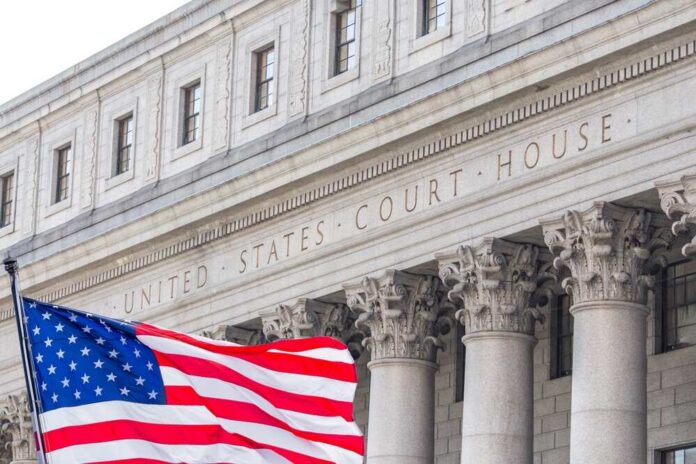
The Supreme Court has reminded Washington that “temporary” protection for migrants really does have to be temporary, and Thomas Homan says that is finally a win for the rule of law.
Story Snapshot
- The Supreme Court reaffirmed that Temporary Protected Status (TPS) is short-term relief, not a backdoor to green cards.
- Border Czar Thomas Homan says Trump is the first president with the courage to enforce TPS as truly temporary.
- Activist groups and liberal lawyers are blasting the ruling and warning of mass deportations.
- Decades of court fights over TPS show a deep clash between humanitarian claims and constitutional limits on immigration powers.
Supreme Court Draws a Hard Line on TPS and Permanent Residency
The Supreme Court’s recent decisions on Temporary Protected Status have drawn a bright line between short-term humanitarian relief and permanent immigration benefits. In the landmark Sanchez v. Mayorkas case, the Court held that people who entered the United States illegally but later received TPS are not “admitted” for purposes of getting a green card.[1] The ruling made clear that TPS is lawful status for a time, but it does not magically erase an illegal entry or convert it into a legal admission.[2] This means TPS alone cannot be used as a backdoor path to permanent residency for those who crossed the border unlawfully.
Advocacy groups on the left quickly attacked these decisions. The Catholic Legal Immigration Network called Sanchez “disappointing” and warned it would deprive many TPS recipients who entered without inspection of the chance to become permanent residents.[1] The American Civil Liberties Union of Southern California went further, blasting a later Supreme Court order in a Venezuelan TPS case as an “unreasoned three-paragraph” shadow-docket ruling that leaves hundreds of thousands at risk of deportation.[3] These reactions show how deeply many activists had come to treat TPS as a long-term, almost permanent foothold in the country, despite the statute’s temporary design.
Thomas Homan: ‘Temporary Means Temporary’ and Trump Is Following the Law
Border Czar Thomas Homan has embraced the Supreme Court’s TPS decisions as a long overdue correction to decades of policy drift. He points out that Congress created TPS in 1990 as a short-term shield for people whose home countries were hit by war, natural disasters, or other crises, not as a permanent resettlement program.[4] Homan argues that the law was always clear: TPS ends when conditions improve, and people are then expected to return home or use regular legal immigration channels. He praises President Trump as having “the guts to follow the law,” insisting that “temporary means temporary” when it comes to TPS enforcement.
Homan is also blunt about the issue of illegal entry. He stresses that crossing the border unlawfully is a crime no matter how long a person has lived in the United States afterward.[4] From his perspective, TPS recipients who entered without inspection and then try to turn a temporary status into permanent residency are “cheating the system” by skipping the legal immigration line. The Sanchez ruling backs up that view by confirming that TPS does not fix an illegal entry or count as an admission for green card purposes.[1] For many conservatives, this is a basic question of fairness: those who followed the rules should not be pushed aside by those who did not.
A Legal Tug-of-War: Courts, Activists, and the Limits of Executive Power
While the Supreme Court has tightened the rules around TPS, lower courts have pushed back hard on how administrations implement terminations. In several recent cases, federal district judges ruled that attempts to end TPS for countries like Venezuela and Haiti violated the Administrative Procedure Act because officials did not follow required steps or fully explain their decisions.[3] One judge held that Homeland Security Secretary Kristi Noem’s moves against Venezuelan and Haitian TPS holders were illegal for failing to meet these procedural standards, showing that even lawful policies must be carried out in the right way to survive judicial review.
The fight has now reached the highest levels of the judiciary. The Supreme Court accepted a case involving Haiti and Syria TPS terminations, after a federal court stayed the end of Haiti’s designation and kept protections and work permits in place while litigation continues.[9] Activist organizations warn that a conservative majority appears ready to allow the Trump administration to move forward with deportations of large numbers of immigrants once TPS ends.[5] At the same time, key rulings like Sanchez and high-profile stay orders in cases such as Noem v. National TPS Alliance show the Court is unwilling to let lower courts permanently block the executive branch from winding down temporary programs when statutory criteria are met.[1]
Humanitarian Program or Permanent Pipeline? What’s Really at Stake
Behind these legal battles is a deeper policy question that matters to every American who cares about secure borders and honest government. Supporters of TPS stress real suffering in countries still facing violence or disaster and point out that many TPS holders have lived, worked, and raised families in the United States for years.[6] They say ending TPS designations could tear apart communities and send people back into danger. Some even claim the Trump administration’s stance reflects an “openly racist mass deportation agenda,” tying legal disputes to broader political accusations.[6] These arguments aim to shift the focus from statutory limits to moral appeals.
Conservatives see the stakes differently. They note that TPS was created as an emergency tool, not a permanent immigration pipeline, and warn that stretching “temporary” protection for decades undermines Congress’s role and the Constitution’s checks and balances.[7] When activist lawyers insist courts must control every TPS decision, they risk turning judges into de facto immigration planners, sidestepping elected leaders and the clear text of the statute.[10] The Supreme Court’s message so far is that while humanitarian concern matters, it cannot erase the law’s plain meaning. For readers who value secure borders, limited government, and respect for the Constitution, Homan’s core point is simple: America can be compassionate, but it must also be honest that temporary relief cannot last forever.
Sources:
[1] YouTube – Border Czar Thomas Homan on U.S. Supreme Court Ruling Ending Temporary …
[2] Web – Supreme Court Rules Grant of TPS Not an Admission
[3] Web – Supreme Court Considers Legality of Temporary Protected Status …
[4] Web – Supreme Court Stays Order That Had Paused Termination of …
[5] Web – BREAKING: TPS Holders and Advocates Denounce Supreme Court …
[6] Web – Supreme Court appears to lean toward ending TPS for some migrants
[7] YouTube – Debrief: Temporary Protected Status at the Supreme Court
[9] YouTube – U.S. Supreme Court Case on Termination of Temporary …
[10] Web – [PDF] National TPS Alliance v. Noem – Ninth Circuit Court of Appeals